WAG Code of Points 2025–2028: Key Changes and D-Score Rules
The FIG WAG Code of Points 2025-2028 explained: how D- and E-scores work on all four apparatus, plus what changed from 2022, from the vault bonus to floor CV.
The WAG Code of Points 2025–2028 is the rulebook that the International Gymnastics Federation (FIG) uses to score women's artistic gymnastics from 2025 through the LA 2028 Olympic Games. This guide walks through how the women's code works today — how the D-score and E-score are built, and how each of the four apparatus is counted — and then lists what actually changed from the 2022–2024 code, based on a side-by-side reading of both official FIG documents.
The focus is on the changes that move scores in competition: the new 0.20 vault bonus, the stricter condition for the floor dismount bonus, the revised floor connection-value formulas, and the new three-step scale for floor artistry deductions.
What Is the WAG Code of Points 2025–2028? Latest Version and Where to Find It
The FIG Rulebook for Women's Artistic Gymnastics
FIG rewrites the Code of Points every four years to match the Olympic cycle. The women's rulebook is called the WAG (Women's Artistic Gymnastics) Code of Points, and the edition in force now covers 2025–2028. Its cover states that it was approved by the FIG Executive Committee in February 2024 (FIG WAG Code of Points 2025-2028, PDF).
The code applies to the Olympic Games, Youth Olympic Games, World Championships, Junior World Championships, World Cups and other FIG competitions. It also says two things worth remembering: where the language versions differ, the English text is the one that counts, and where the code conflicts with the Technical Regulations, the Technical Regulations take precedence.
- Scope: the four women's apparatus — vault, uneven bars, balance beam and floor exercise
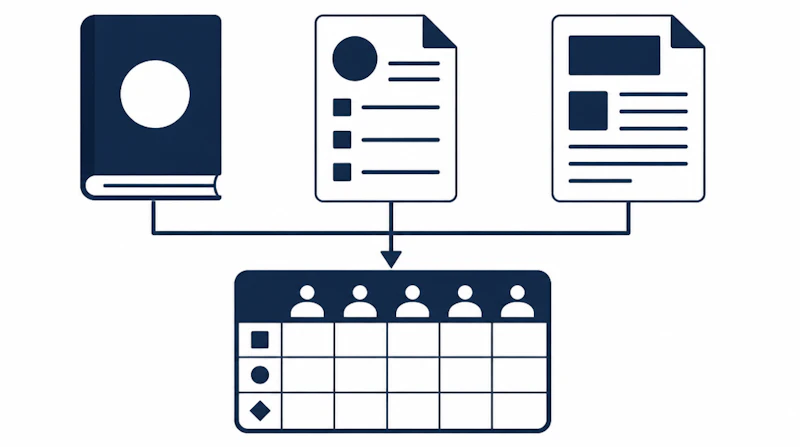
- Structure: general rules (rights and duties of judges, gymnasts and coaches), D-score and E-score rules, apparatus-specific rules, and the Tables of Elements
- Cycle: four years (this one runs 2025–2028)
Where to Check the Latest Rules: Code, Help Desk and Newsletters
The code does not stay frozen for four years. After official competitions FIG publishes a WAG Newsletter with new elements and clarifications, and the WAG Help Desk adds worked examples and interpretations for judges and coaches. Everything sits on the FIG rules page, including the WAG Help Desk, 2nd edition (August 2026). As of November 26, 2026, the Code of Points PDF on that page shows a publication date of October 14, 2026 on its cover.
The make-up and duties of the judging panels are set out separately in the WAG Specific Judges' Rules 2025-2028.
How National Federations Apply the Code
National federations pass FIG updates on to their own competitions and set the date they take effect. Japan is a good example: after FIG's newsletter of March 4, 2026, the Japan Gymnastics Association's women's rules bulletin No. 2 (in Japanese) applied the clarifications to domestic meets from April 1, 2026. Gymnasts and coaches should read both the FIG original and their own federation's notices.
If you want to see what your own routine is worth under this code, Gymnastics AI — D-Score Calculator can help. It follows the FIG 2025–2028 Code of Points and covers the six men's apparatus plus the four women's apparatus in beta.
WAG Code of Points Basics: D-Score and E-Score

Final Score = D-Score + E-Score − Penalties
Under the WAG Code of Points, each routine's final score is the D-score (content) plus the E-score (execution and artistry), minus any penalties such as out-of-bounds or time faults. Scores are shown to three decimal places. Here is the worked example from the code itself:
Component | Points | What it is |
|---|---|---|
Difficulty Value (DV) | 3.100 | Top 8 elements: 3 C, 3 D, 2 E |
Composition Requirements (CR) | 2.000 | All four requirements at 0.50 each |
Connection Value (CV) | 0.600 | Bonus for linking elements |
D-score | 5.700 | Sum of the three above |
E-score | 8.666 | 10.000 minus execution and artistry deductions (average of the middle 3 of 7 judges) |
Final score | 14.366 | 5.700 + 8.666 |
Source: the Section 6 example in the FIG WAG Code of Points 2025-2028. For how A-to-J values map to points, see Women's Gymnastics Difficulty Values Explained.
How the E-Score Is Calculated: Middle Scores and Truncation
The E-score starts at 10.000. Execution deductions (bent knees, landing faults and so on) and, on beam and floor, artistry deductions are added together and subtracted. When there are several E-judges, the code removes the extremes by averaging the middle scores:
- 7 E-judges: average of the middle 3
- 5 E-judges: average of the middle 3
- 4 E-judges: average of the middle 2
- 3 or 2 E-judges: average of all of them
If the average runs past three decimal places, it is truncated, not rounded. In the code's example the seven judges give 8.800, 8.300, 9.000, 8.600, 8.700, 8.700 and 8.100; the middle three (8.600, 8.700, 8.700) average to 8.666. For more on how execution is judged, see What Is the E-Score in Gymnastics?
Short Exercise Penalties
If a routine on bars, beam or floor ends early — for example because of an injury — the D-jury takes a large penalty from the final score based on how many elements were performed:
Elements performed | Penalty from final score |
|---|---|
7 or more | None |
5–6 | −4.00 |
3–4 | −6.00 |
1–2 | −8.00 |
None | −10.00 |
How the D-Score Is Counted on Each Apparatus
Vault: The Table Value Is the D-Score
On vault, the D-score is simply the value of the vault in the Table of Vaults. Vaults are sorted into five groups by how they enter the table:
- Group 1: vaults without salto (handspring, Yamashita, round-off)
- Group 2: handspring forward, with or without a full turn in the first flight
- Group 3: handspring with a 1/4–1/2 turn in the first flight (Tsukahara family)
- Group 4: round-off entry (Yurchenko family)
- Group 5: round-off with a 1/2 turn in the first flight
In qualification, the team final and the all-around final, a gymnast performs one vault. In qualification for the vault final and in the vault final itself, she must perform two vaults from different groups, and the two scores are averaged. For examples of vaults and their values, see Women's Vault Skills List.
Uneven Bars: Top 8 Elements and the Three-per-Root-Skill Limit
On bars, beam and floor the D-score is the value of the top 8 elements including the dismount, plus up to 2.00 for composition requirements, plus connection value and bonuses. Bars adds a few limits of its own:
- Only 3 elements from the same root skill (defined by the entry and the direction of rotation) count, in chronological order — kips, giants and casts to handstand are exceptions
- Only one Tkatchev-type element from each line of the Table of Elements, and only one Jaeger, will be recognised
- No dismount: −0.50 from the final score
For the main skill families and how bar connections are built, see Uneven Bars Skills and Scoring.
Balance Beam and Floor: At Least 3 Dance and 3 Acro
On beam and floor, the 8 counting elements must include at least 3 dance and at least 3 acro elements, with 2 free choices. Floor also caps the number of acro lines — two or more directly connected flight elements, one of them a salto — at four. Difficulty in a fifth line does not count. The floor dismount is the highest-value element in the last counting acro line, and no dismount is credited if the gymnast performs only one acro line.
Composition Requirements: Four at 0.50 Each
Bars, beam and floor each have four composition requirements worth 0.50 apiece, for a maximum of 2.00.
Apparatus | Composition requirements (0.50 each) |
|---|---|
Uneven bars | 1) Flight element from high bar to low bar 2) Flight element on the same bar 3) Different grips (not cast, mount or dismount) 4) Non-flight element with at least a 360° turn (not mount) |
Balance beam | 1) Connection of at least 2 different dance elements, one a leap or jump with 180° split or straddle 2) Turn, or roll/flair 3) Acro series of at least 2 flight elements, one a salto 4) Acro elements in different directions (forward/sideward and backward) |
Floor exercise | 1) Dance passage of two different leaps or hops, one with 180° split or straddle 2) Salto with at least a 360° twist 3) Double salto 4) Salto backward and salto forward (no aerials) |
For a worked floor example, see Women's Floor Scoring: D-Score, CR and Difficulty.
What Changed From 2022–2024: Key Changes in the WAG Code of Points 2025
Vault: +0.20 When the Two Saltos Go in Different Directions (New)
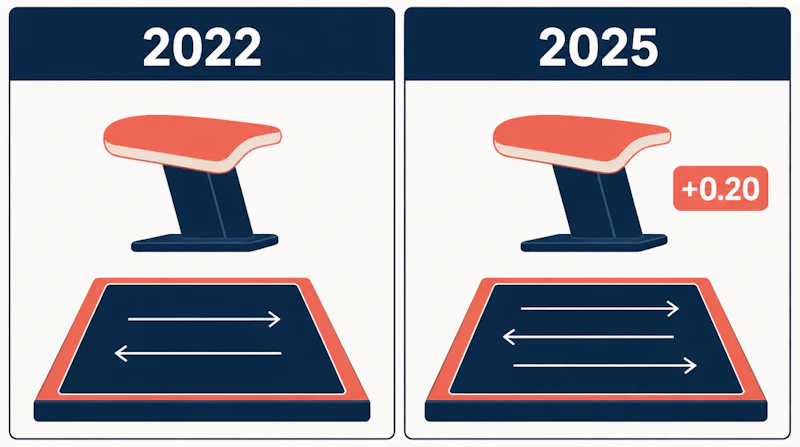
The most visible change in the 2025 code is the vault bonus. In qualification for the vault final and in the vault final, if the saltos in the second flight of the two vaults go in different directions — one forward, one backward — 0.20 is added to the average. The conditions, from section 10.4 of the 2025–2028 code:
- Both vaults must be performed without a fall
- Cuervo-type vaults count as forward-salto vaults
- The bonus is added to the final score (the average of the two vaults)
The vault section of the 2022–2024 WAG Code of Points has no such bonus. British Gymnastics' Women's Technical Committee lists the same conditions in its 2025–2028 vault help sheet, and coaching sites flagged it as one of the headline changes early on (GymnasticsCoaching.com). In the official results of the 2025 World Championships women's vault final in Jakarta, six of the seven gymnasts who competed received the 0.2 bonus. The winner, Angelina Melnikova, scored 14.100 and 14.433, and with the bonus her final mark was 14.466.
Floor: Dismount Bonus Only With Three or More Acro Lines
The 0.20 dismount bonus for a D-value-or-higher dismount performed without a fall applies on bars, beam and floor, and it already existed in the 2022 code. What is new in 2025 is a floor-specific condition: the bonus is only awarded when there are more than two acro lines. The code's own example shows a two-line floor routine judged as "credit dismount, no dismount bonus".
Floor: Revised Connection Value Formulas
The floor connection value (CV) formulas were also changed, for both indirect connections (saltos linked through round-offs or back handsprings) and direct salto connections:
Floor CV | 2022–2024 code | 2025–2028 code |
|---|---|---|
Indirect 0.10 | B/C + D, A + A + D | B + D, A + A + D |
Indirect 0.20 | C + E, D + D, A + A + E | C + D/E, A + A + E |
Direct 0.10 | A + D, C + C | A + D, C + C |
Direct 0.20 | A + E, C + D | A + E, B/C + D |
An indirect connection of a C salto and a D salto, for example, was worth 0.10 under the old code and is worth 0.20 now. In direct connections, B + D has been added to the 0.20 formula.
Floor Artistry Deductions Now Have Three Steps
Floor artistry deductions moved from a two-step scale (0.10/0.30) to a three-step scale (0.10/0.20/0.30). Poor body posture is now 0.10 or 0.20, and poor expressive engagement with the style of the music runs from 0.10 to 0.30. The old "background music" item (0.10/0.30, where the routine connects to the music only partly or only at the start and end) is now worded as "lack of connectivity of the music to the exercise in part or throughout", also from 0.10 to 0.30. Poor music editing is 0.10. Because music choice and editing feed into the score, our competition floor music service edits routines with these rules in mind. For more on artistry, see Floor Exercise Artistry: Music and Choreography.
The quickest way to see how the new rules affect a D-score is to lay out the elements and count them. With Gymnastics AI, you pick the skills and it calculates difficulty, composition requirements, connection value and series bonus automatically (women's apparatus in beta).
Updates Since 2025: FIG Newsletter and National Notices
Uneven Bars: Recognition of the Double Layout Dismount
FIG's newsletter of March 4, 2026 clarified how the double layout (stretched double salto backward) dismount on bars is recognised. As summarised in the Japan Gymnastics Association bulletin, the stretched position must be held for most of the salto, from horizontal to inverted. Held stretched, it is a D; judged as piked, it is credited as a C.
Floor: Clarification of Composition Requirement 1
The same newsletter clarified floor CR 1. The aim of the two-leap or two-hop passage is a large, flowing, travelling pattern, so the requirement is not met if the gymnast does any of the following between the two dance elements:
- Stops or holds a pose
- Walks
- Inserts a small two-foot jump
Limits on Personal Equipment
From June 1, 2026, FIG restricted the personal equipment — handstand blocks, practice beams, yoga mats and similar items — that can be brought into the competition area at FIG-sanctioned events. Japan applied the rule to all domestic competitions from April 1, 2026, and extra landing or support mats that the organising committee has not supplied may not be used in any case.
What Has Not Changed in the WAG Code of Points
Top 8 Elements, 2.00 in CR, −0.50 for No Dismount
The changes get the attention, but the core of the women's code is the same as in 2022. Comparing the two rulebooks, these points did not move:
- Bars, beam and floor count the top 8 elements including the dismount
- Composition requirements: four at 0.50, maximum 2.00
- No dismount: −0.50 from the final score (D-jury)
- Difficulty values from A (0.10) to J (1.00) in 0.10 steps
- The E-score is a deduction system from 10.000
Connection Value and Series Bonus
Connection value is worth 0.10 or 0.20, and the elements used for it do not have to be among the 8 counting elements. On beam, a series of three or more elements of at least B + B + C earns a 0.10 series bonus on top of connection value. For more on beam connections, see Balance Beam Skills and Scoring.
Tips for Reading the Code
The English text of the code is the reference version, and FIG keeps adding interpretations through newsletters and the Help Desk. Junior and age-group competitions may also use modified rules — the age-group programme in the code, for example, counts the top 7 elements. Always check the rules of the specific competition and your national federation's notices.
Summary
- Under the FIG WAG Code of Points 2025–2028, the final score is D-score + E-score − penalties. On bars, beam and floor the D-score is the top 8 elements + composition requirements (max 2.00) + connection value and bonuses
- The main changes from 2022–2024 are the +0.20 vault bonus for saltos in different directions, the three-acro-line condition for the floor dismount bonus, the new floor CV formulas, and the three-step floor artistry scale
- FIG's March 2026 newsletter clarified the bars double layout and floor CR 1; Japan applied these from April 1, 2026
- The latest code, Help Desk and newsletters are on the FIG website; national notices come from your federation
If you want to calculate the D-score of your own routine under the new code, try Gymnastics AI. It is free on iOS and the web (some features are premium; women's apparatus in beta).