2026 All-Japan Team & Apparatus Championships: D-Score Preview
A D-score preview of Japan's 2026 All-Japan Team and Apparatus Championships (Dec 3-6): the Tokushukai vs. Central Sports team final, the format, and the seeds.
*This article reflects information as of November 25, 2026. Teams, rotation groups and seeded gymnasts are taken from the documents published on the Japan Gymnastics Association (JGA) event page. It is written from the perspective of a former Japanese gymnast and the developer of a D-score calculator, with the aim of explaining the meet to readers outside Japan.
The 2026 All-Japan Team and Apparatus Championships (the 80th edition) take place December 3–6 at Soko Arena Yokkaichi in Mie Prefecture. Four of the five men who won the team title for Japan at the Rotterdam World Championships in October will compete here for two different clubs, Tokushukai Gymnastics Club and Central Sports, and the draw has put those two teams in the same group for the team final. Below, we read the published qualifying scores and the official Worlds results through the lens of the D-score (difficulty) and the E-score (execution) to explain what to watch in both the team and apparatus competitions.
2026 All-Japan Team and Apparatus Championships: Schedule and Venue
The four-day schedule
The meet runs in this order: apparatus qualification, a training day, the team final, and the apparatus finals. There is no team qualification round; the team standings are decided in a single session on December 5. The schedule below comes from the official directives (November 9 version) and the timetable on the event page.
Date | Session | Competition time (approx.) |
|---|---|---|
Thu, Dec 3 | Men's and women's apparatus qualification | Subdivision 1 10:40–13:30 / Subdivision 2 14:00–16:50 |
Fri, Dec 4 | Venue training (closed to the public) | – |
Sat, Dec 5 | Men's and women's team final (Groups 1 and 2) | Group 1 approx. 10:30–13:25 / Group 2 approx. 15:00–17:50 |
Sun, Dec 6 | Men's and women's apparatus finals | approx. 10:30–16:00 |
All times are Japan Standard Time (UTC+9).
Venue and how to watch
The venue is Soko Arena Yokkaichi (Yokkaichi City Gymnasium). According to the event page, the team final on December 5 and the apparatus finals on December 6 will be streamed on Locipo, the streaming service of CBC Television. A paid multi-angle stream using JVCKenwood's yourLIVE platform is also offered.
Team-final tickets are sold separately for Group 1 and Group 2, with a full change of spectators between sessions. The directives also note that no raised podium will be used at this meet.
Three things to know before you watch
- The team competition is one-and-done: no scores carry over; the final on December 5 decides everything
- No dropped scores in the team final: three gymnasts compete on each apparatus and all three scores count
- Seeded gymnasts go straight to the apparatus finals: Worlds apparatus finalists and others are exempt from qualification
If you want to check how many D-score points a routine is worth while you watch, Gymnastics AI — D-Score Calculator is a handy companion. It follows the FIG 2025–2028 Code of Points and includes more than 1,500 skills across the six men's and four women's (beta) apparatus.
How the All-Japan Team Championships Work: No Qualification, 6-3-3
How the 16 teams qualified
Sixteen teams compete on each side. On the men's side, the field is the top 12 teams from the combined scores of the All-Japan Senior Championships and the All-Japan University Championships (Inter-College), the top two high school teams from the national high school championships (Inter-High), the top team from the All-Japan Junior Championships (Division 1), and one U20 national selection team. On the women's side, it is the top 15 teams from the combined scores of the All-Japan Junior Championships (Division 1), the Inter-College and the All-Japan Seniors, plus one selection team made up of national and junior national squad members (men's qualified teams, women's qualified teams).
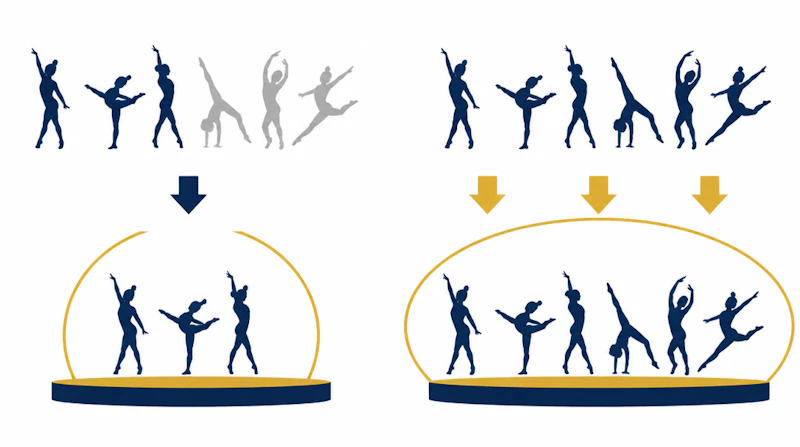
The qualifying order was set by recalculating each meet's scores under a 6-6-3 format: six gymnasts per team, all six compete, and the top three scores count. In other words, the qualifying totals are what remains after each team's three lowest scores on every apparatus have been dropped.
In the final, every score counts
The team final on December 5 uses 6-3-3: six gymnasts registered, three compete on each apparatus, and all three scores count (directives, "Team competition format"). It is the same format as a World Championships team final. If a gymnast falls, that score goes straight into the team total. A mistake weighs very differently in the qualifying totals (6-6-3) and in the final (6-3-3).
For a closer look at how team scoring changes between qualification and the final, see our guide to how team scores are calculated in gymnastics.
Two teams alternate, one gymnast at a time
The team final uses the "FIG final format": each group contains two teams that alternate, one gymnast at a time. On the first apparatus, the first team goes before the second; the order then switches every rotation. Each rotation is scheduled for about 27 minutes.
- Men: the top seven qualifiers plus the Inter-High winner compete in Group 2; the other eight teams are in Group 1
- Women: the top eight qualifiers compete in Group 2; the next seven teams and the national selection team are in Group 1
- The men's U20 selection team and the women's national selection team compete as open (non-ranked) entries
Men's Team Final: Tokushukai vs. Central Sports by the Numbers
The world champions are split across two clubs
Japan's team gold at the 2026 Worlds was won by Daiki Hashimoto, Shinnosuke Oka, Shohei Kawakami, Ryosuke Doi and Fusuke Maeda (International Gymnast's team final report). According to the men's team rotation groups, Oka and Kawakami are registered with Tokushukai Gymnastics Club, while Hashimoto and Doi are registered with Central Sports.
Team | Registered | Key gymnasts |
|---|---|---|
Tokushukai Gymnastics Club (1st qualifier) | 8 | Shinnosuke Oka, Shohei Kawakami, Takaaki Sugino, Takeru Kitazono, Tsuyoshi Hasegawa, Shunpei Fujimaki and others |
Central Sports (2nd qualifier) | 4 | Daiki Hashimoto, Ryosuke Doi, Wataru Tanigawa, Teppei Miwa |
Why Japan won the world team title (it came down to execution) is covered in our analysis of the 2026 Worlds men's team final.
Tokushukai lead on five of six apparatus in qualifying
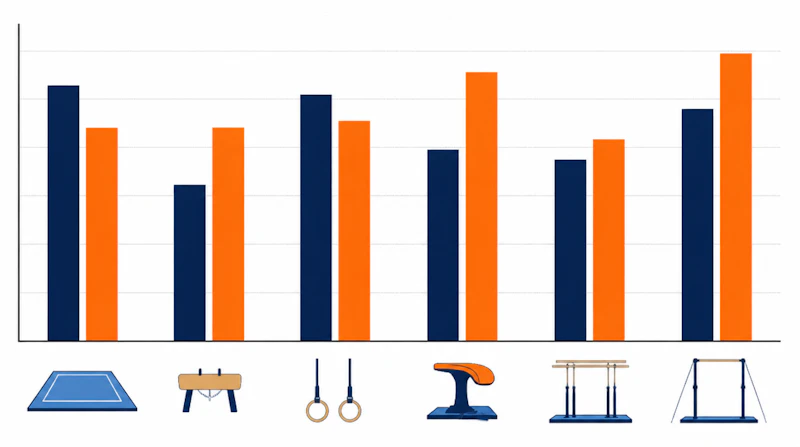
Here are the qualifying totals by apparatus (as of October 12, recalculated under 6-6-3):
Apparatus | Tokushukai | Central Sports | Margin |
|---|---|---|---|
Floor | 41.949 | 41.765 | Tokushukai +0.184 |
Pommel horse | 42.432 | 41.432 | Tokushukai +1.000 |
Rings | 41.816 | 41.132 | Tokushukai +0.684 |
Vault | 43.032 | 43.633 | Central +0.601 |
Parallel bars | 43.732 | 42.432 | Tokushukai +1.300 |
High bar | 42.565 | 42.015 | Tokushukai +0.550 |
Total | 255.526 | 252.409 | Tokushukai +3.117 |
The biggest gaps are on parallel bars (1.300) and pommel horse (1.000); Central Sports are ahead only on vault. Keep in mind that these totals come from different meets and count only the top three scores. The directives also allow a recalculation for Asian Games and Worlds team members who skipped the All-Japan Seniors, using their scores from the All-Japan All-Around Championships and the NHK Trophy instead. These numbers say more about squad depth than about what the final scores will be.
With four gymnasts, Central Sports have one spare
Central Sports have registered only four gymnasts. Because three must compete on every apparatus in the final, three of the four will be up on each of the six events, leaving room for just one substitution per apparatus. Tokushukai, with eight registered, can pick their best three for each event.
On the other hand, all three scores count in the final. More than the size of the roster, the result will depend on which team can deliver 18 routines without a major error. Both teams are in Group 2 and in the same pairing, starting on floor and alternating one gymnast at a time (Group 2 starting apparatus: floor = 1st and 2nd qualifiers, pommel horse = 3rd and 4th, rings = 5th and 6th, vault = 7th and the Inter-High winner).
The rest of Group 2, plus the high schoolers and U20s
Group 2 also includes Nippon Sport Science University, Juntendo University, Miyazaki Hinata GYM, Sendai University, Nihon University, and the Inter-High winner Seifu. Seifu's roster includes Ikki Nishihara, the all-around bronze medalist at the Youth Olympic Games in Dakar in November (our Youth Olympics recap). The U20 selection team competes in Group 1 as an open entry.
Women's Team Final: Namba Gymnastics Club-ngc's 4.5-Point Lead
Comparing qualifying totals by apparatus
The top women's qualifier is Namba Gymnastics Club-ngc (167.364), followed by Yoneda Isao Gymnastics Club (162.863), a gap of 4.501 points (as of September 14, 6-6-3).
Apparatus | Namba-ngc | Yoneda Isao | Margin |
|---|---|---|---|
Vault | 42.200 | 41.365 | Namba +0.835 |
Uneven bars | 42.199 | 40.833 | Namba +1.366 |
Balance beam | 42.199 | 39.766 | Namba +2.433 |
Floor | 40.766 | 40.899 | Yoneda +0.133 |
Total | 167.364 | 162.863 | Namba +4.501 |
More than half of the gap, 2.433 points, comes from balance beam. A single fall on beam costs a great deal, so in a final where all three scores count, that margin is far from guaranteed to hold.
Teams and gymnasts to watch
According to the women's team rotation groups, Group 2 includes:
- Namba Gymnastics Club-ngc / Soai Gakuen: Haruka Nakamura, Yume Minamino, Misa Nishiyama and others (six gymnasts)
- Soko Gymnastics Club: home of Mana Okamura, eighth on beam at the Worlds (listed as Soko Gymnastics Club / Yokkaichi University)
- Juntendo University: Shoko Miyata and others
- Nippon Sport Science University, University of Tsukuba, NGC sports, Buddy Tsukahara Gymnastics Club, Yoneda Isao Gymnastics Club
Okamura scored 12.666 (D 5.900, E 6.766) in the Worlds beam final, finishing eighth (Gym Art women's beam final results). We broke down that final in our 2026 Worlds women's apparatus finals analysis.
The Group 2 pairings
Women's Group 2 starts as follows: vault = 1st and 2nd qualifiers (Namba-ngc and Yoneda Isao), uneven bars = 3rd and 4th (Nippon Sport Science University and Juntendo), beam = 5th and 6th (NGC sports and Soko), floor = 7th and 8th (Tsukuba and Buddy Tsukahara). As on the men's side, the top two teams meet head-to-head in the same pairing.
2026 All-Japan Apparatus Championships: Reading the Seeds Through D-Scores
Men's seeds and their Worlds results
In the apparatus championships, seeded gymnasts skip qualification and go directly to the final. On the men's side, up to two gymnasts per apparatus are seeded in this order: (1) Worlds apparatus medalists, (2) Asian Games apparatus gold medalists, (3) Worlds apparatus finalists, (4) Asian Games apparatus medalists (directives). Here are the seeds published in the men's apparatus final start lists, with their results from the Worlds apparatus finals (Gym Art apparatus final results).
Apparatus | Seeded gymnasts (club) | Worlds apparatus final |
|---|---|---|
Floor | Ryosuke Doi (Central Sports), Shoma Tsukiyama (Higashi Gymnastics School / Namisho Gakuen OUHS Club) | Doi 4th, 14.366 (D 5.8, E 8.566) |
Pommel horse | Daiki Hashimoto (Central Sports) | 8th, 13.466 (D 4.8, E 8.666) |
Rings | Shinnosuke Oka (Tokushukai), Kiichi Kaneta (Soko) | Oka 4th, 14.133 (D 5.1, E 8.933) |
Vault | Shohei Kawakami (Tokushukai) | 8th, 13.333 |
Parallel bars | Daiki Hashimoto, Shinnosuke Oka | Hashimoto 4th, 14.600 (D 5.6, E 8.900) / Oka 5th, 14.566 (D 5.6, E 8.966) |
High bar | Shinnosuke Oka, Shohei Kawakami | Oka silver, 14.800 (D 5.8, E 8.900) / Kawakami 4th, 14.600 (D 5.9, E 8.600) |
Tsukiyama won floor bronze with 14.566 at the Asian Games in Aichi-Nagoya in September (The Star, via Reuters). Kaneta did not reach a Worlds apparatus final either, so his seed also comes from his Asian Games apparatus result.
Oka's high bar silver was built on an 8.900 E-score
Among the seeds, Oka on high bar is the only one who won a medal at the Worlds. His routine carried a D-score of 5.8, 0.8 lower than the 6.6 of champion Tang Chia-Hung (Chinese Taipei), but an E-score of 8.900 plus a 0.1 bonus brought him to 14.800 (full high bar final scores). Kawakami, also seeded on high bar, competed a routine worth 5.9, 0.1 higher than Oka's, and finished fourth.
High bar and parallel bars, where two Japanese Worlds finalists line up on the same event, are the best places to see whether a final is decided by difficulty or by execution. To see how release moves and connections push a high bar D-score up, try building a routine in Gymnastics AI: pick and order the skills, and it calculates difficulty values, element group credit and connection bonuses automatically. We look at that Worlds high bar final in detail in our analysis of Oka's high bar silver.
Women's seeds
On the women's side, up to two gymnasts per apparatus are seeded: first (A) Worlds apparatus medalists, then (B) the top two in the apparatus rankings from Japan's selection meets (the All-Japan All-Around Championships and the NHK Trophy). The women's apparatus final start lists name five seeds:
- Uneven bars: Misa Nishiyama and Yume Minamino (both Namba Gymnastics Club-ngc / Soai Gakuen)
- Balance beam: Haruka Nakamura (Namba Gymnastics Club-ngc / Soai Gakuen) and Mana Okamura (Soko Gymnastics Club / Yokkaichi University)
- Floor: Rina Kishi (Toda City Sports Center / International Pacific University)
- Vault: no seeds (all eight finalists come through qualification)
Tie-breaks work in opposite directions for men and women
A close reading of the directives shows that ties in the apparatus qualification rankings are broken differently for men and women:
- Men: the higher D-score ranks first; if still tied, compare E-scores
- Women: the higher E-score ranks first; if still tied, compare D-scores
The men's rules also state that "the stick bonus is not included in the D-score." In the Worlds results, too, there is a separate "B" (bonus) column next to D and E, and Oka's high bar carries +0.1. The bonus is not part of the D-score; it is added separately. For the basics of D and E, see our guide to gymnastics scoring and the D-score and E-score.
Where This Meet Sits on the Road to LA 2028
Japan's men and women have already qualified full teams
The JGA's "Road to Los Angeles 2028" overview, published on November 16, shows that the top three teams from the 2026 Worlds team finals earned country quota places: Japan, Russia and China for the men, and China, the United States and Japan for the women. We explain the full Olympic qualification system in our article on LA 2028 gymnastics qualification.
What to watch at this meet
This is not a selection event, but it is the last major domestic meet of the 2026 season. Watching for the following will help you read next season's landscape:
- Which apparatus the Worlds team members take on for their clubs in the team final
- The D-scores of gymnasts who come through qualification to reach the apparatus finals without a seed
- How the high schoolers, the U20 team and the women's national selection team score on a senior stage
Where to check the latest information
Rotation groups and timetables can change. Before you watch, check the latest documents on the JGA event page. For English-language coverage of international results in chronological order, The Gymternet is a useful resource.
Summary
- The 2026 All-Japan Team and Apparatus Championships run December 3–6 at Soko Arena Yokkaichi; the team final is on December 5 and the apparatus finals on December 6
- The team final is a single session with no qualification, using 6-3-3: all three scores on every apparatus count
- On the men's side, first qualifier Tokushukai (Oka, Kawakami) and second qualifier Central Sports (Hashimoto, Doi) meet in the same pairing; Tokushukai lead by 3.117 in qualifying totals
- On the women's side, Namba Gymnastics Club-ngc lead Yoneda Isao Gymnastics Club by 4.501, more than half of it on beam
- Apparatus seeds include eight men, such as Oka (rings, parallel bars, high bar) and Hashimoto (pommel horse, parallel bars), and five women: Nishiyama, Minamino, Nakamura, Okamura and Kishi
If you want to see how many D-score points these routines are worth by laying out the skills yourself, give Gymnastics AI a try. It is free on iOS and the web (some features require Premium).