What Is the E-Score in Gymnastics? Execution Deductions Explained
The gymnastics E-score explained from the FIG 2025-2028 Codes: deductions of 0.1, 0.3, 0.5 and 1.0, how judges' marks are averaged, landings and artistry.
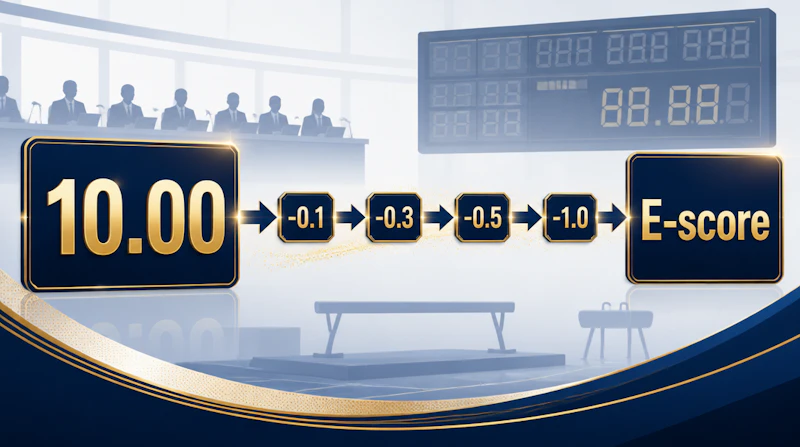
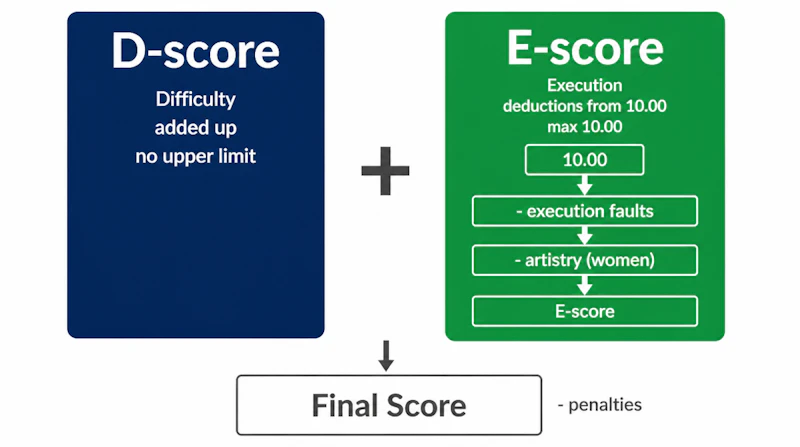
The E-score in gymnastics is the execution score: it measures how well a routine is performed, not how hard it is. Every routine starts at 10.00, and judges take deductions for bent knees, steps on landing, falls and other faults. Whatever is left is the E-score, which is added to the D-score (difficulty) to produce the final mark.
This guide walks through the E-score using the original text of the 2025–2028 Codes of Points published by the International Gymnastics Federation (FIG): the deduction scale (0.1, 0.3, 0.5 and 1.0), how the panel's deductions are averaged, the artistry deductions that only exist in women's gymnastics, and why the E-score cannot be challenged by an inquiry.
What Is the E-Score? The Execution Score Explained
A Deduction System That Starts at 10.00
The "E" stands for Execution. The men's Code states that the E-score "will start from 10 points and will evaluate by deductions applied in tenths of a point" (FIG Men's Artistic Gymnastics Code of Points 2025–2028, Article 6.1).
In other words, the E-score does not reward good moments. It compares the routine with a perfect performance and subtracts every deviation from that ideal. No matter how difficult the content, the E-score can never be higher than 10.00.
Article 8.2 of the same Code puts it plainly: each performance is evaluated against the expectation of perfect performance, and all deviations from that expectation are deducted. That single principle explains almost everything else in this article.
D-Score vs E-Score: The Key Differences
A gymnastics score is the sum of marks from two separate judging panels. The D-panel evaluates the content of the routine; the E-panel evaluates how it was performed.
Item | D-score (Difficulty) | E-score (Execution) |
|---|---|---|
What it measures | Difficulty values, element groups, connections | Form, technique, landings and composition faults (plus artistry for women) |
How it is built | Values are added up | Deductions are taken from 10.00 |
Upper limit | None | 10.00 |
Judges | D-jury | E-jury (several judges) |
Can it be inquired? | Yes | No |
For how the D-score is counted, see our overview of the gymnastics Code of Points. If you want to check the D-score of your own routine, Gymnastics AI, a D-score calculator, lets you line up skills and calculates the value under the FIG 2025–2028 Codes (all six men's apparatus plus the four women's apparatus in beta). Looking at the D-score next to the likely execution deductions makes it much easier to decide whether to add difficulty or clean up what you already have.
From the Perfect 10 to D + E in 2006
For decades gymnastics was scored out of 10. Nadia Comăneci famously received the first perfect 10 in Olympic gymnastics on the uneven bars at the 1976 Montreal Games (Wikipedia: Nadia Comăneci). The Japanese Olympic Committee's guide to the sport (in Japanese) explains that scores became bunched so tightly that small judging errors could change medal colors, which led to the open-ended D + E system from 2006.
The overhaul followed the judging controversy at the 2004 Athens Olympics (Wikipedia: Code of Points (gymnastics)). A simple way to think about it: the old 10.0 ceiling survived as the ceiling of the execution score.
E-Score Deductions: Small, Medium, Large and Falls
The 0.1 / 0.3 / 0.5 / 1.0 Scale
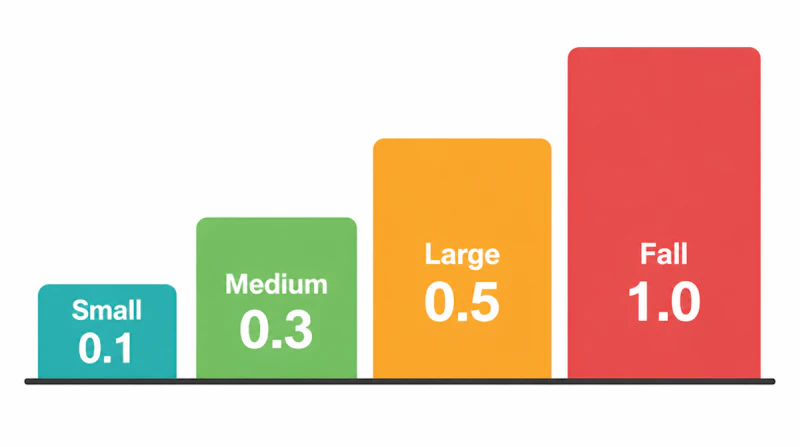
The men's Code sorts every deviation from perfect performance into four sizes (Article 9.2). The women's Code uses the same 0.10 / 0.30 / 0.50 steps for small, medium and large deviations (FIG Women's Artistic Gymnastics Code of Points 2025–2028, Sections 8 and 9).
Category | Deduction | What the Code describes (summary) |
|---|---|---|
Small error | 0.1 | Minor deviation from the perfect end position or technique; minor adjustments of hands, feet or body |
Medium error | 0.3 | Distinct or significant deviation; distinct adjustments |
Large error | 0.5 | Major or severe deviation; any full intermediate swing |
Fall | 1.0 | A fall on or from the apparatus; spotter assistance that helps complete an element |
The size of the deduction depends only on how far the performance strays from the ideal. The same degree of bending is deducted the same way whether it is the arms, the legs or the body (Article 9.2).
E-Judges Ignore Difficulty
The Code is explicit that the E-jury "is not to concern at all with the difficulty of an exercise" and must deduct equally severely for any error of the same magnitude, regardless of the difficulty of the element (men's Code, Article 9.1).
- Bent knees on an A element and bent knees on an I element cost the same if the bend is the same size
- "It was a hard skill, so a little form break is fine" has no place in the E-score
- Difficulty belongs to the D-jury; the two panels are completely separate
One Element Can Take Two Deductions
If an element shows both a technical error and an aesthetic execution error, the E-jury must deduct twice (Article 9.1). The Code's own example is a Stützkehre on parallel bars that receives a deduction for angle deviation and another for bent knees.
On the other hand, the Code tells judges not to deduct movements modified on purpose, such as a giant swing on high bar adjusted to prepare a release or dismount, unless the change is unnecessary or extreme. The E-score is not a mechanical checklist; judges are expected to understand why a movement looks the way it does.
How the E-Score Is Calculated: Averaging the Panel
Drop the Highest and Lowest, Average the Middle
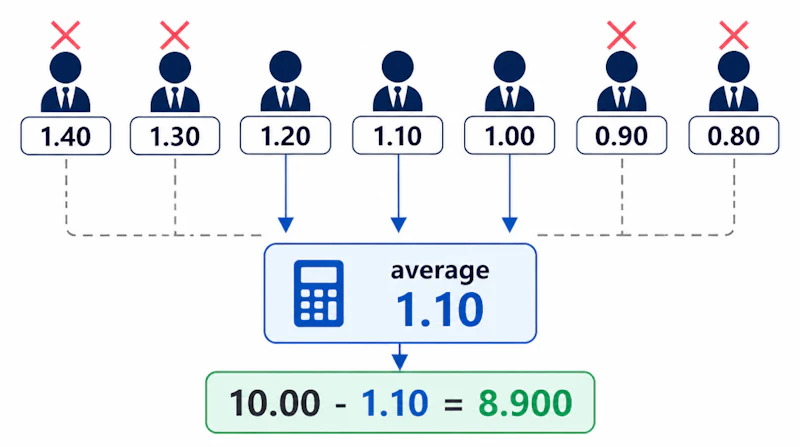
Each E-judge decides deductions independently. The highest and lowest totals are then removed, and the average of the remaining totals is subtracted from 10.00 (men's Code Article 6.1, women's Code Article 6.2). The Codes list the averaging method by panel size:
- 7 E-judges: average the middle 3
- 5 E-judges: average the middle 3
- 4 E-judges: average the middle 2
- 3 E-judges: average all 3
- 2 E-judges: average both
Panel size depends on the level of the competition. Dropping the extremes means one unusually harsh or lenient judge cannot swing the result on their own.
Worked Example (Hypothetical Numbers)
Here is a seven-judge panel with made-up numbers (not a real gymnast's score):
Judge | Total deductions | Status |
|---|---|---|
E1 | 1.40 | Dropped (highest) |
E2 | 1.30 | Dropped (second highest) |
E3 | 1.20 | Counted |
E4 | 1.10 | Counted |
E5 | 1.00 | Counted |
E6 | 0.90 | Dropped (second lowest) |
E7 | 0.80 | Dropped (lowest) |
The middle three average (1.20 + 1.10 + 1.00) ÷ 3 = 1.10. The E-score is 10.00 − 1.10 = 8.900.
Final Score = D-Score + E-Score − Penalties
The final score is the D-score plus the E-score, minus any penalties such as stepping out of bounds or going over time (women's Code, Article 6.2). The women's Code gives this example:
- D-score: difficulty 3.10 + composition requirements 2.00 + connection value 0.60 = 5.70
- E-score: 10.00 − (execution 0.70 + artistry 0.30) = 9.00
- Final score: 5.70 + 9.00 = 14.70
The D-score grows when you add skills; the E-score can only shrink. To weigh the two, calculate the D-score of each version of a routine in Gymnastics AI and set it next to the execution you can realistically deliver. The app adds up difficulty values, element group requirements and connection bonuses automatically as you place skills.
Landing and Form Deductions: Where E-Scores Slip
Landing Deductions
Landings are where E-score differences are easiest to see. The men's Code sets out the following (Articles 9.2 and 9.4):
- Landing with the feet slightly apart (up to about 10 cm) and joining the heels without moving the front of the feet: no deduction. Wider than that: 0.1 or 0.3
- A small step (up to one foot's length) is 0.1; anything larger is a medium error (0.3)
- Deductions for steps and hops are capped at 1.0 in total
- A low landing, with the hips below the knees, is 0.5
In women's gymnastics, if there is no fall, the deduction for a single landing may not exceed 0.80 (women's Code, Article 9.3). For technique tips on sticking landings, see our guide to landing technique and deductions.
Bent Arms, Bent Knees and Angle Guidelines
The men's Code converts bending and angle errors into degrees (Articles 9.2 and 9.4):
Situation | Small 0.1 | Medium 0.3 | Large 0.5 |
|---|---|---|---|
Bending of arms, legs or body | >0°–45° | >45°–90° | >90° (and no recognition) |
Angle deviation in hold positions | >5°–20° | >20°–45° | >45° (and no recognition) |
Deviation in swings to or through handstand | >15°–30° | >30°–45° | >45° (and no recognition) |
The 2025–2028 Code relaxed angle judging: strength skills held within 5 degrees of perfect now carry no deduction (Inside Gymnastics breakdown of the new men's Code). Some apparatus, high bar in particular, have their own exceptions, so always check the apparatus chapter as well.
What Happens After a Fall
A fall costs 1.0, and that 1.0 already includes any steps or hand support leading up to it. Other execution deductions for the element, such as lack of height, still apply (men's Code, Article 9.2).
- Men: the routine may be continued within 30 seconds, and the missed element may be repeated for credit, except after a fall on a dismount (other than pommel horse) or on vault
- Women: a gymnast may rest up to 30 seconds after a fall from uneven bars and 10 seconds after a fall from beam without deduction (women's Code)
For a full list of women's deductions for falls, landings and stepping out of bounds, see our article on how deductions work in women's gymnastics.
The Women's E-Score: Execution Plus Artistry
Execution and Artistry Are Added, Then Taken From 10.00
In women's artistic gymnastics, the E-score is calculated by adding the execution deductions and the artistry deductions and subtracting the total from 10.00 (women's Code, Articles 9.1 and 9.2). In the worked example above, 0.70 for execution and 0.30 for artistry made a total of 1.00.
The men's E-score also covers aesthetic, execution, technical and compositional faults (men's Code, Article 8.1). What sets the women's Code apart is that "artistry of presentation" is written into the definition of the E-score as its own pillar, with dedicated deduction tables for specific apparatus.
Artistry Is Judged on Beam and Floor
The women's Code lists "Artistry & Composition Deductions" for the E-jury on balance beam (Section 12.5) and floor exercise (Section 13.5). On vault and uneven bars, execution and composition deductions do the work.
- Balance beam: posture, amplitude of movement, amplitude of leg swings and kicks, foot work and relevé, variation in rhythm and tempo (12.5)
- Floor exercise: artistic performance plus musicality, music editing and corner choreography (13.5)
- Uneven bars and vault: no artistry table; execution and composition deductions apply
The tables run from 0.10 to 0.20 per item on beam and from 0.10 to 0.30 on floor (Sections 12.5 and 13.5). Small as they are, these deductions add up across a routine and pull the E-score down.
What Floor Artistry Judges Look For
Floor's artistry and composition deductions (0.10 to 0.30) cover the following items (women's Code, Section 13.5):
- Artistic performance: posture of head, shoulders and trunk; foot work; amplitude; involvement of body parts; complexity of movement
- Musicality: expression that fits the style of the music, connection between music and exercise, synchronisation with the beat at the end
- Music: poor editing of the music
- Composition: poor or repetitive corner choreography, no movement touching the floor
The line "poor editing of the music" is easy to overlook. Awkward cuts, or a routine that finishes out of step with the music, can cost tenths even when every skill is clean. If you need a floor track built around these rules, Daito Iwasaki offers competition floor music production, with editing and original composition that take the Code into account.
Can You Inquire About an E-Score? Judging Rules
Inquiries Are Only for the D-Score
Coaches who disagree with a score may submit an inquiry. However, Article 8.5.1 of the FIG Technical Regulations 2026 states that, in all disciplines that allow inquiries, only the D-score may be the subject of an inquiry.
- D-score: element recognition, element groups and connection values can be questioned
- E-score: not open to inquiry; the panel's deductions stand
Because the E-score is already an average of several judges with the extremes removed, the system relies on the panel itself to absorb individual errors. With no route to appeal, consistent execution in training is what shows up on the scoreboard.
E-Judges Decide Independently Within 20 Seconds
Under the men's Code, E-judges evaluate the routine independently and set their deductions within 20 seconds of the end of the exercise (Article 8.2). At official FIG competitions, each individual E-judge's score appears on the main results form (Article 6.2).
For how the D-panel and E-panel are organized and who does what, see our guide to the gymnastics judging system.
Benefit of the Doubt Goes to the Gymnast
The Code also says that if an E-judge cannot reach a decision for any reason, the benefit of the doubt must go to the gymnast (men's Code, Article 9.1).
Judges are further required to stay up to date with contemporary gymnastics and to know what performance standard is currently expected for each element. The standard behind the E-score is not frozen; it moves with the sport.
How to Raise Your E-Score: Fewer Deductions
Never Trade Execution for Difficulty
The men's Code states that a gymnast "must never attempt to increase the difficulty or the D-score at the expense of aesthetic and technical execution" (Article 8.3). It also says gymnasts should include only elements they can perform with complete safety and a high degree of mastery.
- A skill that adds 0.2 to the D-score can still lose points overall if it brings a landing step (0.1–0.3) and bent knees (0.1–0.3)
- A fall costs 1.0, so low-percentage skills should be judged by their expected value
- In men's gymnastics, a stuck landing after a dismount rated C or higher (including vaults with saltos, but not pommel horse) earns a 0.1 bonus, awarded by the D-jury (men's Code, Section 7)
Why Practicing Stuck Landings Pays Off
A small step costs 0.1, a big step 0.3 and a low landing 0.5, so landings alone can swing a score. For men, a stuck landing both avoids E-score deductions and earns the 0.1 stick bonus on the D-score side.
Choosing skills you can land with height and rotation to spare is often the faster route to a higher total. For how connections protect the E-score on parallel bars, see our article on parallel bars routine construction and the E-score.
Turn the Deduction List Into a Training Checklist
E-score deductions are written down in the Code, so they can be checked. When reviewing training video, go through these points:
- Knees, arms and toes: any bending, separation or relaxed feet?
- Handstands and holds: is the angle on target where the position should stop?
- Landings: foot width, number of steps, hip height
- Women's beam and floor: posture, amplitude, timing with the music
National federations publish their own rule updates and judging courses; in Japan these are posted on the Japan Gymnastics Association's rules page (in Japanese). For another walk-through of D and E scoring with examples, see the JudgeMate guide to artistic gymnastics scoring.
Summary
- The E-score is the execution score: it starts at 10.00 and judges take deductions
- Deductions come in four sizes, 0.1, 0.3, 0.5 and 1.0 for a fall, and the same error costs the same regardless of difficulty
- The panel's highest and lowest totals are dropped and the rest averaged (middle three of seven)
- Women's E-scores combine execution and artistry deductions; artistry is judged on beam and floor, and on floor even music editing counts
- Only the D-score can be inquired; the E-score cannot
Understanding the E-score changes how much difficulty is worth adding. If you want to check the D-score of your routine and balance it against execution, try Gymnastics AI. It is free on iOS and the web, with some features in the premium plan.