LA28 Gymnastics Qualification Explained: Japan's 5-Athlete Cap
How gymnasts qualify for LA28: the FIG criteria, key dates through 2028, why Japan is capped at five men and five women, and what Rotterdam D-scores reveal.

This article reflects information available as of November 17, 2026.
On November 16, 2026, the Japan Gymnastics Association (JGA) published its "Road to Los Angeles 2028" guide, a visual summary of how gymnasts qualify for the LA28 Olympic Games. Artistic gymnastics at LA28 has 96 quota places for men and 96 for women, and Japan, which finished in the top three of both team finals at the 2026 World Championships in Rotterdam, has already secured full teams in both competitions. Written from the perspective of a former Japanese gymnast and the developer of a D-score calculator, this analysis walks through the FIG qualification system, explains why Japan's Olympic roster is capped at exactly five men and five women, and looks at what the D-scores from Rotterdam say about building a five-person team.
LA28 Gymnastics Qualification: What Was Announced on November 16

The JGA publishes its "Road to Los Angeles 2028" guide
The document released by the JGA is a PDF titled "Process for Earning Quota Places at the 2028 Los Angeles Olympics" (version dated November 16, 2026). It sets out, one page per discipline, which competitions award how many places in men's and women's artistic gymnastics, trampoline, and rhythmic gymnastics (individual and group).
The source behind it is the International Gymnastics Federation's LA28 Qualification System for Artistic Gymnastics (version of June 3, 2026). It defines seven qualification criteria, and the places are filled over roughly eighteen months, from the 2026 World Championships to the continental championships that close by the end of May 2028.
96 men and 96 women, and Japan already has both teams
Under the FIG system, artistic gymnastics has 94 quota places per gender, plus one host country place and one universality place each, for a total of 96 men and 96 women (192 athletes).
- Men: Japan won the team final in Rotterdam, and qualified a team alongside World Gymnastics 2 (the neutral Russian team) in second and China in third.
- Women: Japan placed third in the team final, qualifying alongside champion China and runner-up USA.
- A team quota is five athletes with no reserves, so Japan's men and women have each locked in five Olympic spots already.
Japanese regional daily Kumamoto Nichinichi Shimbun (via Kyodo News) also reported that Japan's men "earned a place at the 2028 Los Angeles Olympics together with second-placed Russia and third-placed China."
What this article covers
Olympic qualification in gymnastics is notoriously hard to follow: the criteria are numbered, and some places go to a country while others go to a named athlete. This article focuses on three questions.
- When, at which events, and how many places are decided on the road to LA28?
- Why is Japan capped at five men and five women, with no extra individual spots?
- What do the D-scores from Rotterdam say about building a five-person team that has to cover six apparatus (four for women)?
If you want to check what D-score a contender's routine is worth, Gymnastics AI, a D-score calculator app, lets you do it in a few taps. It follows the FIG 2025–2028 Code of Points and includes a database of more than 790 skills across all six men's apparatus.
How LA28 Gymnastics Qualification Works: Criteria 1 to 7
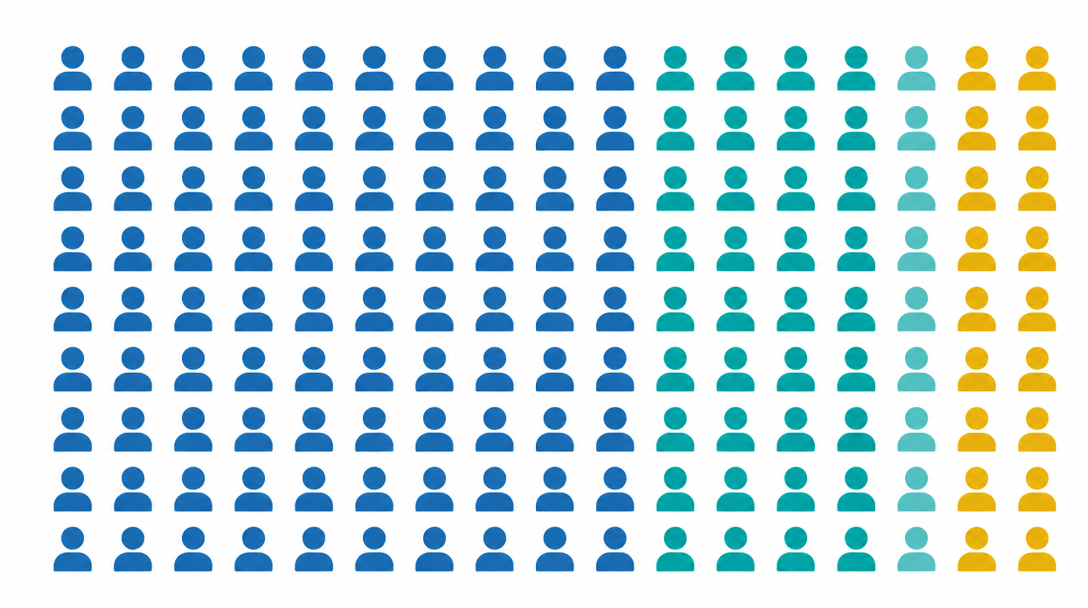
Quota places by criterion for men and women
Combining the FIG qualification system with the JGA's summary, the places are distributed as follows.
Criterion | Event / method | Men | Women | Allocated to |
|---|---|---|---|---|
1 | 2026 World Championships (Rotterdam): top 3 nations in the team final | 3 teams (15) | 3 teams (15) | NOC |
2 | 2027 World Championships (Chengdu): top 9 nations in team qualifications, excluding Criterion 1 nations | 9 teams (45) | 9 teams (45) | NOC |
3 | 2027 Worlds: next 3 nations in team qualifications without a team place (one athlete each) | 3 | 3 | NOC |
4 | 2027 Worlds all-around (excluding nations with a team, one per nation) | 8 | 14 | Named athlete |
5 | 2027 Worlds apparatus finals: top eligible athlete per apparatus (must finish top 3) | 0–6 | 0–4 | Named athlete |
6 | 2028 Apparatus World Cup Series ranking (top 2 per apparatus) | 12 | 8 | Named athlete |
7 | 2028 continental championships all-around (one per continent) | 5 | 5 | Named athlete |
– | Host country place / universality place | 1 / 1 | 1 / 1 | Named athlete |
Sources: FIG Qualification System and the JGA summary. Any Criterion 5 places that cannot be allocated are distributed using the 2028 Apparatus World Cup ranking, which is why the JGA chart lists the men's Criterion 6 total as "12 + α".
2026 Worlds: top 3 teams in the team final (Criterion 1)
The first places were decided at the 2026 World Championships in Rotterdam, the Netherlands (October 17–25). According to the official men's team final scores, Japan scored 251.928, WG2 250.329, and China 249.193. In the women's team final, China scored 165.764, the USA 165.531, and Japan 164.063.
Each of these three nations receives a team place of five athletes with no reserves. International Gymnast described Japan, WG2, and China as the first men's teams to qualify for Los Angeles.
2027 Worlds in Chengdu: nine more teams and individual places (Criteria 2–5)
The biggest qualifier is the 2027 World Championships in Chengdu, China, from September 28 to October 6, 2027. The top nine teams in qualifications (excluding the three already qualified) earn team places, completing a field of 12 teams for both men and women.
- Criterion 3: one place each for the next three nations in team qualifications that missed out on a full team (allocated to the NOC).
- Criterion 4: all-around places for athletes from nations without a team (8 men, 14 women, one per nation).
- Criterion 5: the highest-ranked eligible athlete on each apparatus in the event finals, provided they finish in the top three.
2028 Apparatus World Cups and continental championships (Criteria 6 and 7)
Places remain open into the Olympic year. Criterion 6 uses the six-stop Apparatus World Cup Series from February 24 to April 15, 2028 (Cottbus, Baku, Antalya, Cairo, Osijek, and Doha). The best four results out of six form a ranking, and the top two athletes per apparatus earn named places. Criterion 7 awards one place per continent to the top all-around gymnast at each continental championship, held by the end of May 2028.
Both routes exclude athletes from nations that have qualified a team. In other words, the main paths for apparatus specialists, Criteria 5 and 6, exist for gymnasts from countries without a full team.
Why Japan's Olympic Team Is Capped at Five Men and Five Women
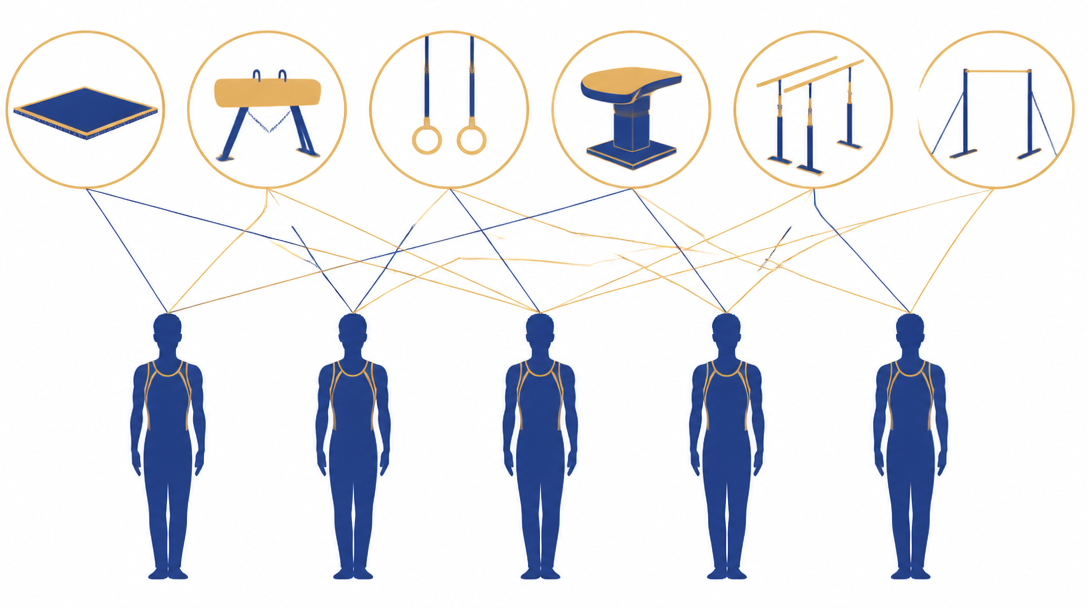
The per-nation maximum is one team of five
The FIG system sets the maximum per NOC as "one team of five athletes (no reserves)." The limit of three individual athletes applies only to "NOCs with no team qualified." Criteria 3 through 7 each state explicitly that athletes from NOCs whose team qualified through Criteria 1 or 2 are not eligible.
So once Japan qualified full teams, its Olympic roster became a maximum of five men and five women. Even if a Japanese gymnast wins an apparatus title at the 2027 Worlds or tops the World Cup ranking in 2028, that does not create a sixth spot.
Team places go to the nation, so the roster is decided at home
Team places under Criteria 1 and 2 are allocated to the National Olympic Committee, not to named athletes. The five men who won in Rotterdam (Daiki Hashimoto, Shinnosuke Oka, Shohei Kawakami, Ryosuke Doi, and Fusuke Maeda) are not automatically the Olympic team; Japan's own selection process will decide who fills the five places.
As of November 17, the JGA has not yet published its LA28 selection procedure for artistic gymnastics. For trampoline, however, it has already decided that any gymnast who reaches the final at the 2027 World Championships and earns an Olympic place will be selected (Kumamoto Nichinichi Shimbun via Kyodo News, October 9, 2026). Once the artistic gymnastics criteria are released, the key question will be which competitions and which scores count.
Age requirements and Japan's young Olympic prospects
According to the FIG system, men must be born on or before December 31, 2010, and women on or before December 31, 2012, to compete at LA28. For men, an athlete declared as a junior before his first competition in 2028 is not eligible.
On October 5, 2026, the JGA named its men's special development athletes for the Los Angeles Olympics: Ikki Nishihara (designated from fiscal 2025) and Ono (小野凉城, designated from fiscal 2026). Nishihara won all-around bronze at the Youth Olympic Games in November. With only five places available, how the experienced World Championships squad and the younger generation fit together is one of the storylines to follow.
A D-Score View of the Road to LA28: Five Gymnasts, Six Apparatus
Rotterdam team final: WG2 led Japan by 0.8 in total D-score
The details of the Rotterdam team final are what Japan's men will keep in mind through 2027 and beyond. Adding up all 18 routines from the official scores gives the following.
Team | Total D | Total E | Total |
|---|---|---|---|
Japan | 97.000 | 154.928 | 251.928 |
WG2 (Russia) | 97.800 | 152.429 | 250.329 |
China | 96.800 | 152.393 | 249.193 |
WG2 had 0.8 more in total D-score (difficulty), and Japan won by outscoring them by 2.499 in E-score (execution). For a primer on how the two scores work, see our guide to the Code of Points, D-score, and E-score.
Apparatus by apparatus: won on pommel horse and rings, lost on parallel bars and high bar
Breaking down the gap to WG2 by apparatus (Japan's margin, sum of three scores per event) shows how Japan built its win.
- Events Japan won: pommel horse +1.166, rings +1.267, vault +0.300
- Events Japan lost: floor −0.034, parallel bars −0.834, high bar −0.266
Pommel horse and rings alone produced 2.433 points, which carried Japan to the final 1.599 margin. Event scores and individual breakdowns are covered in our analysis of the 2026 Worlds men's team final. With the Russian team already ahead on difficulty, adding D-score before 2028 is one of Japan's clear challenges.
With five gymnasts, the balance of all-arounders and specialists is key
An Olympic team has only five athletes, and no individual places can be added. In Rotterdam, Japan's men used Hashimoto on all six apparatus, Kawakami on five, Doi and Oka on three each, and Maeda on high bar only. Putting up three scores on each of six events demands gymnasts who can cover several apparatus, yet a high-difficulty specialist can also be worth a place. That balance will shape both the selection criteria and the race for the team.
The qualification system does not say how many gymnasts will compete or count per apparatus in the LA28 team competition. The Rotterdam team final used a "three up, three count" format. For how qualification and final formats differ, see our explainer on team scoring in gymnastics.
To see how changing a routine affects the D-score, try Gymnastics AI. Pick skills and line them up, and it automatically calculates difficulty values, element group requirements, connection bonuses, and dismount values.
The New Mixed Team Event and the Road-to-LA28 Calendar
Mixed team: format not yet announced, no separate quota
LA28 adds a mixed-gender team event to artistic gymnastics. The FIG qualification system lists "Mixed Team" as one event alongside eight men's and six women's events.
However, the LA28 announcement of April 9, 2025 states that the competition format for the new mixed team event will be finalized and announced by the FIG at a later date. The qualification system only provides 96 places per gender (192 in total) and lists no separate quota for the mixed team. Who competes on which apparatus is still to be determined.
Key dates on the road to Los Angeles
Based on the FIG qualification timeline and the JGA summary, the main milestones are as follows.
Date | Milestone |
|---|---|
October 17–25, 2026 | World Championships, Rotterdam (Criterion 1, completed) |
December 3–6, 2026 | All-Japan Team and Apparatus Championships (domestic) |
September 28 – October 6, 2027 | World Championships, Chengdu (Criteria 2–5) |
October 1, 2027 – January 15, 2028 | Universality place requests |
February 24 – April 15, 2028 | Apparatus World Cup Series, six events (Criterion 6) |
By end of May 2028 | Continental championships (Criterion 7) |
June 26, 2028 | Olympic sport entries deadline |
July 14–30, 2028 | Los Angeles Olympic Games |
Domestic meets as a preview of the race for five places
December's All-Japan Team and Apparatus Championships is not an Olympic selection event, but it is the first major domestic competition after Rotterdam. The JGA published the qualification subdivisions for the apparatus championships on November 13. Even before the selection procedure is announced, it is worth watching who raises their D-score on which apparatus.
LA28 Gymnastics: Where Other Nations Stand
US and British men head to Chengdu in 2027
Great Britain (4th) and the USA (6th) in the Rotterdam men's team final will need to finish in the top nine in team qualifications at the 2027 Worlds in Chengdu. As hosts, the USA receives a host country place for each gender, but that is a single individual place, not a team place.
Women: China, USA, and Japan are in; France and Brazil go to Chengdu
For the women, France (4th), Brazil (5th), and the rest of the field will try again in 2027. The women's all-around route (Criterion 4) offers 14 places compared with 8 for the men, giving gymnasts from nations without a team a wider path.
How WG2 (the neutral Russian team) is listed
The men's runner-up competed as World Gymnastics 2 (WG2), the neutral Russian team. The JGA chart lists the Criterion 1 men's nations as "JPN, RUS, CHN." How that place is treated at the Games themselves will depend on future announcements.
Summary
- On November 16, the JGA published its guide to qualifying for LA28. Artistic gymnastics has 96 places each for men and women.
- Japan finished in the top three of both team finals in Rotterdam and holds five-athlete team places for men and women. Nations with a team cannot add individual places, so Japan is capped at five men and five women.
- The remaining places are decided at the 2027 Worlds in Chengdu, the 2028 Apparatus World Cup Series, and the continental championships.
- Team places belong to the nation, so the roster will be decided by Japan's selection process, which had not been announced for artistic gymnastics as of November 17.
- In the Rotterdam team final, WG2 out-difficulted Japan by 0.8. Raising D-score with a five-person squad covering six apparatus is the challenge ahead.
To simulate the D-score of the routines in the race for LA28, give Gymnastics AI a try. It is free on iOS and Android.