Women's Gymnastics Competitions in Japan: A Guide by Age Group
A guide to Japan's women's gymnastics competitions by age group, from elementary nationals, U12/U15 and juniors to Inter-High, All-Japan and the NHK Trophy.
Women's gymnastics competitions in Japan form a ladder that starts with national meets for elementary school children and ends with the All-Japan Championships and the NHK Trophy, where national team spots are decided. The organizers differ from level to level, and so does the way you qualify. Parents and young gymnasts often ask the same questions: which competitions can my daughter enter, and how does anyone get to a national championship? This guide uses the official 2026 competition directives published by the Japan Gymnastics Association (JGA) and the school sports federations to map out the main women's gymnastics competitions in Japan by age group, along with their eligibility rules and qualification routes.
Every one of these meets needs floor music, and each sets its own rules for how that music is submitted, so it pays to prepare early. If you want help from song selection and editing all the way to a submission-ready file, you can talk to Daito, a former gymnast and recording artist, about custom competition floor music.
Women's Gymnastics Competitions in Japan: The Big Picture
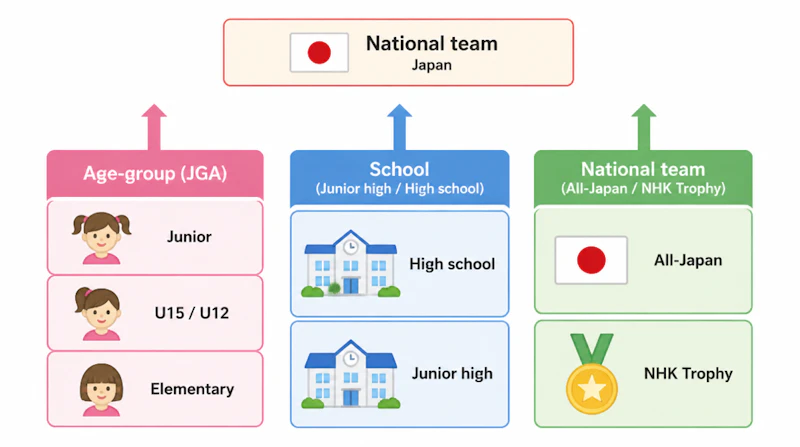
Three tracks: age-group, school, and national-team events
Japan's national women's gymnastics competitions are easiest to understand as three separate tracks. The first is the age-group track run by the Japan Gymnastics Association, where events are divided by age or school grade. The National Elementary School Gymnastics Championships, the National Block Selection U12 and U15 Championships, and the All-Japan Junior Championships all belong here, and most of the athletes come from private gymnastics clubs.
The second is the school track, where gymnasts compete for their school team. For junior high school students the top event is the National Junior High School Gymnastics Championships (known as "Zenchu"), run with the Nippon Junior High School Physical Culture Association. For high school students it is the Inter-High School Championships ("Inter-High"), run with the All Japan High School Athletic Federation. In both cases athletes qualify step by step from prefectural meets upward.
The third is the national-team track: the All-Japan Individual All-Around Championships, the NHK Trophy and the All-Japan Team and Apparatus Championships. Results from the age-group and school events feed directly into qualification for these meets.
Main national women's gymnastics competitions by age group
The table below lists the main national meets for women that appear on the JGA's artistic gymnastics competition page for the 2026 season (dates and venues are those of the 2026 editions).
Competition | Main target group | 2026 dates and venue |
|---|---|---|
National Elementary School Gymnastics Championships | Grades 1-6 (prefectural teams) | Late March, Kasamatsu Sports Park Gymnasium (Ibaraki) |
National Block Selection U12 / U15 | U12 = grade 6 and below / U15 = junior high grades 1-3 | Nov 7-8, Yokkaichi City General Gymnasium (Mie) |
All-Japan Junior Championships and East-West Finals | Elementary to high school (split by division and class) | Aug 13-17, Nikkan Arena Tochigi |
National Junior High School Championships (Zenchu) | Junior high school students (school teams) | Aug 20-22, FP Corporation Arena Fukuyama (Hiroshima) |
Inter-High School Championships | High school students (school teams) | Jul 31-Aug 2, Green Arena Kobe |
National High School Selection Championships | High school students | Mar 25, White Ring (Nagano) |
National Sports Games (artistic gymnastics) | Prefectural teams | Sep 3-6, Aomori Prefectural Budokan |
All-Japan Individual All-Around Championships / NHK Trophy | Top gymnasts from junior high age up | Spring (All-Japan first, then NHK Trophy) |
All-Japan Team and Apparatus Championships | Grade 6 and above (selected via rankings and video review) | Dec 1-6, Yokkaichi City General Gymnasium (Mie) |
The first requirement: JGA athlete registration
Almost every national directive lists the same basic eligibility condition: the gymnast must be registered as an athlete with the Japan Gymnastics Association for the current season. Both the 2026 directive for the National Block Selection U12/U15 and the directive for the All-Japan Team and Apparatus Championships require 2026 registration. Registration is normally handled through the gymnast's club or school, so families entering a meet for the first time should check with their club first.
National Women's Gymnastics Competitions for Elementary School Children
National Elementary School Gymnastics Championships: competing for your prefecture
The flagship national meet for elementary school children is the National Elementary School Gymnastics Championships, organized by the JGA. According to the directive for the 25th edition, entrants must be JGA-registered children in grades 1 to 6 who are nominated by their prefectural gymnastics association. Each prefecture sends six girls and six boys (four for the team and two individuals). In other words, this is a meet you reach by being selected to represent your prefecture.
The women's events are vault, uneven bars (single bar), balance beam and floor, all performed as optional routines. "Single bar" means the bars event is done on one rail rather than the usual two. A meet-specific scoring code is used, and awards are not based on placings. Instead, a gymnast whose average score across the four events is 9.50 or higher receives a gold award, 9.00 to under 9.50 a silver award, and 8.50 to under 9.00 a bronze award.
- Who: grades 1-6, nominated by the prefectural gymnastics association
- Places: six girls per prefecture (four team members, two individuals)
- Events: vault, uneven bars (single bar), balance beam, floor
- Awards: gold, silver and bronze awards based on the four-event average
National Block Selection U12: qualifying through regional trials
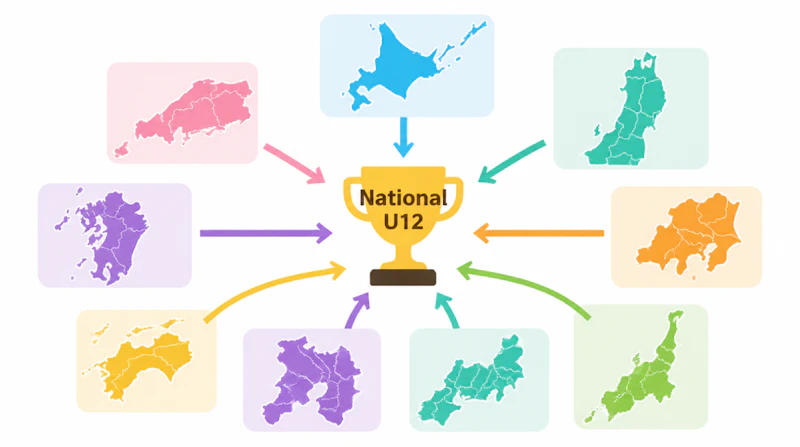
The other national meet for elementary-age gymnasts is the National Block Selection U12. In 2026 it ran as the "Table Mark Cup", with the U12 (21st edition) and the brand-new U15 (1st edition) held together. Under the 2026 directive, U12 is open to children in grade 6 or below as of April 2, 2026, and the field is capped at 60 girls nationwide.
Those 60 places are divided among Japan's nine regional "blocks" (Hokkaido, Tohoku, Kanto and so on), and the directive states that both U12 and U15 must hold qualifying trials at block level. Gymnasts compete in the four-event all-around under a dedicated women's rule set (2026 edition) based on FIG regulations. The top six all-arounders receive the title "Japan Elite Gymnast", and the top three are named U12 development athletes and invited to JGA training camps.
East-West Finals at the All-Japan Juniors: Classes A, B and C
The East-West Finals take place at the same venue and during the same week as the All-Japan Junior Championships. The 2026 All-Japan Junior result sheets show that the women's East-West Finals were split into Classes A, B and C, with competitors ranging from third grade of elementary school to third year of junior high. Class C was made up entirely of elementary school children in grades 3 to 6, which makes this one of the most accessible national stages for younger gymnasts. Class boundaries and entry requirements are set in each year's directive, so check the latest version through your club.
Junior High Women's Gymnastics Competitions: Zenchu and U15
National Junior High School Gymnastics Championships (Zenchu)
For gymnasts who compete for their junior high school team, the top event is the National Junior High School Gymnastics Championships, or "Zenchu". According to the official Zenchu gymnastics website, the 57th edition was held on August 20-22, 2026 at FP Corporation Arena Fukuyama in Hiroshima Prefecture, organized by the Nippon Junior High School Physical Culture Association, the JGA and local education boards. Gymnastics is one of the sports in the summer national junior high school games run by the Nippon Junior High School Physical Culture Association.
The road to Zenchu: prefecture, region, nation
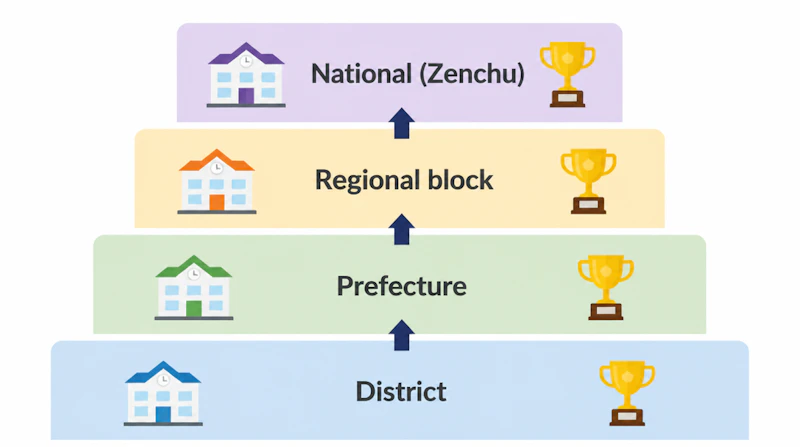
Gymnasts reach Zenchu by advancing through prefectural and then regional (block) competitions. Take the 2026 directive for the Kyoto Prefecture junior high school championships as an example. Only teams and individuals who earned a place at their district meet can enter the prefectural meet. From there, the winning and runner-up teams (for both girls and boys) plus the top four individual all-arounders not on those teams advance to the Kinki regional championships.
- City or district meet (the name varies by area)
- Prefectural meet (in Kyoto, the prefectural junior high school championships)
- Regional block meet (in Kyoto's case, the Kinki championships)
- National Junior High School Gymnastics Championships (Zenchu)
The number of places at each step differs by prefecture and region. Directives also explain special cases, such as schools without a gymnastics club being allowed to enter individuals only, so the school team's coach is the best person to confirm the details.
U15 and the road to the junior national squad
For club gymnasts of junior high age, the big goals are the National Block Selection U15 and the All-Japan Juniors. U15 was launched in 2026 for students in their first to third year of junior high as of April 2, 2026. Alongside regional qualifying places, the 60 women's places include a "junior high federation quota" of one gymnast from each of the nine regional junior high championships, plus five JGA nomination places. That gives school-team gymnasts a route into the event as well.
Above that sits the JGA's women's junior national squad. Under the 2026 selection procedure, about 15 gymnasts born between January 1, 2011 and April 1, 2014 are selected in a set order, drawing on NHK Trophy placings, All-Japan Junior Division 1 placings and a tryout.
High School Women's Gymnastics Competitions: Inter-High and the Selection Meet
The Inter-High School Championships
The pinnacle for high school teams is the Inter-High. According to the JGA's 2026 Inter-High gymnastics event page, the 2026 competition was held from July 31 to August 2 at Green Arena Kobe. General information about the Inter-High is published by the All Japan High School Athletic Federation.
From prefectural qualifier to nationals: the Kumamoto example
Gymnasts qualify for the Inter-High through their prefectural high school championships. In the 2026 Kumamoto Prefecture high school gymnastics directive, the prefectural meet doubles as the qualifier for both the Kyushu regional championships and the Inter-High. The women's places were as follows.
Next-level meet | Women's teams | Women's individuals |
|---|---|---|
Inter-High (national) | 1 team | 2 gymnasts |
Kyushu regional championships | 1 team | 5 gymnasts |
The same directive also limits each athlete to three appearances in the same sport and one appearance per school year. Other prefectures allocate different numbers of places, and some route gymnasts through a district meet first, so always check the directive from your own prefecture's high school gymnastics committee.
The National High School Selection meet and the National Sports Games
High school gymnasts have other national meets besides the Inter-High. The 42nd National High School Gymnastics Selection Championships took place on March 25, 2026 at White Ring in Nagano City. Gymnasts can also represent their prefecture at the National Sports Games (artistic gymnastics), held on September 3-6, 2026 at the Aomori Prefectural Budokan.
All-Japan Junior Championships: Where Divisions 1 and 2 Fit
Division 1, Division 2 and the East-West Finals
For club gymnasts, the All-Japan Junior Championships are the biggest meet of the summer. Counting the school years of the women who competed in each division in 2026 gives the following picture.
Division (2026) | School years of competitors |
|---|---|
Championship Division 1 | Elementary grade 6 to high school year 3 |
Championship Division 2 | Junior high year 3 to high school year 3 |
East-West Finals (Classes A, B, C) | Elementary grade 3 to junior high year 3 |
Division 1 included gymnasts from sixth grade of elementary school right up to the final year of high school, which shows that the divisions are set by competitive level rather than by age alone. The entry requirements for each division are defined in each year's directive.
Division 1 doubles as a qualifier for higher meets
All-Japan Junior Division 1 matters because its results feed straight into higher-level selection. In JGA documents, Division 1 counts toward all of the following:
- the qualifying ranking for the All-Japan Individual All-Around Championships (alongside the All-Japan University and All-Japan Senior Championships)
- the women's team ranking for the All-Japan Team Championships
- the national apparatus ranking for the All-Japan Apparatus Championships
- selection for the women's junior national squad (places for first-year, second-year and third-year junior high age groups)
Raising the difficulty value (D-score) of a routine is one of the fastest ways to climb these rankings. To check the D-score of your own routine, you can use Gymnastics AI, a D-score calculator app. It follows the FIG 2025-2028 Code of Points and supports all four women's events in beta.
National-Team Women's Gymnastics Competitions: All-Japan and the NHK Trophy
All-Japan All-Around: junior high school age and up
The All-Japan Individual All-Around Championships are the centerpiece of national team selection. According to the JGA notice on qualifying places for the 81st women's championships, gymnasts must be at least in their first year of junior high in the 2027 school year, and the field is 72 gymnasts. That breaks down into the top 54 from a combined all-around ranking of All-Japan Junior Division 1, the All-Japan University Championships (Divisions 1 and 2) and the All-Japan Senior Championships, six nominations by the national team committee, and the top 12 from a tryout.
NHK Trophy: age 13 and up, top 24 from All-Japan
The NHK Trophy follows the All-Japan All-Around and decides national team places for events such as the World Championships. Under the directive for the 65th NHK Trophy, women had to be at least 13 years old (reaching that age by December 31, 2026), and the field was the top 24 from the 80th All-Japan Individual All-Around Championships.
All-Japan Team and Apparatus Championships
The All-Japan Team and Apparatus Championships at the end of the year were open in 2026 to women in grade 6 and above. The team event takes the top 15 teams from the women's team ranking plus one national selection team. The apparatus event takes the top 18 from the national apparatus ranking plus gymnasts selected by video review (six on the non-vault apparatus and 24 on vault), among others. A score of 12.500 on the apparatus is the benchmark for entering the video review. In the team final, three of six team members perform on each apparatus and their scores are added together. Our guide to how team scores are calculated in gymnastics explains this format in more detail.
International age rules: FIG seniors are 16
To compete internationally, gymnasts also have to meet the age rules of the International Gymnastics Federation (FIG). Article 5.2 of the FIG Technical Regulations 2026 sets the minimum age for women's artistic gymnastics "in the year of the competition" at 16 for seniors, with juniors aged 14 to 15. The World Championships and the Olympic Games are senior events, so eligibility begins in the year a gymnast turns 16. For more on how Japan's Olympic places are earned, see our article on LA 2028 Olympic gymnastics qualification.
How to Prepare Before Entering a Women's Gymnastics Competition
Five things to check in the competition directive
Even when a competition keeps the same name, its entry conditions and competition format can change from year to year. Once you know which meet you are entering, check these five points in the directive first.
- Eligibility: the reference date for age or school year (for example, as of April 2 or by December 31) and whether JGA registration is required
- Rules: whether the FIG Code of Points applies or a meet-specific rule set (the elementary championships, U12 and U15 each have their own)
- Equipment: whether the uneven bars are a single bar, and which springboards are allowed (such as 2-1-2 boards)
- Entry and fees: deadlines and entry fees (for example, 10,000 yen per gymnast for the elementary championships and 15,000 yen for U12/U15)
- Floor music: how it must be submitted, on what media and in what file format
Match your floor music to each meet's submission rules
Floor music submission rules vary widely between meets. The elementary championships directive, for example, requires "one piece of music per CD, playable on a standard player", while the JGA's All-Japan-level meets ask for the music to be submitted as data. We cover file formats and how to avoid problems on competition day in our guide to submitting floor music for competitions.
The best way to avoid a last-minute scramble is to settle the routine and the music well before the meet. If you want editing matched to your routine, or a fully original composition, Daito's competition floor music service produces music with the Code of Points in mind.
Know that the scoring standard differs from meet to meet
Meets that use their own scoring rules, such as the elementary championships and U12/U15, can judge the same routine differently from All-Japan-level meets that follow the FIG Code of Points. For the basics of fall and landing deductions, see how deductions work in women's gymnastics. For the rules of each apparatus, see our guide to the four women's events.
Summary
- Women's gymnastics competitions in Japan fall into three tracks: age-group events (JGA), school events (junior high and high school federations) and national-team events (All-Japan and NHK Trophy)
- Elementary school gymnasts can reach the national elementary championships (as prefectural representatives), the U12 block selection (via regional trials) and the All-Japan Junior East-West Finals
- Junior high gymnasts aim for Zenchu (prefecture, then region, then nationals) and U15; high school gymnasts aim for the Inter-High (via prefectural qualifiers) and the National High School Selection meet
- All-Japan Junior Division 1 results feed into the All-Japan All-Around, the All-Japan Team and Apparatus Championships and junior national squad selection
- Entry rules, scoring codes and music submission rules differ by meet and by year, so always read the latest directive
If you want your floor music ready for competition, from song choice to a submission-ready file, get in touch with Daito about custom competition floor music. Editing of existing music and fully original compositions are both available.