2026 Mediterranean Games Men's Gymnastics: A D-Score Analysis
A D-score analysis of the 2026 Mediterranean Games men's events: Georgiou's all-around win, Turkey's team gold, and the execution-decided parallel bars result.
Note: This article reflects information as of September 6, 2026.
The artistic gymnastics program of the 2026 Mediterranean Games wrapped up in Taranto, Italy, from August 30 to September 2. In the men's events, Turkey took team gold while Cyprus's Marios Georgiou won the individual all-around. As a former gymnast and the developer of a D-score app, I want to read these results through the lens of the FIG Code of Points rather than simply recap them. The story of these Games is a clean contrast: the deep benches of the powerhouse nations versus the overwhelming individual brilliance of a single ace from a small country.
Overview of the 2026 Mediterranean Games Gymnastics
What the Mediterranean Games Are
The Mediterranean Games are a multi-sport event held every four years for nations around the Mediterranean basin. First staged in 1951, the 2026 edition in Taranto marked the 20th Games. It is smaller than the Olympics or Worlds, but it gathers strong programs like Italy, Spain, Turkey, Egypt, and Greece alongside top athletes from smaller nations such as Cyprus and Morocco. That mix gives it a distinct value as a "regional near-major" and a useful barometer of European and Mediterranean form heading into the World Championships.
Schedule and Venue
The gymnastics competition ran August 30 to September 2 at the sports hall in Grottaglie, near Taranto. The men contested the team all-around, individual all-around, and six apparatus finals. Details are available via the official FIG website.
If you want to see how a men's routine's D-score is built, the Gymnastics AI D-score app is handy. It follows the FIG 2025–2028 Code of Points and carries a database of 790+ skills, so you can simulate the compositions discussed here as you read.
Medal Summary
The headline of these Games is that the all-around and team titles went to different nations, as the table shows.
Event | Gold | Silver | Bronze |
|---|---|---|---|
Team | Turkey (238.40) | Italy (237.00) | Spain (234.40) |
All-Around | M. Georgiou (CYP) | N. Mir (ESP) | O. Mohamed (EGY) |
Floor | Tantalidis (GRE) | Brunello (ITA) | Vannucchi (ITA) |
Pommel | Yockers (ESP) | Elshobki (EGY) | Arican (TUR) |
Rings | Kosak (TUR) | Vannucchi (ITA) | Mohamed (EGY) |
Vault | Hossaini (MAR) | Brugnami (ITA) | Avci (TUR) |
P-Bars | Dogan (TUR) | Georgiou (CYP) | Levantesi (ITA) |
High Bar | Georgiou (CYP) | Bellil (FRA) | Kyriakou (CYP) |
Results were confirmed via the official record and specialist media. For context, see my D-score analysis of the 2026 European Championships in Zagreb.
Men's All-Around: Reading Georgiou's Consistency in D-Score Terms
A 28-Year-Old Veteran Wins with 80.45
Marios Georgiou (Cyprus) won the all-around with 80.45, one point clear of Spain's Nicolau Mir (79.45), with Egypt's Omar Mohamed third (79.05). According to International Gymnast, Georgiou is 28 and embodies Cypriot gymnastics history: his country's first European medalist (2019 AA bronze), first European champion (2022 high bar), and 2024 European all-around champion. He has competed at three straight Olympics, placing sixth on high bar at Paris 2024.
Where the Margins Came From
The all-around rewards the absence of weaknesses over a single standout piece. Per The Gymternet's live blog, Georgiou avoided any major break across all six pieces, including a stuck pommel dismount (13.900). Mir posted strong marks on parallel bars (13.700) and high bar (14.150) but could not close the one-point gap, while Mohamed stuck a double-double on rings (13.950) yet gave points back on floor (12.100).
The Composition Behind His 14.20 on High Bar
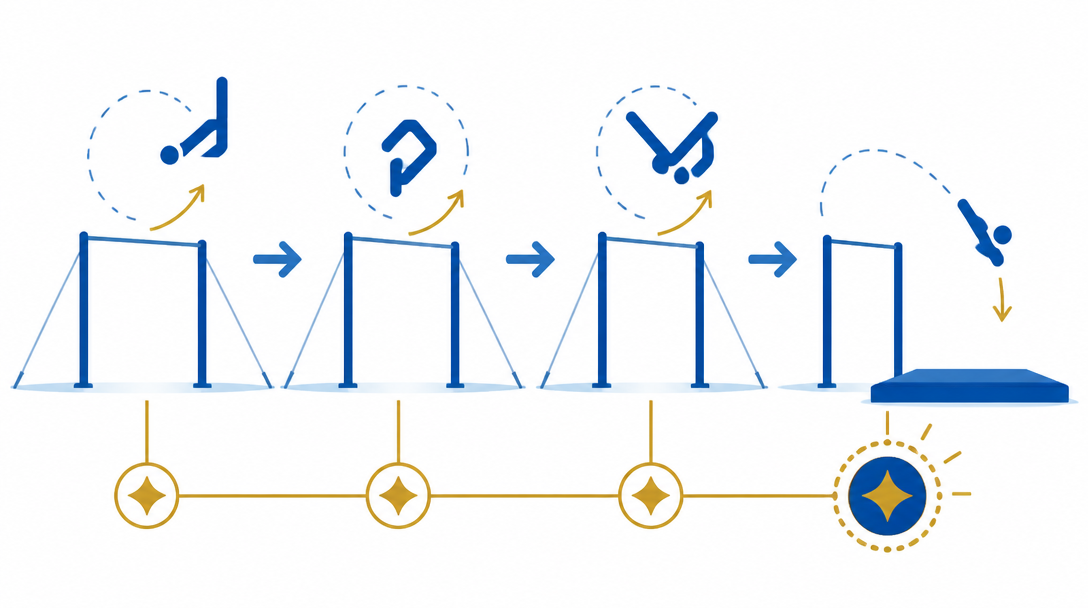
High bar is Georgiou's calling card; he won the apparatus final with 14.20. The Gymternet noted a routine stringing together a Tak full, a Tak half, and a big Cassina release, capped by a double-twisting double layout dismount that was mostly clean. Packing consecutive release skills into a routine is the classic way to lift a D-score. For the family tree of release moves, see my explainer on Endo, Adler, and Markelov on high bar.
The Parallel Bars Tie-Break: Why Execution Wins
A 14.000 Tie Goes to Dogan
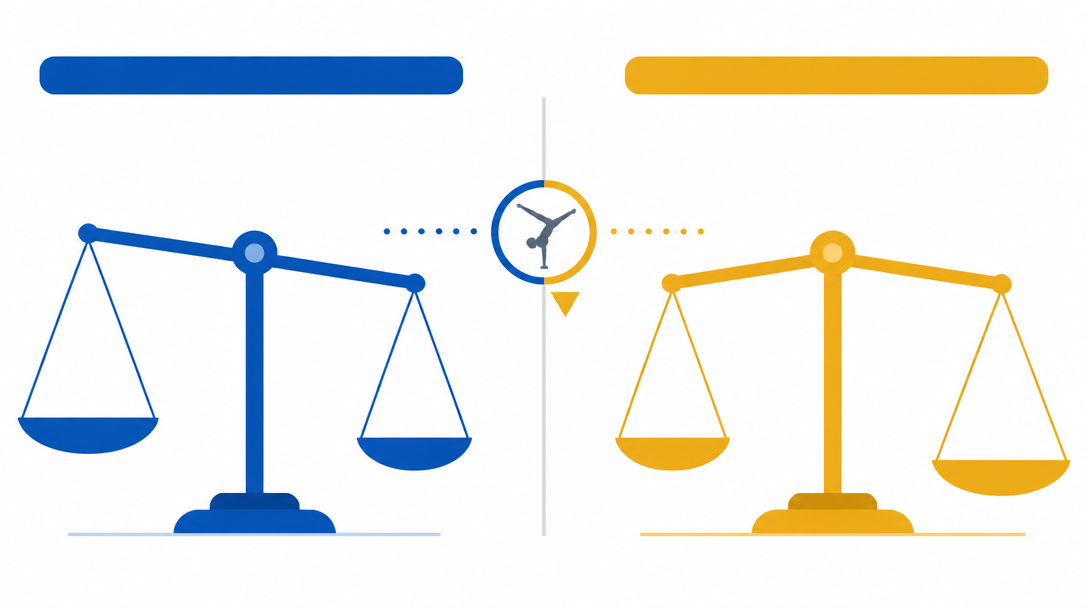
The most instructive moment came on parallel bars. Turkey's Altan Dogan and Georgiou both scored 14.000, sending the gold to a tie-break. According to Cyprus Mail and International Gymnast, Georgiou scored D 5.400 + E 8.600, while Dogan scored D 5.300 + E 8.700. Same total, but the higher execution score handed Dogan the gold and Georgiou the silver.
How the Tie-Break Rule Works
Under the FIG Code of Points, when totals are level in an apparatus final, the athlete with the higher execution (E) score ranks higher. In other words, polishing execution can beat piling on difficulty. For the division of labor between D and E, see my breakdown of the D-panel and E-panel judging system.
Athlete | D-score | E-score | Total | Result |
|---|---|---|---|---|
Dogan (TUR) | 5.300 | 8.700 | 14.000 | Gold |
Georgiou (CYP) | 5.400 | 8.600 | 14.000 | Silver |
Difficulty vs. Execution
This episode captures gymnastics' eternal trade-off. Georgiou led by 0.1 in difficulty but lost by 0.1 in execution.
- Difficulty-first: raise the ceiling with D-score, but accept more execution risk.
- Execution-first: hold D-score slightly lower and secure the total through clean E.
- The tie-break rule: level totals go to the higher E-score. Precision has the last word.
To test how your own composition moves the D-score and total, try Gymnastics AI. Selecting and ordering skills auto-calculates difficulty, group requirements, connection bonus, and dismount value. See also my parallel bars D-score analysis of Kovtun.
Team and Apparatus: The Balance of Power
Turkey's Team Gold (238.40)
Turkey won the team title with 238.40, powered by Ferhat Arican, Alperen Ege Avci, Altan Dogan, and Mehmet Ayberk Kosak, with scoring spread across pommel, rings, parallel bars, and vault. Italy (237.00) and Spain (234.40) followed, while Cyprus, despite the all-around champion, finished sixth (230.45) on account of a thinner roster. Individual and team strength are clearly different beasts.
Apparatus Gold Medalists
Yockers of Spain on pommel (14.250) and Kosak of Turkey on rings (14.250) posted the top marks of the men's apparatus finals.
Apparatus | Champion | Score |
|---|---|---|
Floor | Tantalidis (GRE) | 13.700 |
Pommel | Yockers (ESP) | 14.250 |
Rings | Kosak (TUR) | 14.250 |
Vault | Hossaini (MAR) | — |
P-Bars | Dogan (TUR) | 14.000 |
High Bar | Georgiou (CYP) | 14.200 |
Small-Nation Aces vs. Deep Powerhouses
These Games neatly showed that a small program can win individual and apparatus titles through one exceptional athlete, while the team title goes to nations whose six athletes can all generate D-score. The same dynamic drives Worlds and the Olympics: under the current team format, roster depth is the ultimate weapon.
Looking Ahead to the Rotterdam 2026 Worlds
Momentum for Europe and the Mediterranean
The next big test is the 2026 World Championships in Rotterdam (Ahoy Arena), October 17–25. Sitting six weeks earlier, the Mediterranean Games served as a live tune-up for Italy, Spain, and Turkey, and Turkey's team gold suggests genuine podium potential on the world stage.
What It Signals for Japan
Japan did not compete here, but the form of rivals still matters. With more nations posting stable 14s on pommel and rings, the team scoring battle will only get tighter. For Japan's projected lineup, see my D-score outlook for Japan's men's team at the 2026 Worlds.
The D-Score Trend
As the parallel bars tie-break showed, when elite D-scores converge, execution decides everything. Expect the "win on execution" trend to intensify in Rotterdam. Whether you are an athlete, coach, or judge, it pays to verify the D/E balance in numbers.
Conclusion
Here are the key takeaways from a D-score reading of the 2026 Mediterranean Games men's events:
- Georgiou (CYP) won the all-around with 80.45, anchored by his high bar (14.20) and clean work across all six pieces.
- Turkey won team gold (238.40), showing the power of a deep roster that spreads scoring.
- Parallel bars went to a 14.000 tie-break, with Dogan (TUR) taking gold on the higher E-score — the FIG rule that level totals favor execution decided it.
- At the top level, execution decides the difficulty-vs-execution debate, a trend likely to continue in Rotterdam.
To simulate your routine's D-score, try Gymnastics AI — free on iOS/Android and built on the FIG 2025–2028 Code of Points.