How to Improve Focus in Sport: Entering the Zone (Flow State)
How to improve focus in sport: conditions for entering the zone (flow state), why concentration breaks down, and skills like routines and cue words.

In sports like artistic gymnastics, where a single routine can decide the result, the ability to concentrate under pressure often separates winners from the rest. Some athletes freeze, while others slip into "the zone" a
nd move better than they thought possible. This article explains how to improve focus based on sport psychology, the conditions for entering the zone (flow state), and practical techniques you can train every day.
What Focus Really Is: Concentration, the Zone, and Flow
To improve concentration, you first need to understand what it actually is. Although "focus" is often used loosely, sport psychology defines it fairly precisely.
Concentration Is Selective Attention
Concentration is "the ability to focus attention on the task at hand and not be affected or disturbed by internal or external distractions" (Virginia Tech Athletics sport psychology). The key point is that concentration is not about "trying harder," but about selective attention: choosing which few pieces of information matter right now. Because we can only hold so much in mind at once, deciding what to ignore is itself the act of concentrating.
The Zone and Flow (Csikszentmihalyi's Flow Theory)
The state of total absorption, where action and awareness merge, is called the zone or flow. In the flow theory proposed by psychologist Mihaly Csikszentmihalyi, flow is described as an optimal experience of complete absorption that occurs "when one's skills
are adequate to cope with the challenges at hand" (Positive Psychology on flow). During flow, self-consciousness fades, time perception distorts, and the activity becomes rewarding in itself.
Elite programs also treat this ideal mental state as something athletes can learn to create for themselves, rather than wait for by luck (Japan High Performance Sport Center (HPSC)).
One-Shot Focus in Gymnastics
Gymnastics has many events, such as beam and high bar, where a small error leads to big deductions or a fall, with no chance to redo the routine. That is exactly why the ability to pour attention into "this one attempt" matters. We cover coping with nerves in our article on mental training for athletes; here we focus on the next step: raising concentration and entering the zone.
Why Focus Breaks Down: Internal and External Distractions
Before improving focus, it helps to know why it slips. Distractions fall into two broad groups: external and inte
rnal.
- External distractions: officiating calls, opponents and crowd, weather, venue and apparatus conditions
- Internal distractions: negative self-talk, dwelling on past mistakes, outcome anxiety, overthinking
External Distractions (Environment, Crowd, Conditions)
External distractions include officiating calls, opponents, weather, venue conditions, and hostile crowds (Virginia Tech Athletics). Most of these are outside your control, and the tricky part is that the harder you try to ignore them, the more your attention drifts toward them.
Internal Distractions (Negative Self-Talk, Past Mistakes, Overthinking)
Internal distractions include negative self-talk, dwelling on past mistakes, anxiety about the outcome, and overanalyzing mechanics. Carrying "the skill I just missed" into the next moment steals attention from the routine in front of you. When this rumination becomes chronic it can lead to burnout, so it is worth reviewing our article on mental health and burnout prevention.
How Overthinking Freezes Movement
The more skilled the athlete, the more that consciously monitoring movement makes it stiff. Focusing on your own body (an internal focus) interferes with motor control that is normally automatic. This is the constrained action hypothesis: an external focus on the movement effect or an outside target produces more automatic, fluent movement than an internal focus (meta-analysis on attentional focus (PMC)). The loss of air awareness known as the "twisties" is also thought to be worsened by over-conscious control (see our article on the twisties in gymnastics).
Optimal Focus Is Neither Too Tense Nor Too Relaxed
Have you ever been told to "focus harder," tensed up, and performed worse? The relationship between focus and performance is not a simple straight line up.
The Yerkes-Dodson Law (Inverted-U)
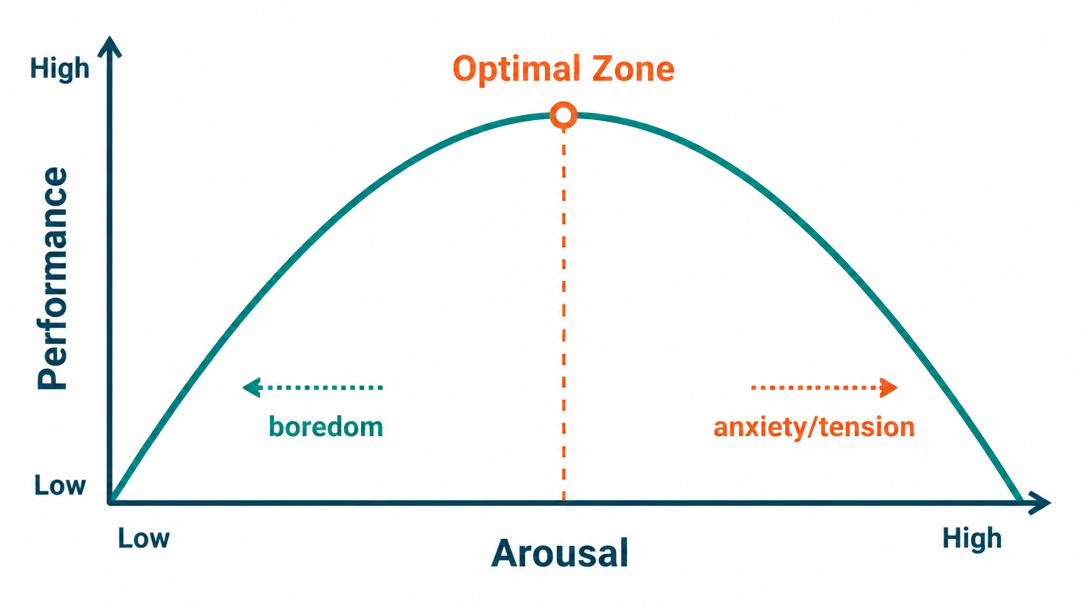
The relationship between arousal and performance follows an inverted-U. Rooted in a 1908 study by Yerkes and Dodson, the idea is that performance rises with arousal up to an optimal point, then falls sharply beyond it (Simply Psychology on the Yerkes-Dodson law). Moderate arousal, neither too low nor too high, tends to produce the best results.
Harder Tasks Have a Lower Optimal Arousal
Crucially, the optimal arousal level shifts with task difficulty. Simple, well-practiced actions can be performed at higher arousal, but the harder and more novel the skill, the lower the optimal arousal. In other words, for high-difficulty routines, "staying calm and organized" often beats "getting fired up."
Know Your Own Sweet Spot
Optimal arousal varies widely by person, event, and confidence. If you are over-aroused, cool down with breathing; if you feel flat, raise your heart rate with psyching-up. This kind of self-monitoring is the foundation. The table below is a rough guide.
State | Signs | Main response |
|---|---|---|
Over-aroused | Tension, rushing, mind going blank | Deep breathing, muscle relaxation, fix your gaze |
Optimal zone | Moderate tension, calm, confident | Maintain the state with a routine |
Under-aroused | Flat, sluggish | Psyching-up, vocal cues, dynamic warm-up |
Conditions for Entering the Zone (Flow): Three Prerequisites
According to flow theory, the zone is not random; it becomes more likely when certain conditions align. Three of the main prerequisites Csikszentmihalyi describes are below.
Clear Goals
To enter flow, it must be clear what to do right now (Positive Psychology). Goals should be proximal, specific, and within reach. Instead of "do a good routine," narrowing it to a movement cue like "chest up on the first salto" sharpens attention. See our article on goal setting with SMART and backward planning.
Immediate Feedback
Second, you need on-the-spot cues about whether you are performing well. In gymnastics, the stability of a landing or the feel of the apparatus provides immediate feedback. Getting into the habit of naming "that felt good/bad" after each practice attempt sharpens your feedback sensitivity for competition.
Balance Between Challenge and Skill
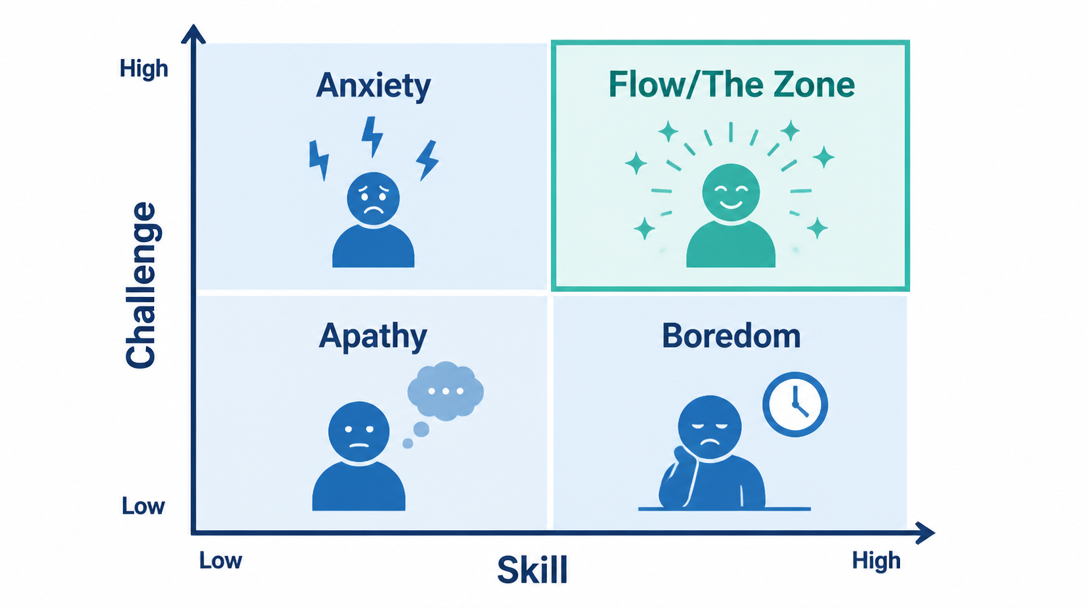
Most important is the balance between the challenge and your ability. If the challenge far exceeds your skill you feel anxiety; if it is too easy you feel boredom. When both are high and matched, you enter the flow channel.
Challenge \ Skill | Low skill | High skill |
|---|---|---|
High challenge | Anxiety / panic | Flow (the zone) |
Low challenge | Apathy | Boredom / relaxation |
So if you want to enter the zone, set tasks that are "just a bit hard" relative to your current ability. Neither impossible nor trivial goals produce flow.
Practical Techniques to Improve Focus
Understanding the conditions is useless if you cannot reproduce them in competition. Here are practical, evidence-based techniques.
Pre-Performance Routines (Backed by Meta-Analysis)
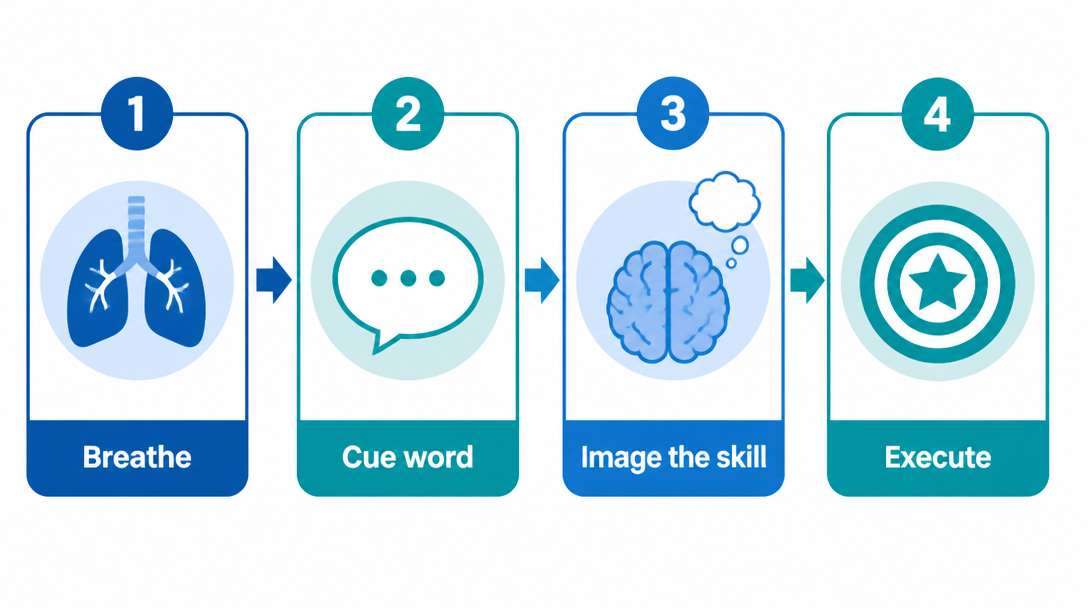
A pre-performance routine, a fixed set of thoughts and actions before executing a skill, is a classic way to raise focus. A 2021 meta-analysis by a University of Vienna team, covering 15 sports and about 800 athletes, found that athletes who used routines performed significantly better, with benefits confirmed under pressure (University of Vienna press release). Like Michael Jordan's free-throw ritual, a consistent sequence strengthens concentration and helps you drop into an optimal mental state. A basic routine can be built like this:
- Settle your breathing (long exhale with diaphragmatic breathing)
- Say your cue word ("axis," "chest up")
- Image a successful execution
- Enter every routine from the same preparatory actions
Cue Words and Shifting Attention
Cue words pair well with routines. Short words like "chest up" or "axis" limit focus to one or two elements and shut out extra thoughts (Virginia Tech Athletics). HPSC also lists fixing your gaze on a focal point and using cue words as attention-switching techniques (HPSC).
Breathing and Muscle Relaxation to Regulate State
When over-aroused, exhale slowly with diaphragmatic breathing and use progressive muscle relaxation. When flat, raise your heart rate with psyching-up to reach the optimal zone. These body-based methods act quickly on tension. For the foundation of physical and mental condition, our article on sleep and recovery for athletes is also useful.
Use an External Focus to Automate Movement
As noted, skilled performers move better with an external focus on the effect of the movement or an outside target than with an internal focus on their own body (meta-analysis on attentional focus). Instead of "straighten the knee," think "push the floor" or "reach the bar," placing attention on the external target to avoid stiffness from overthinking.
Using the Four Types of Attention (Nideffer's Model)
Focus is about direction as well as intensity. Psychologist Robert Nideffer organized attention along two axes.
Broad/Narrow x Internal/External
Attention can be split into four types by width (broad vs. narrow) and direction (internal vs. external) (Virginia Tech Athletics). Choosing the right type for the situation is what it means to truly command your focus.
Type | Function | Gymnastics example |
|---|---|---|
Broad-external | Read the whole environment | Check the venue and apparatus |
Broad-internal | Analyze and plan | Organize the routine order |
Narrow-internal | Rehearse a specific move | Mental imagery of a skill |
Narrow-external | Lock onto one point and react | The instant of takeoff or landing |
Switch by Event and Moment
Before starting, use broad-external to scan the environment, broad-internal to confirm the routine, narrow-internal to image the skill, and switch to narrow-external at the moment of execution. Moving between attention types like this lets you pick up only the information you need. A delayed switch lets broad-internal thinking creep in mid-skill, causing errors.
Training Focus in Daily Practice
Concentration is not something you can only produce on competition day; it is a skill you build every day.
Focus Is a Skill, Not a Talent
Routines and cue words only work in competition after being trained repeatedly. The meta-analytic benefit of routines assumes athletes have practiced them beforehand (University of Vienna). Treat every practice attempt as focus training, and always enter from the same preparatory actions.
Sleep and Daily Rhythm Are the Foundation
No matter how many techniques you learn, sleep deprivation and an irregular schedule lower attention itself. A well-organized condition supports concentration. Student-athletes juggling sport and study may find our article on time management for student-athletes helpful.
Goal Setting and Self-Monitoring
The flow prerequisites of "clear goals" and "immediate feedback" are trained through daily goal setting and self-monitoring. Set a small goal for each session and review it at the end. This accumulation builds the base that makes entering the zone in competition more likely.
Summary
Improving focus can be organized as a repeatable skill rather than sheer willpower. The key points:
- Concentration is selective attention, choosing only the information you need; its extreme form is the zone (flow).
- Focus is disrupted by external and internal distractions; overthinking in particular freezes a skilled athlete's movement.
- Optimal arousal follows an inverted-U; the harder the skill, the more calm beats hype.
- The zone requires clear goals, immediate feedback, and a balance between challenge and skill.
- Routines, cue words, breathing, and an external focus are evidence-based; train them in practice and use them in competition.
Focus is not a gift but a skill anyone can build with the right knowledge and repetition. Start by learning your own optimal zone and entering every routine from the same preparation.