Music Theory Basics: Scales, Keys & Diatonic Chords Explained
A clear, beginner-friendly guide to music theory basics: how whole and half steps build major and minor scales, how to find the key, and how diatonic chords and Roman numerals work. The foundation behind melody, chords and arranging.

Understanding music theory basics lets you build melodies and chord progressions on purpose instead of by accident. This guide walks beginners in songwriting and DTM through the whole picture, from the smallest units of whole and half steps up to scales, keys, and diatonic chords, using concrete examples like C major and A minor. Rather than memorizing terms, you will follow the cause and effect that connects each idea.
What Music Theory Basics Really Are

Music theory is not a set of rules invented to restrict you. It is a shared language created after the fact to analyze and communicate music that already exists. It helps you turn ideas into finished tracks faster and talk to other musicians and producers.
Theory Is a Map for Arranging Notes
With theory, you gain a map of which notes naturally connect on a keyboard or DAW piano roll. That map cuts down on random trial and error and makes it easier to reproduce a target mood, whether bright, wistful, or tense. Finished tracks can be released to streaming platforms like Daito's distributed music, but a solid theory foundation first makes your results more repeatable.
Where Self-Learners Get Stuck
Beginners tend to stall on three things: counting whole and half steps, telling scales apart from keys, and connecting diatonic chords with Roman numerals. This article resolves all three in order. Applications are covered in our guides on writing melodies and chord progressions, but first we build the shared foundation.
How This Guide Progresses
We move along a single path: whole and half steps, then scales, then keys, then diatonic chords, then application. Each section is the prerequisite for the next, so reading in order builds understanding step by step.
The Foundation: Whole Steps, Half Steps and the 12 Notes
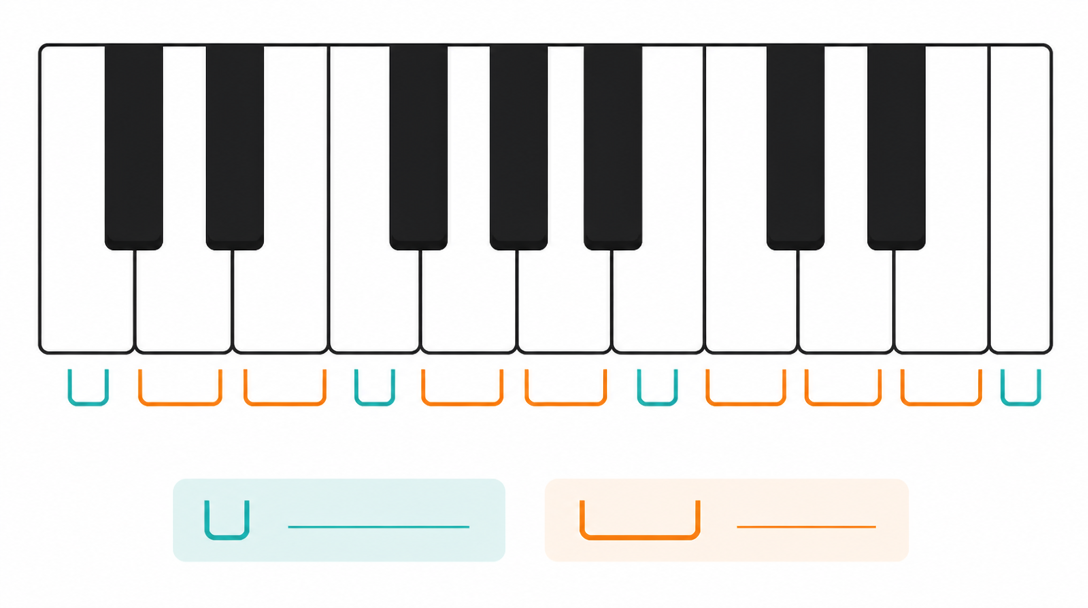
The smallest units in music theory are the half step and the whole step. Being able to count them accurately is the dividing line for understanding scales.
Half Steps, Whole Steps and the Octave
Western music divides one octave into 12 half steps. On a piano, moving to the nearest key (white or black) is a half step, and two half steps make a whole step. E to F and B to C are half steps because there is no key between them, while C to D is a whole step. As explained in guides to half steps and whole steps, this arrangement of whole and half steps is exactly what gives each scale its character.
Natural Notes and Accidentals
The seven notes C D E F G A B are the natural notes, while notes formed with a sharp (raise a half step) or flat (lower a half step) are accidentals. When one pitch has two names, such as C sharp and D flat, we call them enharmonic equivalents. Which spelling to use depends on the key, as we will see.
Why 12 Notes
Picture seven white keys and five black keys, twelve notes in total, repeating up the keyboard. Holding that image makes the scale discussions far clearer, and since a DAW piano roll repeats the same twelve notes, your keyboard intuition transfers directly to programming.
How the Major Scale Works (W-W-H-W-W-W-H)
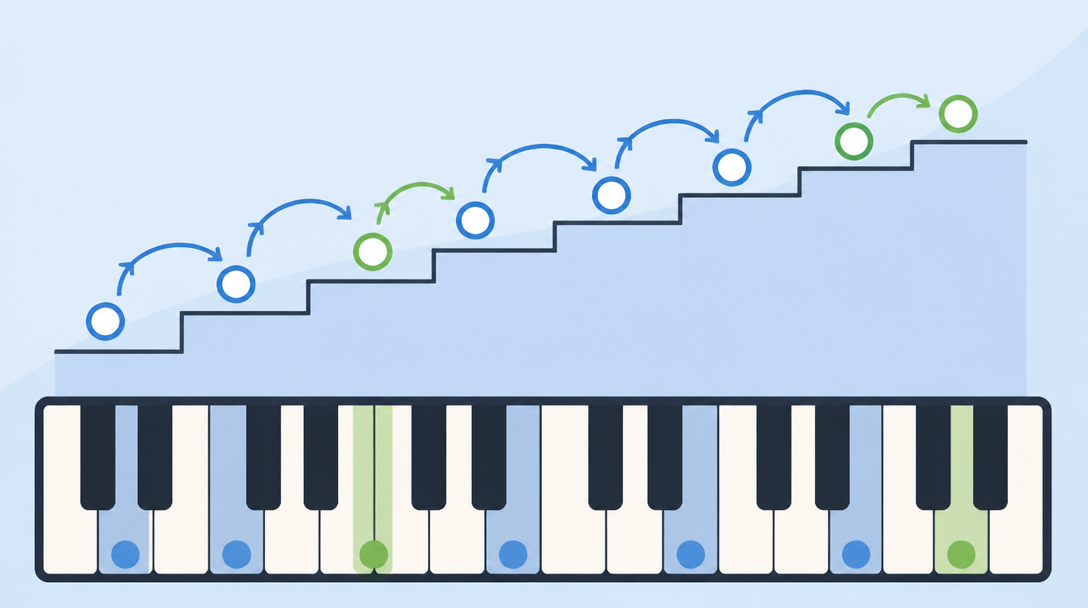
The major scale is the most fundamental scale, with a bright, stable sound. Its identity is simply a fixed order of whole and half steps.
The Major Scale Pattern
A major scale is built from the root using the order W-W-H-W-W-W-H. As shown by the University of Puget Sound theory materials and this major scale explainer, the WWHWWWH pattern is common to every major key. Start on any note and keep those intervals, and you always get a major scale.
C Major as an Example
Building from C gives C, D, E, F, G, A, B, and back to C, which is the C major scale. The only half steps are E to F and B to C, exactly where there are no black keys. That is why C major can be played on the white keys alone.
Common Keys and Their Major Scales
Start on a different note and you get another major scale with the same intervals, but you need sharps or flats to keep the WWHWWWH shape.
Key | Notes | Sharps / Flats |
|---|---|---|
C major | C D E F G A B | none |
G major | G A B C D E F# | 1 sharp (F#) |
D major | D E F# G A B C# | 2 sharps (F#, C#) |
F major | F G A Bb C D E | 1 flat (Bb) |
As you transpose the scale, the required sharps and flats increase in a regular pattern, which the circle of fifths lets you see at a glance.
The Three Types of Minor Scale
The minor scale has a darker, more wistful sound and comes in three types: natural, harmonic, and melodic. Guides such as this overview of minor scales and Music Theory Academy present these three as the basics.
Natural Minor (W-H-W-W-H-W-W)
The base form is the natural minor, ordered W-H-W-W-H-W-W. Built from A it gives A, B, C, D, E, F, G, and back to A, the A natural minor scale. The half steps are B to C and E to F, so it too can be played on the white keys.
Harmonic and Melodic Minor
Raise the seventh note of natural minor by a half step and you get the harmonic minor. In A harmonic minor, G becomes G#, giving A B C D E F G#. The gap between the sixth and seventh notes widens to an augmented second (three half steps), producing a distinctive, exotic sound. Raise both the sixth and seventh going up and revert to natural minor coming down, and you have the melodic minor, whose ascending form is W-H-W-W-W-W-H. The raised seventh creates a leading tone that strengthens resolution.
Relative Keys (C Major and A Minor)
A key idea here is the relative key. A major and a minor key that share the same key signature are relatives, and A natural minor is simply the C major scale started from its sixth note (A). The notes are identical; only which note feels like the center changes the mood from bright to dark. When two keys share the same tonic but swap major for minor (C major and C minor), we call them parallel keys, which are different from relative keys.
Keys and Reading Key Signatures
If a scale is an arrangement of notes, a key is the framework describing which scale a piece centers on. Knowing the key instantly narrows down the usable chords and notes.
What a Key Is
A key is the tonal framework built from a central note (the tonic) and its scale. In the key of C major, a piece mainly draws on the seven notes of C major and sounds stable when it returns to C. A scale is the note order itself; a key is the blueprint for the whole piece built on it.
Key Signatures and the Circle of Fifths
The key signature shows how many sharps or flats a key uses, and the circle of fifths arranges those signatures in a ring. Moving clockwise by a fifth adds one sharp; moving counterclockwise adds one flat. The outer ring holds the major keys and the inner ring their relative minors, so you can read signatures, spot relative keys, and plan modulations from one diagram.
Tips for Finding a Song's Key
To identify the key of an existing song, this practical sequence helps:
- Count the sharps and flats to narrow the major/minor pair that shares that signature.
- Check the note the melody and bass finally rest on; major pieces settle on the tonic, minor pieces on the relative minor's tonic.
- Confirm the central chord; if it ends on C, C major is likely.
Once you can do this, you can choose notes that will not clash when improvising or programming.
Diatonic Chords and Roman Numerals
Diatonic chords are the most important concept for building progressions. Once the key is set, the seven chords that fit naturally are determined automatically.
Building Diatonic Chords by Stacking Thirds
Diatonic chords are the seven chords made by stacking notes in thirds (every other scale note) on each degree of the scale, using only notes from that scale. As StudyBass explains, building a chord on each of the seven scale notes yields seven diatonic chords. Because no notes outside the scale are used, the chords stay unified within the key.
The Seven Diatonic Chords in C Major
Stacking thirds on the C major scale gives these seven triads.
Degree | Chord | Notes | Quality |
|---|---|---|---|
I | C | C E G | major |
ii | Dm | D F A | minor |
iii | Em | E G B | minor |
IV | F | F A C | major |
V | G | G B D | major |
vi | Am | A C E | minor |
vii° | Bdim | B D F | diminished |
Every major key follows the same pattern: three major chords (I, IV, V), three minor chords (ii, iii, vi), and one diminished chord (vii°).
Roman Numerals and the Power of Transposition
Writing each chord as a Roman numeral gives its degree name. As covered in guides to degree names and in Roman numeral analysis, uppercase means major, lowercase means minor, and a small circle means diminished. The biggest advantage is transposition: a progression like I-V-vi-IV becomes C-G-Am-F in C major or G-D-Em-C in G major, just by keeping the same degrees. Memorize a progression by degree and you can transpose to a singer's key in an instant.
Putting Theory to Work in Production
Everything above (scales, keys, diatonic chords) applies throughout real production. Theory sticks only once you use your hands.
Melodies and Chord Progressions
Once you know the key and its diatonic chords, writing a progression becomes a matter of choosing from seven options. See our chord progression basics to try common progressions, and how to write melodies to place a tune over them.
Bass Lines and Arranging
Bass sounds stable when it moves around chord roots. Thinking in degrees makes it easy to design bass lines that track the progression (how to write bass lines). Arranging multiple parts into one track is also less likely to fall apart within the key and diatonic framework (arranging basics). Harmonies come together naturally when you choose thirds and sixths within the scale (vocal harmony basics).
Confirm Theory by Ear
The fastest way to learn scales and chords is to play them in a DAW and check with your ears. Play through the diatonic chords once, switch to the relative key and hear the difference, and small experiments like these turn theory from knowledge into instinct. Finished tracks can go all the way to release, like these distributed songs.
Summary
Hold the music theory basics in this order and the whole picture connects.
- Whole and half steps: one octave is 12 half steps; two half steps make a whole step. The foundation.
- Major scale: W-W-H-W-W-W-H. C major uses only white keys.
- Minor scale: natural is W-H-W-W-H-W-W; raise the seventh (and sixth) for harmonic and melodic.
- Keys and signatures: the central key of a piece; the circle of fifths shows signatures and relative keys at a glance.
- Diatonic chords and Roman numerals: seven chords per key; degree names make transposition easy.
Grasping the chain from whole and half steps to scales, keys, and chords beats rote memorization. With the foundation set, move on to the melody, chord, and arranging guides to practice.