Japan National Sports Festival 2026: Osaka's 3rd Men's Team Title
Osaka took its third straight men's team title at Japan's 2026 National Sports Festival, with Teppei Miwa first all-around. A D-score view before Worlds.

*This article reflects information available as of September 15, 2026.
From September 3 to 6, 2026, the artistic gymnastics events of Japan's 80th National Sports Festival ("Ao no Kirameki Aomori Kokuspo") were held at the Aomori Prefectural Budokan in Hirosaki, Aomori Prefecture, as a pre-festival competition. In the senior men's team all-around, Osaka won on 330.157 points for its fifth title overall and third in a row, and in the individual all-around, The Gymternet's tally placed Osaka's Teppei Miwa at the top. With the 2026 World Championships in Rotterdam (October 17-25) roughly six weeks away, this article reads the Kokuspo 2026 results from the perspective of the D-score (difficulty value).
The National Sports Festival is one of Japan's largest multi-sport competitions, pitting prefectures against one another and bringing together everyone from national-team-level athletes to strong regional competitors. Unlike the flash of international results, it offers a sense of how the domestic base is being raised. In this article we cross-check the team results verified against official records with the individual results compiled by overseas gymnastics media to map out where Japan stands just before the World Championships.
Overview of the 2026 National Sports Festival men's gymnastics results
Held in Hirosaki as a pre-festival competition
This year's gymnastics competition was moved up to early September and staged as a "pre-festival" event ahead of the main Aomori Kokuspo held in autumn. The venue was the Aomori Prefectural Budokan in Hirosaki. The dates, venue and competition category can be confirmed on the Japan Gymnastics Association page for the 80th National Sports Festival (gymnastics) and the gymnastics page on the official Aomori Kokuspo site. Host Aomori Prefecture posted strong results in both the senior men's and women's events, and the Toonippo reported that its senior men finished as runners-up.
Osaka takes its fifth senior men's team title, third in a row
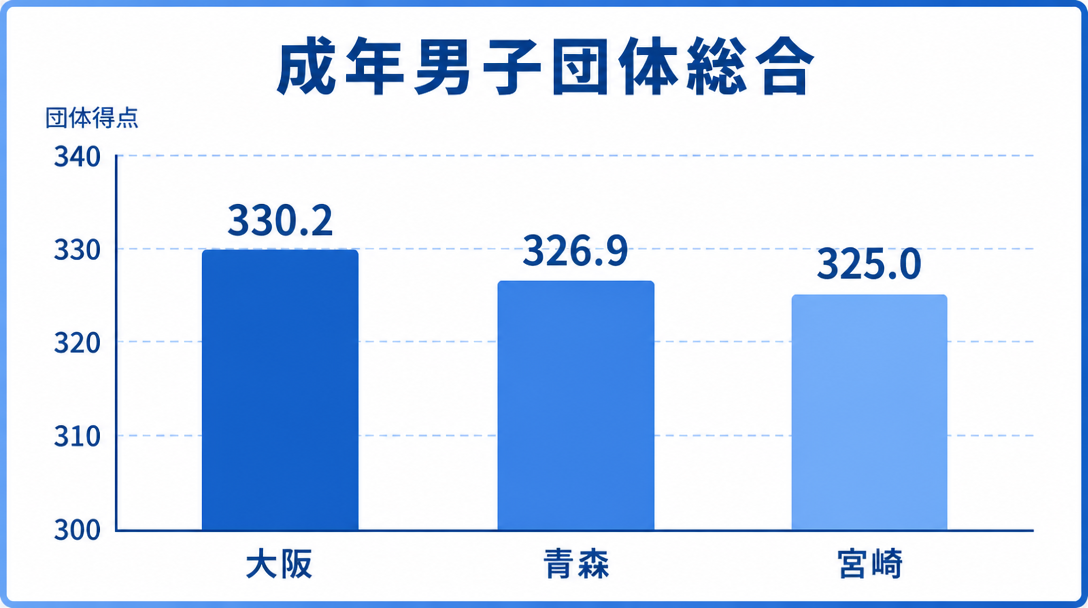
The senior men's team all-around final was held on September 5, and Osaka won with 330.157 points. According to the official competition records (results search system), this was Osaka's third consecutive and fifth overall team title. Host Aomori took second with 326.927 points, and Miyazaki was third with 325.026 points. The gap among the top prefectures was within a few points, so as a team competition it was a tightly contested affair.
If you want an easy way to check the composition and difficulty value of a gymnastics routine, Gymnastics AI - the D-score calculation app is handy. It complies with the FIG 2025-2028 Code of Points and is loaded with a database of more than 790 skills, so it helps you read competition scores like these through the lens of "what kind of skill composition could produce them."
Teppei Miwa tops the all-around (The Gymternet tally)
For the individual all-around standings, the senior men's tally compiled by the overseas gymnastics outlet The Gymternet put Osaka's Teppei Miwa on top with 82.797 points, followed by Shiga's Ono in second (82.665) and Osaka's Shohei Kawakami in third (82.499). Miwa, who competed in the all-around at the 2026 Asian Championships, again showed stable overall ability on home soil. Note that Kokuspo gymnastics centers on the team all-around, so the individual all-around order is an unofficial ranking built up from each athlete's scores in the team final.
Reading the senior men's team standings and scores
Comparing the scores of the top three prefectures
The scores of the top three prefectures in the senior men's team all-around were as follows.
Rank | Prefecture | Team score | Notes |
|---|---|---|---|
1st | Osaka | 330.157 | Fifth title, third in a row |
2nd | Aomori | 326.927 | Host, runner-up |
3rd | Miyazaki | 325.026 | - |
The gap between champion Osaka and third-placed Miyazaki was about 5.1 points. In a team gymnastics competition the final order is decided by an accumulation of fractions of a point per apparatus, so across six apparatus and multiple athletes this margin is by no means large. It was a result that highlighted Osaka's overall strength in consistently keeping deductions down.
What the "top four of five" format means
In Kokuspo team competition, each prefecture fields five athletes and counts the top four scores on each apparatus. This means there is a kind of "insurance" in that one athlete's mistake can be discarded, but at the same time it demands a certain level of execution from all five. According to the official records, champion Osaka's roster was made up of Kitazono, Miwa, Kawakami, Fukubayashi and Ebisu. It is a structure in which depth translates directly into team strength.
Athletes who stood out by apparatus
In The Gymternet's tally, Shiga's Ono posted 15.033 on vault, the highest single mark overall. Vault is a one-shot apparatus where the D-score (difficulty value) is clearly reflected in the result, and landing a high-difficulty vault can yield a high score around 15 points. All-around winner Miwa also scored 14.966 on vault, and the top athletes generally built up their scores on power-based apparatus. For more on the characteristics of each apparatus, our article on the six men's gymnastics apparatus and the physical abilities they require is a useful reference.
Breaking down the Kokuspo scores from a D-score perspective
How the D-score (difficulty) and E-score (execution) work
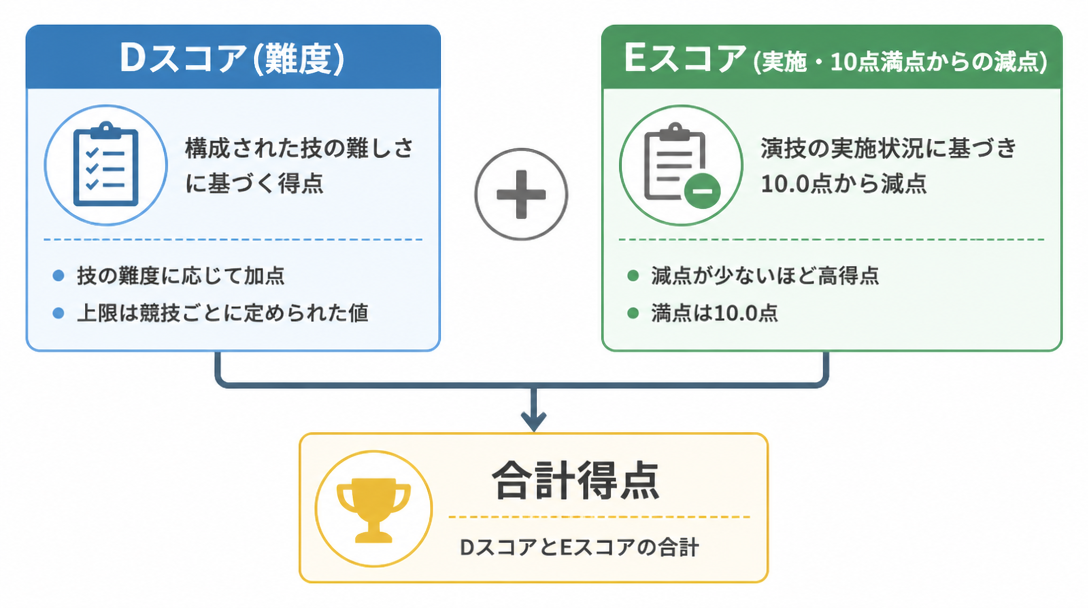
A gymnastics score is the sum of the D-score (Difficulty, the routine value that expresses how hard the routine is) and the E-score (Execution, which expresses how beautiful and precise the performance is). The D-score is calculated under the FIG Code of Points by adding up skill difficulty, element group requirements, connection bonuses, dismount bonuses and more, while the E-score is evaluated by deducting from 10.000 points. This basic structure is explained in detail in the basics of the Code of Points.
A score in the high 14-point range on a single apparatus, as seen at Kokuspo, is proof that a correspondingly high D-score was executed without major deductions. Conversely, even with the same difficulty, any disruption in execution lowers the E-score and reshuffles the overall order. A domestic top-tier all-around score in the 82-point range shows that an athlete executed consistently across all six apparatus.
The D-score gap between domestic and world leaders
At the level of contending for an individual all-around podium at the World Championships, an athlete must stack higher D-scores on each apparatus while also pairing them with high E-scores. The 82-point range at a well-rounded domestic event like Kokuspo is a solid figure, but the summit of the world demands even greater all-around ability. What makes the difference here is how far an athlete can push into high difficulty on apparatus such as vault, horizontal bar and parallel bars, and how far they can hold down execution deductions while maintaining that difficulty, which is the "balance of D and E." As with how to calculate the floor exercise D-score, the ceiling changes depending on how a routine is built on each apparatus.
Check your own routine's D-score
If you want to try out how the D-score changes with a real routine composition, we recommend Gymnastics AI. Just by selecting and arranging skills, it automatically calculates difficulty value, element group bonuses, connection bonuses, dismount bonuses and ND (neutral deductions). It helps you understand, through your own simulations, what kinds of compositions the top Kokuspo athletes used to produce high scores.
Japan's squad just before the 2026 Rotterdam World Championships
The schedule and the men's team final on October 20
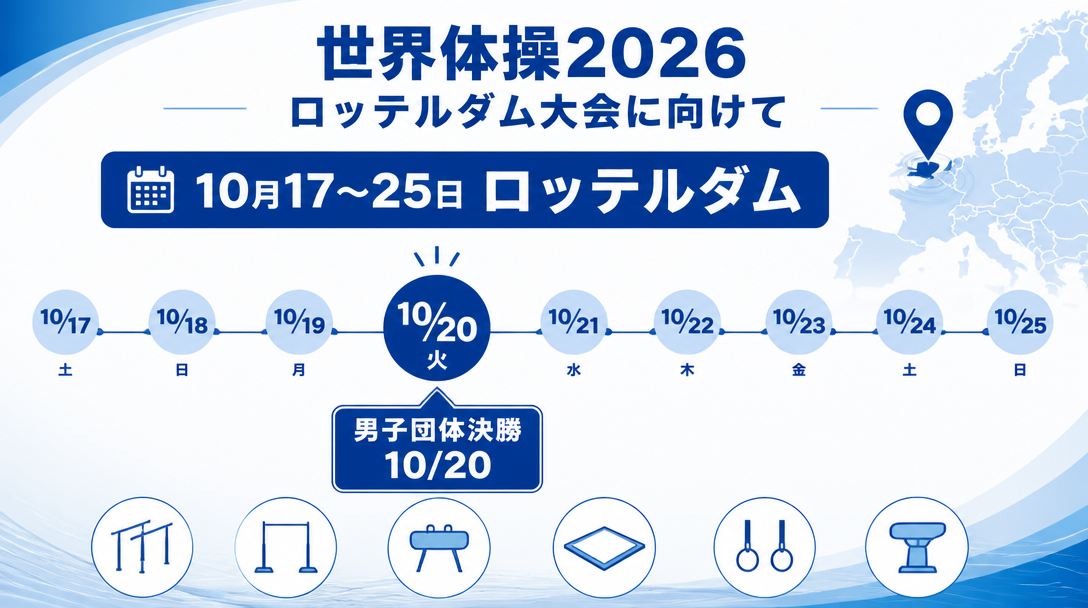
The 2026 World Championships will be held at Rotterdam Ahoy in Rotterdam, the Netherlands, from October 17 to 25, 2026. According to the competition overview (Wikipedia), the men's team final is scheduled for October 20. This will be Rotterdam's third time hosting the World Championships, after 1987 and 2010. Event information can also be checked on the Olympics.com event page and the FIG official event page.
Shohei Kawakami links Kokuspo to the world team
One name to watch is Osaka's Shohei Kawakami, who finished third in the senior men's individual all-around at Kokuspo. The Japanese men's team for the 2026 World Championships reported by Gymnastics Now includes Kawakami alongside Daiki Hashimoto, Shinnosuke Oka and others. Kawakami is also registered with the Japanese Olympic Committee (JOC), and now appears on both the Kokuspo and the world-team rosters. How his domestic form carries over to the world stage is a key point to watch. The full lineup of Japan's squad is laid out in Japan's men's team for the 2026 World Championships: the five-man composition and a D-score outlook.
The grassroots and next-generation depth seen at Kokuspo
Held at a time when world-team-level athletes are entering their final preparation, Kokuspo is an important stage where athletes one step short of national selection, and the next generation building strength in the regions, gain competitive experience. Osaka's third straight team title shows the depth of its athlete pool, and host Aomori's runner-up finish was a strong result boosted by competing at home. This kind of raising of the domestic base feeds into the depth of national-team competition a few years down the line. For how teams are built and contested, see also the men's team at the 2026 World Championships: a D-score outlook on the title contenders.
What is the National Sports Festival (Kokuspo)?
Renamed from the National Sports Meet, and its place
The National Sports Festival (Kokuspo) is a prefecture-versus-prefecture multi-sport competition that changed its name from the former "National Sports Meet (Kokutai)," used through 2023. It is held mainly in autumn, rotating among the prefectures each year, and in many sports it gathers Japan's top domestic competitors in one place. In 2026 Aomori Prefecture served as the host, and the gymnastics competition was held in early September as a pre-festival event.
The senior and junior divisions
Kokuspo gymnastics is divided into "senior" and "junior" categories, each contested mainly around the men's and women's team all-around. The senior men's field is centered on top athletes of the working-adult and university age groups, and the senior men's team covered in this article is one of the highest domestic levels. The junior category is centered on the high-school age group and gathers promising next-generation talent from across the country.
The significance of hosting in Aomori
A host prefecture advances athlete development and venue preparation in many sports, which becomes a big source of motivation for local athletes. According to the official Aomori Kokuspo site, the festival theme is "Soar to the future, riding the Jomon wind." The runner-up finish by host Aomori's senior men can be seen as the fruit of that development as a host prefecture.
Summary
- The gymnastics competition at Kokuspo 2026 (Aomori) was held as a pre-festival event on September 3-6 at the Aomori Prefectural Budokan in Hirosaki.
- In the senior men's team, Osaka won with 330.157 points for its fifth title overall and third in a row. Aomori was second and Miyazaki third, with the top places tightly contested.
- In the senior men's individual all-around, The Gymternet's tally placed Teppei Miwa (Osaka) on top and Shohei Kawakami (Osaka) third.
- Kawakami also appears on Japan's men's team for the 2026 World Championships, becoming a figure who links Kokuspo to the world team.
- A gymnastics score is the sum of the D-score (difficulty) and the E-score (execution). A domestic score in the 82-point range is solid, but the summit of the world demands even greater all-around ability.
If you want an easy way to simulate the D-score of a routine composition, please try Gymnastics AI. It is free to use on iOS and Android, and lets you enjoy Kokuspo and World Championship scores from the angle of "what kind of composition could produce them."