Commonwealth Games 2026: Canada Ends England's Gymnastics Reign
Canada won men's team gold at the 2026 Commonwealth Games with 241.400, ending England's three-title reign. A D-score and technical breakdown of Glasgow.
Note: This article reflects information as of July 25, 2026.
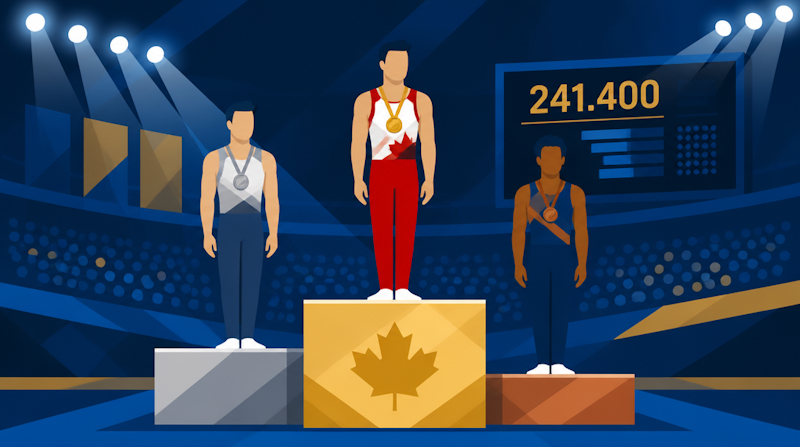
On July 24, 2026, on the opening day of the Glasgow Commonwealth Games 2026, Canada scored 241.400 to claim the men's artistic gymnastics team gold for the first time in 20 years. Three-time defending champions England took silver on 238.250, wit
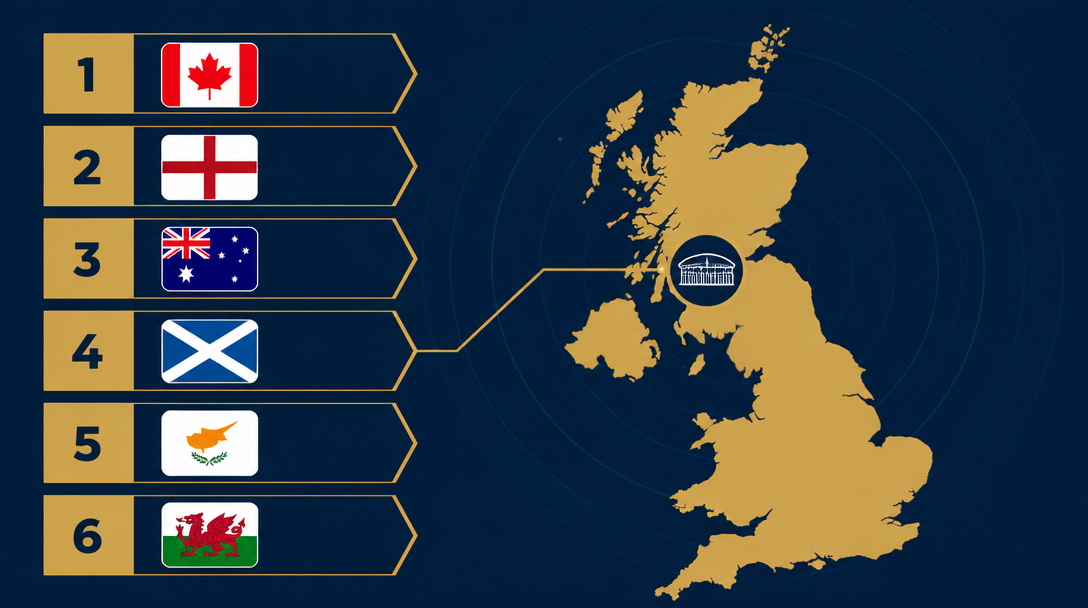
h Australia earning bronze on 235.650 and host Scotland just off the podium in fourth. This analysis breaks down the men's team final through the lens of apparatus scores and D-score strategy, written from a former gymnast and D-score app developer's perspective rather than as a straight news recap.
Commonwealth Games 2026 Men's Gymnastics Overview
The Commonwealth Games bring together Commonwealth nations and territories — Japan does not compete. That makes the event a useful gauge of how the non-Japanese rivals are shaping up ahead of the Rotterdam World Championships.
Venue and Format
According to the event overview, artistic gymnastics ran July 24–28 at Glasgow's Emirates Arena (the same venue as the 2014 Games), with 116 athletes from 22 nations. The men's programme opened with qualifying on July 24–25, the all-around final on July 26, and apparatus finals on July 27–28. The team title was decided on qualification scores on day one.
Men's Team Final Result
Per the Olympics.com results list and Gymnastics Now, the final standings were as follows.
Rank | Team | Score |
|---|---|---|
Gold | Canada | 241.400 |
Silver | England | 238.250 |
Bronze | Australia | 235.650 |
4th | Scotland | 234.300 |
5th | Cyprus | 228.350 |
6th | Wales | 227.000 |
Gymnastics Canada confirmed this was Canada's first men's team title in r
oughly 20 years (last won around 2006). Coach Jean-Sébastien Tougas said the athletes had "worked hard for this result."
Why It Was a "Subdued" Gold
The night was not pure celebration. According to The Gymternet, England's 19-year-old Gabriel Langton slipped on a Tak (Tkatchev-family) release on high bar and landed on his head. He was reportedly conscious and later spoke with doctors, but the arena fell quiet and Canada's celebration was muted.
If you want to explore how routines translate into difficulty scores, the Gymnastics AI D-score calculator is a handy companion — it follows the FIG 2025–2028 Code of Points and carries a database of over 790 skills.
The Gymnasts Behind Canada's Gold
>
241.400 came not from a single superstar but from a smart division of roles across the six apparatus.
Félix Dolci — Top All-Around Qualifier
Paris 2024 Olympian Félix Dolci of Quebec topped all-around qualification with 81.650 and qualified first on both vault and high bar, also reaching multiple other finals. His consistency anchored Canada's stability.
Jordan Carroll — Beating the Olympic Pommel Champion
The most striking moment was Jordan Carroll's 14.550 on pommel horse, a score Gymnastics Canada noted was ahead of the reigning Olympic champion. Northern Ireland's Rhys McClenaghan, the Paris 2024 pommel gold medallist, scored 14.500 — Carroll edged him by 0.050.
William Émard — Rings Leader and Veteran Support
William Émard topped rings qualification with 13.850 and placed fifth all-around (78.850), rebounding from a shaky pommel horse with strength on rings and vault. Veteran René Cournoyer steadied the team, while newcomer Ethan Ikeda stuck a double-double dismount.
Reading Difficulty Strategy Through the Scores
As the signature angle of this blog, here is a D-score-focused read of the numbers. Note that the early results mostly show combined totals (D+E); the D and E breakdowns arrive with the apparatus finals.
What Is a D-Score?
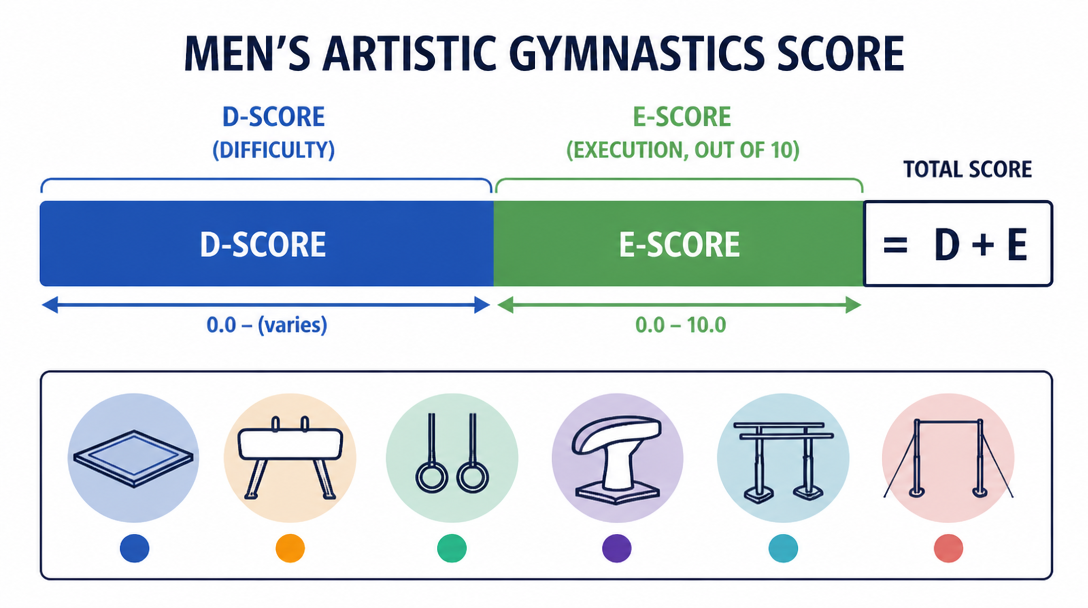
Under the FIG Code of Points, a men's score combines the D-score (difficulty value) and the E-score (execution out of 10). A 14.550 therefore requires both high difficulty and clean execution. For the fundamentals, see our explainer on the judging system and the D and E panels.
Apparatus Finals Qualifier Map
Apparatus | Top Qualifier (Score) | Other Finalists |
|---|---|---|
Floor | Whitehouse/ENG 14.400 | Dolci/CAN, Cournoyer/CAN |
Pommel | Ward/SCO 14.550 | Carroll/CAN, McClenaghan/NIR |
Rings | Émard/CAN 13.850 | Tobin/ENG, Dolci/CAN |
Vault | Dolci/CAN 14.100 | Whitehouse/ENG, Hardy/AUS |
P-Bars | Yolshin-Cash/ENG 14.100 | Georgiou/CYP, Tobin/ENG |
High Bar | Dolci/CAN 14.250 | Georgiou/CYP, Émard/CAN |
Pommel Horse: A World-Class Difficulty Battle
Pommel horse stands out: Ward and Carroll tied at 14.550 with Olympic champion McClenaghan at 14.500. Three athletes packed within 0.050 on such a fall-prone apparatus points to genuinely high D-scores. Try building a routine yourself in Gymnastics AI to see how difficulty, group bonuses and connections add up.
England's Miscalculations
Competing Without Whitlock
England entered without pommel specialist Max Whitlock (injured) and Jake Jarman (focusing on Worlds), a scenario we flagged in our Commonwealth Games preview. Langton was called up from reserve to fill the gap.
A Chain of Pommel Errors
Per The Gymternet, Joshua Nathan and Alexander Yolshin-Cash erred early on pommel horse, disrupting the team's rhythm, before Langton's high bar fall sealed the loss of the title.
All-Around and Apparatus Finals to Come
All-Around Final (July 26)
Rank | Gymnast / Nation | Qual. Score |
|---|---|---|
1 | Félix Dolci / Canada | 81.650 |
2 | Marios Georgiou / Cyprus | 80.950 |
3 | Reuben Ward / Scotland | 79.650 |
4 | Adam Tobin / England | 79.650 |
Georgiou is Dolci's closest challenger, while Ward carries home-crowd momentum from his pommel horse form.
Apparatus Finals (July 27–28)
Watch the three-way pommel battle (Ward–Carroll–McClenaghan), Dolci's vault/high bar double bid, and Whitehouse's floor. This is when D and E breakdowns finally become visible.
Implications for the Rotterdam World Championships
Rival Form Check
Dolci, Georgiou, the British gymnasts and McClenaghan will all contend with Japan for places in Rotterdam (Oct 17–25). Canada peaked well as a unit; England underperformed. Mid-summer peaking gaps are valuable intel for the autumn.
What It Means for Japan
Japan has locked in its five-man Worlds squad around Daiki Hashimoto. With McClenaghan-level pommel difficulty now the world standard, Japan's ability to stack D-score on pommel and high bar will be decisive. See also our European Championships 2026 preview.
Summary
- Canada won men's team gold with 241.400 — its first in 20 years — ending England's three-title reign.
- Félix Dolci topped all-around qualification (81.650) and led vault and high bar.
- Jordan Carroll's 14.550 on pommel beat Olympic champion McClenaghan.
- England fell to silver amid Whitlock's absence, pommel errors and Langton's fall.
- The all-around (July 26) and apparatus finals (July 27–28) will reveal the D-score breakdowns — a key preview of Rotterdam.
To simulate any of these routines' D-scores, try Gymnastics AI, built on the FIG 2025–2028 Code of Points, free on iOS and Android.