Asian Games 2026 Gymnastics: Japan's Medals & the D-Score Gap
The 2026 Asian Games gymnastics ended in Nagoya on Sept 25. Japan's Oka took two apparatus silvers—here is the D-score gap that decided the men's event finals.
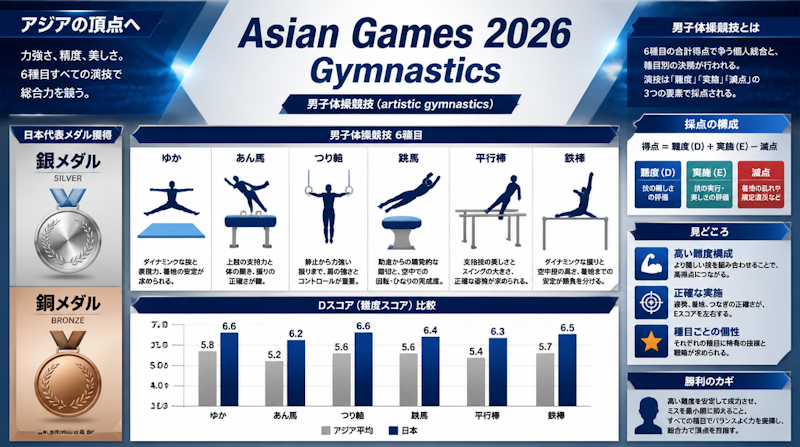
The artistic gymnastics competition of the 2026 Asian Games (Aichi-Nagoya) ran from September 21 to 25 in Nagoya, closing on the 25th. This article is written from the perspective of a former gymnast and D-score app developer, and reflects information as of September 25, 2026. Japan's men reached the podium in the team, all-around and apparatus finals, yet every apparatus gold went to specialists from China, the Philippines and Uzbekistan. Below we analyze the Asian Games 2026 gymnastics men's event finals and the "D-score gap" that separated Japan's medals from the golds.
Asian Games 2026 Gymnastics: Results Overview (Sept 21–25, Nagoya)
Format and schedule
The 20th Asian Games artistic gymnastics contested all 14 titles — team, all-around and apparatus — under the same FIG Code of Points used at the Olympics and World Championships. The men's all-around was held on Sept 21, the team final on the 23rd, and apparatus finals across Sept 24–25. As Olympics.com noted, the field doubled as a preview of the upcoming World Championships.
If you want to check a routine's D-score (difficulty score), the Gymnastics AI D-score calculator is a handy tool. It follows the FIG 2025–2028 Code of Points and includes a database of over 790 skills, so you can rebuild the routines discussed here and see how the difficulty adds up.
Japan's medal haul
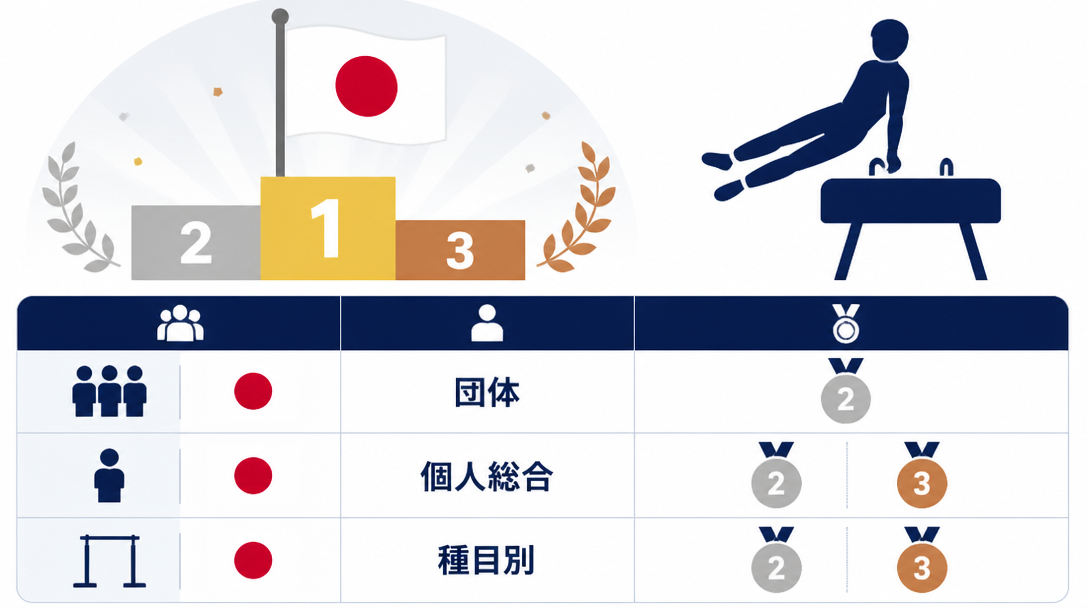
Japan showed impressive depth. In the men's all-around, Oka Shinnosuke took silver and Hashimoto Daiki bronze; the team earned silver for a third straight Games. In the event finals, Kaneda Kiichi took rings silver, Oka claimed silver on both parallel bars and high bar, while Hashimoto (pommel) and Tsukiyama Shoma (floor) added bronze. On the women's side, Sugihara Aiko won all-around gold and Nishiyama Misa bronze.
Event | Athlete | Medal |
|---|---|---|
Men's all-around | Oka Shinnosuke | Silver |
Men's all-around | Hashimoto Daiki | Bronze |
Men's team | Japan | Silver |
Men's parallel bars / high bar | Oka Shinnosuke | Silver (each) |
Men's rings | Kaneda Kiichi | Silver |
Men's pommel horse | Hashimoto Daiki | Bronze |
Men's floor | Tsukiyama Shoma | Bronze |
Women's all-around | Sugihara Aiko | Gold |
Women's all-around | Nishiyama Misa | Bronze |
Full results are available on the Wikipedia results page and via the Japan Gymnastics Association.
Men's Team & All-Around: China's Three-Peat and Japan's Silver
A team final decided by inches
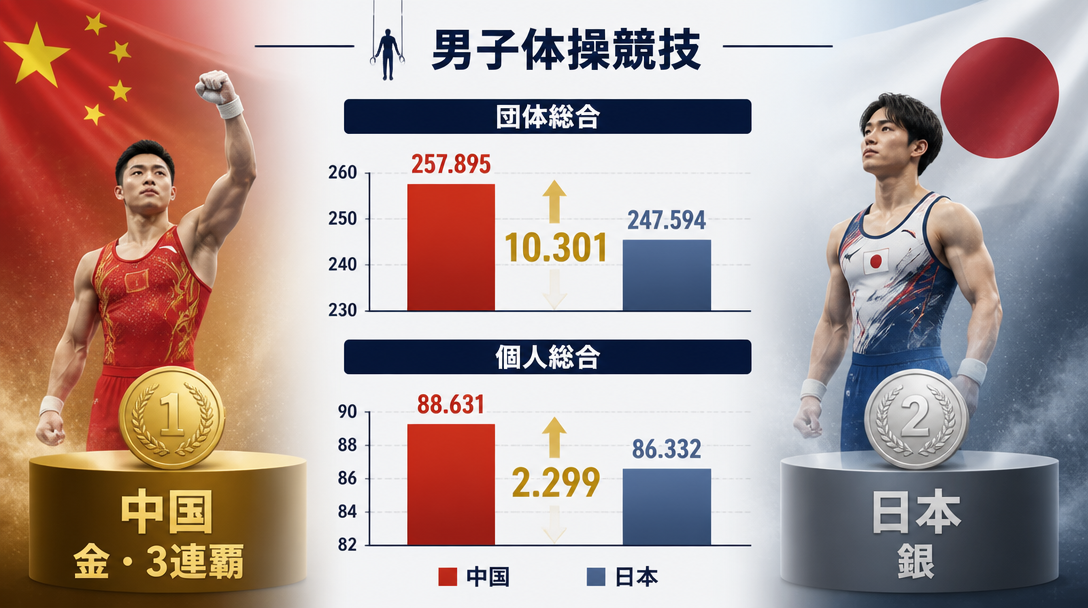
In the Sept 23 team final, China scored 255.095 for a third consecutive gold, Japan took silver with 253.826, and Chinese Taipei bronze with 239.896. According to THE DIGEST (Yahoo! Japan), Japan opened strongly on floor and pommel horse, but China seized control with a 44.099 on rings. A margin of roughly 1.3 points reflected how small differences in routine quality stack up across six apparatus.
Zhang Boheng edges Oka and Hashimoto
In the men's all-around on Sept 21, China's Zhang Boheng retained his title with 85.065, ahead of Paris 2024 all-around champion Oka Shinnosuke (84.698, silver) and Tokyo 2020 champion Hashimoto Daiki (83.865, bronze), per Olympics.com. A deeper all-around breakdown is available in our article Asian Games 2026 Men's All-Around: The Big Three by D-Score.
Men's Apparatus Finals: Full Results (Sept 24–25)
Sept 24: floor, pommel, rings
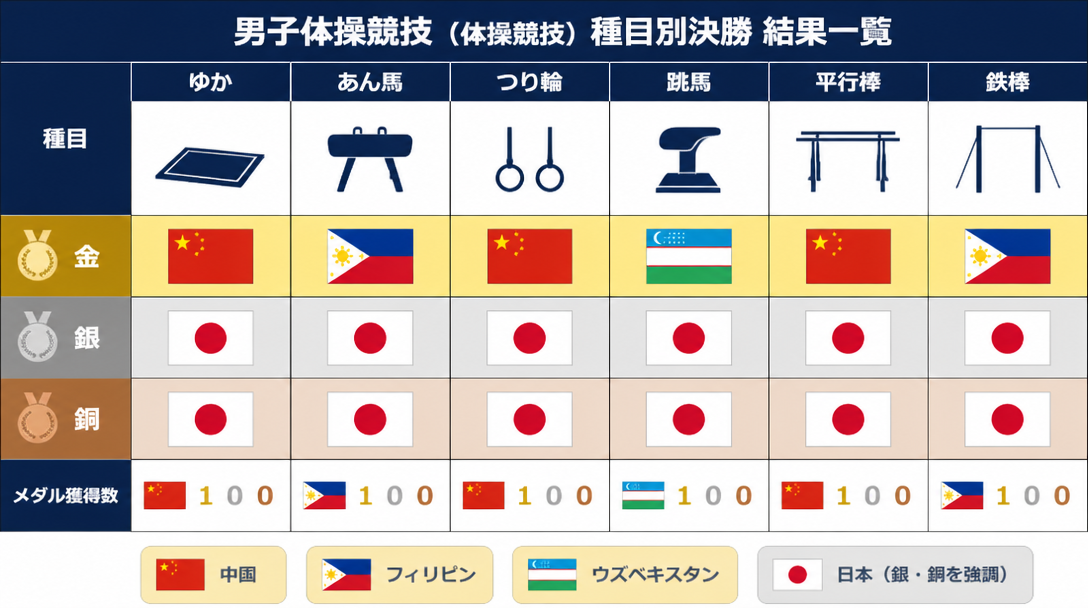
On Sept 24, the Philippines' Carlos Yulo won floor with 14.666 on a 5.7 difficulty, with Japan's Tsukiyama Shoma taking bronze. On pommel horse, Uzbekistan's Utkirbek Juraev won gold with 14.733 and Hashimoto Daiki took bronze with 14.500. On rings, China's Lan Xingyu won with 14.933 and Kaneda Kiichi took silver with 14.733.
Sept 25: vault, parallel bars, high bar
On the final day, Yulo added vault gold with a two-vault average of 14.599. On parallel bars, China's Zou Jingyuan won gold and Oka took silver; on high bar, China's Tian Hao won gold and Oka took silver again. The main men's event medalists are below.
Event | Gold | Silver | Bronze |
|---|---|---|---|
Floor | C. Yulo (PHI) | M. Karimov (KAZ) | Tsukiyama (JPN) |
Pommel | U. Juraev (UZB) | A. Valehzaghard (IRI) | Hashimoto (JPN) |
Rings | Lan Xingyu (CHN) | Kaneda (JPN) | Zou Jingyuan (CHN) |
Vault | C. Yulo (PHI) | M. Olfati (IRI) | Ng Ka Ki (HKG) |
Parallel bars | Zou Jingyuan (CHN) | Oka (JPN) | R. Abdurakhimov (UZB) |
High bar | Tian Hao (CHN) | Oka (JPN) | E. Yulo (PHI) |
Complete medalists and scores are compiled at Olympics.com. Japan reached the podium in five of six events but fell just short of gold.
All-Arounders vs. Apparatus Specialists, Read Through the D-Score
How the D-score works
A men's gymnastics score combines the D-score (difficulty) and the E-score (execution). The D-score adds up the difficulty value of up to eight counted skills, the composition/element-group requirements (CR), and connection value between skills. For the relationship between the two, see The Basics of the Code of Points: How D-Score and E-Score Work.
Why specialists win event finals
The all-around rewards consistency across six apparatus, while an event final is a single-apparatus shootout that favors athletes who have pushed one routine's difficulty to the limit. Zou Jingyuan, for instance, is renowned for an extremely high parallel-bars D-score, and Tian Hao and Lan Xingyu are event specialists too. For all-arounders like Oka and Hashimoto to beat them in a single event, they must raise their D-score on a target apparatus while keeping their execution clean.
To experiment with how a routine's D-score changes, try Gymnastics AI. Select and arrange skills, and it automatically calculates difficulty value, group bonuses and connection value — so you can see exactly how much "one more skill" is worth.
Japan's Event Finals, Analyzed by the Code of Points
Oka Shinnosuke: two silvers on p-bars and high bar
Oka took silver on both parallel bars and high bar on the final day, finishing behind the specialists Zou Jingyuan and Tian Hao. Parallel bars rewards connection value, while high bar rewards release skills — both directly shaping the D-score. For high-bar release variety, see High Bar Release Skills: Tkatchev, Kovacs and Rybalko.
Kaneda on rings, Hashimoto on pommel
Kaneda Kiichi's 14.733 earned rings silver; rings is decided by the difficulty and control of static strength holds like the cross and planche (Strength Holds on Rings: Judging the Cross and Planche). Hashimoto's pommel bronze came on an apparatus where deductions are easy to incur, making it hard to pair a high D-score with a stable execution.
Tsukiyama on floor
Floor bronze medalist Tsukiyama Shoma competed against Yulo's 5.7-difficulty tumbling. On floor, the acrobatic difficulty drives the D-score while stuck landings protect the E-score — a reminder that beating specialists demands a sharpened, single-event routine.
Looking Ahead to the 2026 World Championships in Rotterdam
The extra D-score needed for event medals
Next up is the 2026 World Championships in Rotterdam, Netherlands (Oct 17–25). Having felt the D-score gap here, Japan's men will need more difficulty on their target apparatus to reach the top of a World event podium. See our guide, World Championships 2026 Rotterdam: Schedule and Highlights by D-Score. International team news is tracked by outlets like Gymnastics Now.
Events Japan can target
Oka's parallel bars and high bar, and Kaneda's rings, were all "one step away" silvers here. Lift the D-score on these while keeping execution high, and world event medals are well within reach. For the projected Japan roster, see Japan's Men's Team for Worlds 2026: Five Athletes by D-Score.
Summary
The men's event finals at the Asian Games 2026 revealed both Japan's all-around strength and the D-score gap versus the world's specialists. Key points:
- Japan's men earned team silver plus all-around silver (Oka) and bronze (Hashimoto)
- In event finals, Oka took silver on p-bars and high bar, Kaneda silver on rings, Hashimoto bronze on pommel, Tsukiyama bronze on floor
- Every event gold went to specialists — Zou Jingyuan, Tian Hao, Lan Xingyu, Yulo and Juraev
- Winning an event requires extra D-score on a target apparatus, paired with clean execution
- The next focus is event medals at Worlds 2026 in Rotterdam (Oct 17–25)
To simulate a routine's D-score, try Gymnastics AI — free on iOS/Android and built on the FIG 2025–2028 Code of Points.