Asian Games 2026 Men's All-Around: D-Score Look at the Top 3
D-score analysis of the men's all-around at the 2026 Asian Games: Zhang Boheng gold, Oka silver, Hashimoto bronze, and what it means for Worlds 2026.

Note: This article reflects information as of September 22, 2026. The competition is ongoing; please check official federation sources for the latest results.
On September 21, 2026, at the 20th Asian Games in Aichi-Nagoya, Japan, the men's artistic gymnastics all-around final delivered a genuine world-class showdown. Zhang Boheng (China) took gold with 85.065, Shinnosuke Oka (Japan) won silver with 84.698, and Daiki Hashimoto (Japan) earned bronze with 83.865 (
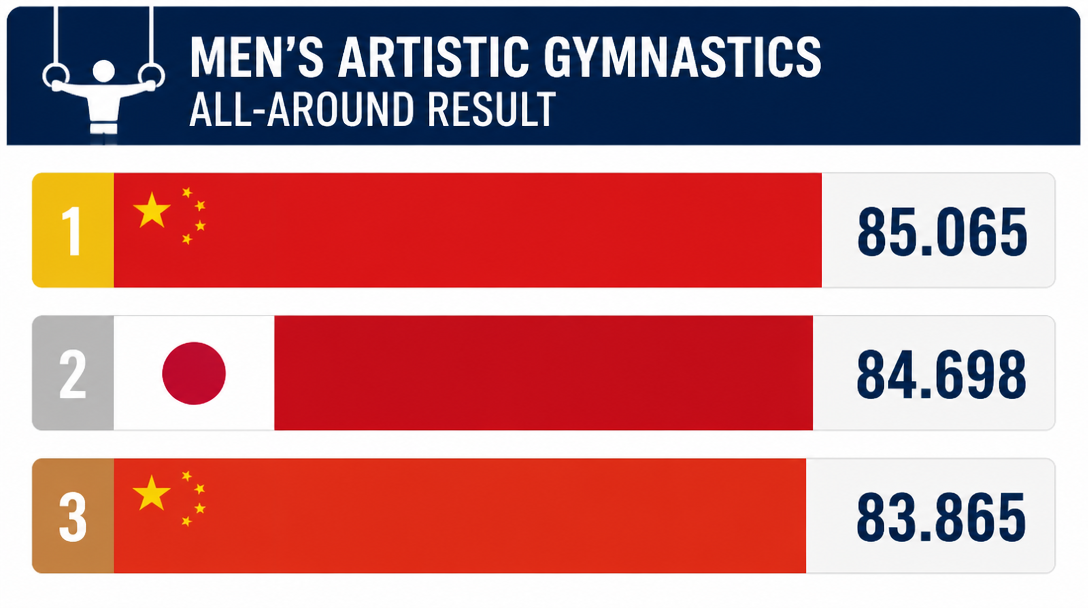
, Gymnastics at the 2026 Asian Games). As a former gymnast and the developer of a D-score app, I break down this all-around through the lens of the Code of Points.
Asian Games 2026 Men's All-Around Results
The scores that decided the medals
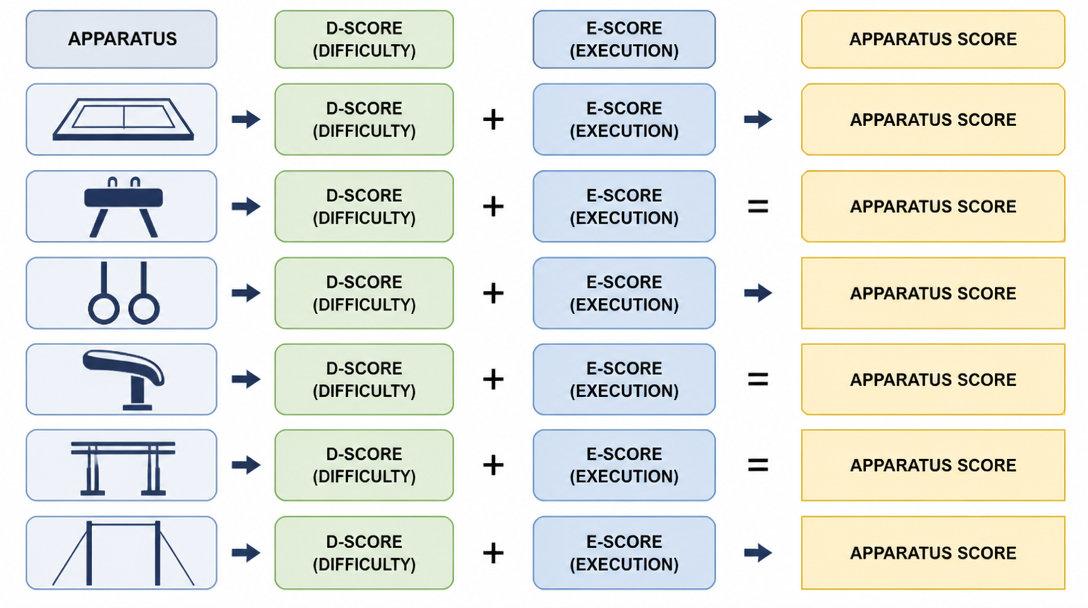
Here are the final standings. In artistic gymnastics, the all-around total is the sum of six apparatus scores, and each apparatus score is the sum of the D-score (difficulty) and the E-score (execution).
Medal | Gymnast | Country | Total |
|---|---|---|---|
Gold | Zhang Boheng | China | 85.065 |
Silver | Shinnosuke Oka | Japan | 84.698 |
Bronze | Daiki Hashimoto | Japan | 83.865 |
Gold to silver was decided by only 0.367, and silver to bronze by 0.833. Across six apparatus, that is razor-thin: a single step on a landing can swing the order.
A home crowd and a world-class field
The Games are hosted in Japan, with artistic gymnastics running September 21–25 at the Nippon Gaishi Hall (Nagoya City Gymnasium). Zhang has contended for all-around honors at the World Championships, Oka is the 2024 Paris Olympic all-around champion, and Hashimoto is the Tokyo Olympic all-around champion — an unusually stacked podium.
If you want to explore how elite gymnasts build their diff
iculty, the Gymnastics AI D-Score Calculator is handy. It follows the FIG 2025–2028 Code of Points and includes a database of 790+ skills, so you can retrace how top athletes stack difficulty.
"Like a World Championship final"
Japan's head coach Kensuke Murata said the all-around "felt like a World Championship final" (THE DIGEST report). All three gymnasts praised the rivalry afterward. Specialist outlets such as The Gymternet continue to track the Asian Games.
Reading the Top 3 Through the D-Score
The all-around is a stack of D and E
The men's all-around sums six apparatus: floor, pommel horse, rings, vault, parallel bars and high bar. Each apparatus score is the D-score (difficulty value) plus the E-score (execution, judged down from 10.000). See the basics of the Code of Points (D-score and E-score) for details.
So a sub-point battle among three elites is really the cumulative result of how each balances "attacking with difficulty" versus "protecting execution."
What a sub-point gap means
A spread of 85.065 / 84
.698 / 83.865 averages only about 0.06–0.14 per apparatus. When the field is this even, the medals hinge on who minimizes mistakes on the day. Higher difficulty raises the ceiling, but a shaky landing gives it back in execution.
Where the gaps open up
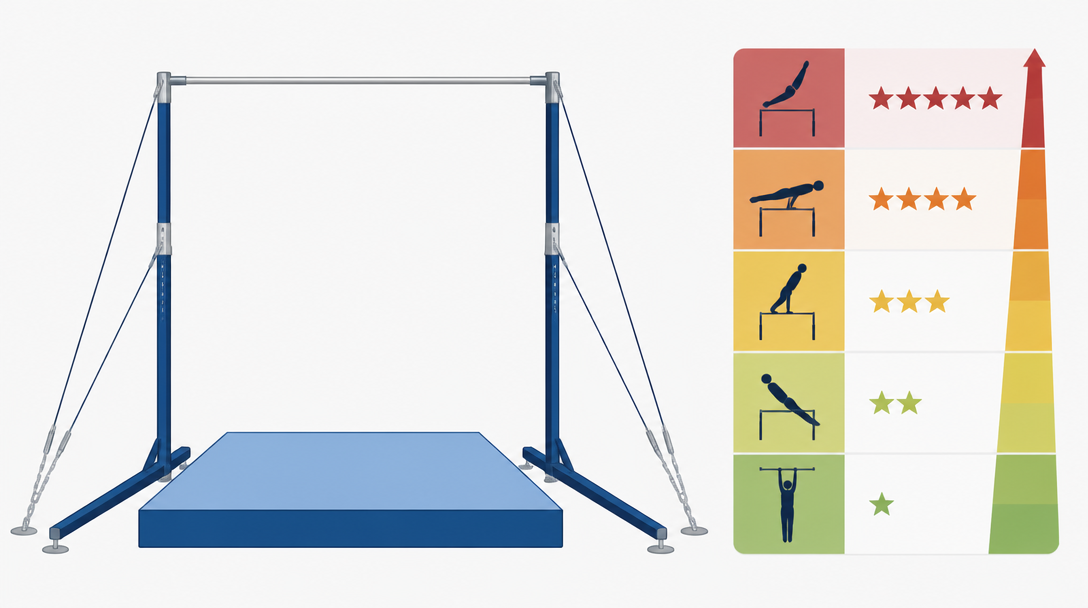
Some apparatus reward difficulty (high bar release combinations) while others punish small errors (pommel horse). All-around champions manage risk and reward across all six. To experiment with how a routine's D-score changes, try Gymnastics AI — select and order skills and it auto-calculates difficulty, group requirements and connection bonuses. The D-difficulty skills map is a useful companion.
Spotlight: The High Bar Qualification
Japan's high bar qualification scores
Event qualifications were also held on September 21. On high bar, Japan placed strongly:
Gymnast | Qual. rank | Score |
|---|---|---|
Shoma Tsukiyama | 2nd | 14.266 |
Shinnosuke Oka | 3rd | 14.233 |
Daiki Hashimoto | 6th | 14.033 |
Tomoharu Tsunogai | 10th | 13.433 |
Figures per JOC (Team Japan).
Release skills and difficulty
High bar difficulty is driven by release moves (Tkatchev, Kovacs, Adler families) and giant-based elements. See the guide to Tkatchev, Kovacs and Rybalko. Higher difficulty means a bigger D-score — but a missed catch costs heavily in execution.
Why high bar often decides the all-around
High bar is frequently the last rotation, so holding a high-difficulty routine together at the end can decide gold, silver and bronze.
Japan's Team and the Road Ahead
Japan's five-man squad
Japan's men's team is Oka, Hashimoto, Tsunogai, Tsukiyama and Kaneta (Japan Gymnastics Association).
- Shinnosuke Oka — all-around silver; complete and polished across apparatus.
- Daiki Hashimoto — all-around bronze; high-difficulty high bar is his signature.
- Shoma Tsukiyama — high bar qualification leader among Japan; event-final medal hope.
- Tomoharu Tsunogai & Kiichi Kaneta — team and event contributors.
From second in team qualification to the team final
Japan qualified second in the men's team (254.460). The team final is on September 23. See also the World 2026 men's team D-score outlook.
Event finals
Event finals run September 24 (floor, pommel, rings) and 25 (vault, parallel bars, high bar), where raw D-score tends to map directly onto placement.
What It Means for Worlds 2026 in Rotterdam
Positioning
The Asian Games sit about four weeks before the 2026 World Championships in Rotterdam (October 17–25). See the Rotterdam schedule and viewing guide.
The top 3 will headline Worlds too
Zhang, Oka and Hashimoto are all-around contenders at Worlds. On China's generational shift, see this analysis.
Japan's challenge
Closing the 0.367 gap to Zhang means both raising the D-score and steadying the E-score. Japan's World squad is covered in this article. Gymnastics Now is updating Rotterdam entries.
Summary
- Men's all-around: Zhang Boheng (CHN) 85.065 gold, Shinnosuke Oka (JPN) 84.698 silver, Daiki Hashimoto (JPN) 83.865 bronze.
- The sub-point margins reflect the cumulative balance of D-score and E-score across six apparatus.
- On high bar qualification, Japan placed 2nd (Tsukiyama), 3rd (Oka) and 6th (Hashimoto).
- Team final September 23 (Japan qualified 2nd); event finals September 24–25.
- A dress rehearsal roughly four weeks before Worlds 2026 in Rotterdam (Oct 17–25).
To simulate how elite routines build their D-score, try the Gymnastics AI app — free on iOS/Android, based on the FIG 2025–2028 Code of Points.