Sports Scholarships in Japan: Fee Waivers, Limits & Aid Rules
How sports scholarships work in Japan: which fees are waived, when status can be withdrawn, JASSO grant and loan amounts, academic rules, and combining aid.

A sports scholarship student in Japan (supōtsu tokutaisei) is a student whose entrance fee, tuition, or other school fees are fully or partly waived because of their athletic record or potential. But what exactly is waived, when the status can be withdrawn, and whether it can be combined with government scholarships all depend heavily on the school and the program.
This guide is written for student-athletes and parents in Japan, and for international families who want to understand how Japanese schools reward athletic talent. Using primary sources — the Japan High School Baseball Federation's rules on athletic scholarships, a Japanese sports university's waiver categories, the Japan Student Services Organization (JASSO) grant and loan programs, and a private foundation's sports scholarship — it lays out what to check before you enroll. If you are considering studying at a university abroad instead, see our guide to sports scholarships for studying at overseas universities.
What Is a Sports Scholarship Student in Japan? Fee Waivers vs. Scholarships
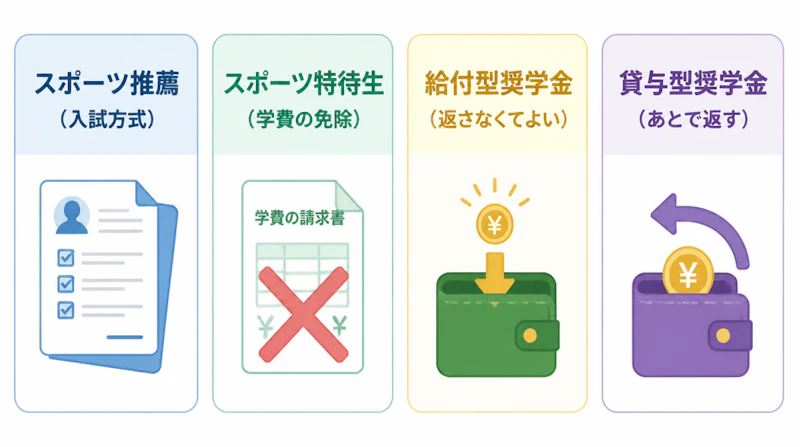
How Japanese schools define athletic scholarships
There is no single national definition of a sports scholarship student in Japan. Each school designs its own program. A useful reference point is the policy of the Japan High School Baseball Federation (JHBF). Its guidelines on high school baseball scholarship students (issued November 30, 2007, in Japanese) define the system as one in which a member school waives "the entrance fee, tuition, and other similar charges" for students with particularly outstanding baseball ability.
In other words, the core of a Japanese athletic scholarship is not receiving money but being excused from paying the school. That is the key difference from a grant-type scholarship, which pays cash into the student's account, and a loan-type scholarship, which must be repaid after graduation.
Sports admission, athletic scholarships, and financial aid compared
Three terms are often confused. Here is how they differ:
Program | What it is | How money moves | Run by |
|---|---|---|---|
Sports recommendation admission (supōtsu suisen) | An entrance route that evaluates athletic results | No fee reduction by itself | Each school |
Athletic scholarship student (tokutaisei) | Fee waiver or reduction based on athletic results | You pay the school less | Each school |
Grant-type scholarship | Money that does not have to be repaid | Paid into the student's account | JASSO, foundations, local governments |
Loan-type scholarship | A loan repaid after graduation | Paid to the student, then repaid | JASSO, local governments |
Getting in through a sports recommendation does not automatically make you a scholarship student. Conversely, some universities let students who entered through regular exams qualify later based on their competition results. Always check whether the admissions guide lists "recommendation" and "scholarship student" as separate items.
The conditions should be published by each school
Under the JHBF guidelines, a school that offers athletic scholarships must define in advance what is waived, how many students qualify, the selection criteria, and the selection procedure, and make these public through its admissions guide or similar documents. The guidelines also state that it is "desirable" to keep the number to five or fewer per grade (JHBF guidelines).
These rules apply to baseball and do not automatically carry over to other sports. Still, the principle — the conditions should be published, and you should confirm them in writing rather than rely on verbal promises — is useful for athletes in any sport.
What a Sports Scholarship Covers: Full and Partial Fee Waivers
A university example: coverage depends on the category
University athletic scholarships are often split into categories with different levels of coverage. For example, the Nippon Sport Science University scholarship program listed on Kawaijuku's Kei-Net (2026 academic year information) has two categories for students with outstanding athletic results:
Category | Year 1 | Years 2–4 |
|---|---|---|
Category A | Full entrance fee; full annual tuition, facilities fee, and educational enrichment fee | Full annual tuition, facilities fee, and educational enrichment fee |
Category B | Full entrance fee; full annual facilities fee | Full annual facilities fee and educational enrichment fee |
Both are called "scholarship students," yet Category A covers tuition while Category B does not. The total you pay over four years can differ by a large amount, so do not judge an offer by the word "scholarship" alone — check exactly which fees are waived.
Costs that are rarely covered: dormitory, travel, and equipment
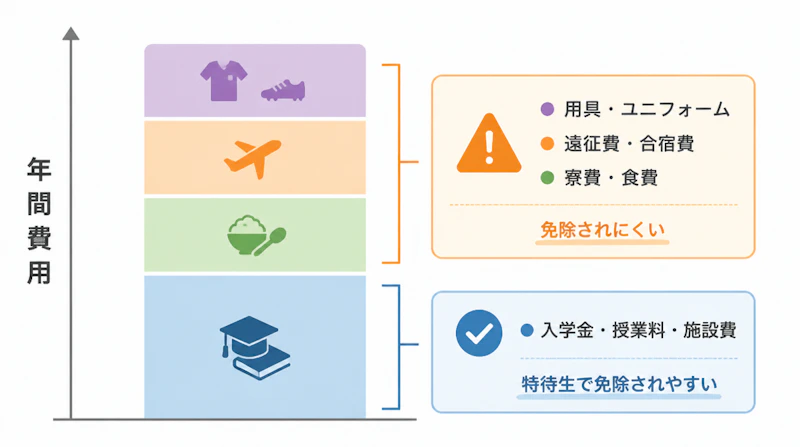
The easiest costs to overlook are the ones outside tuition. The JHBF guidelines state explicitly that athletic scholarships cover entrance fees, tuition, and similar charges, and do not cover travel costs, equipment, other club expenses, or living costs such as dormitory fees (JHBF guidelines).
The situation varies by sport, but stronger programs tend to have higher costs for training camps, away competitions, and gear. When you compare schools, list these costs as well:
- Dormitory and meal fees (especially if the team requires living in a dorm)
- Travel, training camp, and competition entry fees
- Uniforms, shoes, and equipment
- Club dues and booster club fees
- Textbooks, practical training fees, and other charges billed separately from tuition
The waiver may be reviewed every year
Scholarship status is not always fixed at entry and kept until graduation. In the Nippon Sport Science University example, selection is carried out "at entry and by internal selection each academic year". Because you may not keep the same category from the second year on, confirm the renewal conditions — athletic results, academic grades, club membership, and so on.
When a Sports Scholarship Can Be Withdrawn — and What to Check Before Enrolling

Common reasons for losing a scholarship
Athletic scholarships and athlete-focused scholarships come with conditions under which the support can be lost. As a concrete example, the application guidelines of the Yasuda Scholarship Foundation's sports program for Japanese students list reasons for suspending or ending the scholarship, including (excerpt):
- Leaving the university, taking a leave of absence, or being absent for a long period
- Repeating a year, or a risk that graduation will be delayed
- Poor academic results or poor student conduct (including attendance)
- Clear lack of effort, or being unable to continue competing because of injury or physical problems
- Changing to a different sport
These conditions show that athlete-focused support usually assumes both continued competition and continued study.
What happens if an injury ends your season — or your career
The biggest worry for student-athletes is an injury that stops them from competing. For cases where a student no longer meets scholarship conditions because of injury, the JHBF guidelines say it is "desirable" for schools to have measures in place so the student can continue their school life (JHBF guidelines).
"Desirable," however, is not an obligation. Actual treatment differs by school, so it is worth confirming in writing before you enroll what happens to the waiver after an injury, and whether you can stay enrolled by paying regular fees.
A pre-enrollment checklist
When a school offers you a sports scholarship, check these points against its admissions guide and official explanations:
- Which fees are waived (entrance fee, tuition, facilities fee, etc.) and the amounts
- How long the waiver lasts (renewed annually or guaranteed until graduation)
- Renewal conditions (athletic results, grades, attendance, club membership)
- What happens if you leave the team, get injured, or switch sports
- Estimated costs not covered, such as dormitory, travel, and equipment
- Whether the waiver can be combined with government or private scholarships
Government Scholarships for Student-Athletes in Japan: Grants and Loans
Grant scholarships and tuition reduction (the higher education support system)
If you do not receive an athletic scholarship, or it only covers part of your fees, national programs can fill the gap. Under the higher education study support system of Japan's Ministry of Education (MEXT), students who meet household income and other requirements receive a combination of tuition and entrance fee reductions plus a grant-type scholarship that does not have to be repaid. MEXT's overview gives the annual tuition reduction cap as about 540,000 yen at national and public universities and about 700,000 yen at private universities.
According to JASSO's grant amount table, the monthly grant for university students in Bracket I is:
University type | Living with family | Living away from home |
|---|---|---|
National / public | 29,200 yen | 66,700 yen |
Private | 38,300 yen | 75,800 yen |
Bracket II receives two-thirds of these amounts, Bracket III one-third, and Bracket IV (multi-child households only) one-quarter. Student-athletes who live in a team dormitory or on their own count as "living away from home," which makes a big difference to the amount.
No income limit for households with three or more children from 2025
Since April 2025, students from households supporting three or more children can have tuition and entrance fees reduced up to a set amount with no income limit (MEXT). For families with several children, tuition may drop substantially even without an athletic scholarship. Check eligibility — including how the number of dependent children is counted — with JASSO and the school you plan to attend.
Loan-type scholarships (Type I and Type II)
JASSO loan-type scholarships must be repaid after graduation. According to JASSO's loan scholarship information, there is an interest-free Type I and an interest-bearing Type II.
Type | Interest | Monthly amount (university) |
|---|---|---|
Type I | Interest-free | For private universities, living away from home: choose 20,000, 30,000, 40,000, 50,000, or 64,000 yen (JASSO amount table) |
Type II | Interest-bearing (capped at 3% per year) | Choose from 20,000 to 120,000 yen in 10,000-yen steps (JASSO Type II information) |
A loan is money your future self will repay. If you borrow heavily as a "bridge" in case your athletic scholarship is cut, repayment after graduation can become a real burden. The basic rule is to borrow only what you need.
Academic Requirements for Grant Scholarships: Keeping Your Funding While You Train
Warning, suspension, and termination criteria
Grant-type scholarships do not have to be repaid, but recipients' academic records are reviewed every year. JASSO's academic standards are as follows:
Result | Main conditions |
|---|---|
Warning | Credits earned are 70% or less of the standard; GPA (or equivalent) in the bottom quarter; attendance of 80% or less or other signs of low motivation, as judged by the school |
Suspension | Two consecutive warnings where the only reason for the second is a GPA in the bottom quarter (excluding three consecutive warnings) |
Termination | It is confirmed that the student cannot graduate within the standard period; credits earned are 60% or less of the standard; attendance of 60% or less or other signs of very low motivation, as judged by the school; consecutive warnings |
If you keep missing classes during periods of heavy training, camps, and away competitions, you risk falling below the attendance or credit thresholds. As JASSO's grant scholarship overview notes, depending on the circumstances, the grant can be terminated and you may even have to pay money back.
Practical ways to balance competitions and classes
To stay above the academic thresholds, compare your competition calendar with your class schedule early:
- When the annual competition and camp schedule is released, identify the busy periods before you register for courses
- Ask the academic affairs office whether official absences for competitions are recognized and what the deadlines are
- Plan your courses each year so that required classes do not clash with away trips
- If your grades start to slip, talk to your coach and academic advisor early
For concrete time-management methods, see our article on time management for university student-athletes.
Academics are becoming a requirement in university sport, too
Balancing study and sport is not only a scholarship issue. During the preparations for the Japan Association for University Athletics and Sport (UNIVAS), a rule that students who have not earned a certain number of credits cannot compete was discussed (minutes of the November 2018 working group, in Japanese). Even for students who enter as athletic scholarship holders, attending classes and earning credits is increasingly a precondition for continuing to compete.
Can You Combine a Sports Scholarship With Other Financial Aid?
Government tuition reductions and school waivers are coordinated
Even if you qualify for both a sports scholarship tuition waiver and the government's tuition reduction, the two amounts are not necessarily added together. Each school decides which program is applied first and how any difference is handled.
As an example of how this coordination works, Shinshu University's explanation of its own tuition waiver and the national support system shows calculations in which the national reduction is applied first and the university's own waiver covers the remaining difference. This is a general tuition waiver rather than an athletic scholarship, but the same questions — "coordinated, not added" and "which one the school applies first" — are worth asking about any sports scholarship.
Private foundation sports scholarships often restrict combining
Private foundations also offer grant scholarships for student-athletes. For example, the Yasuda Scholarship Foundation's sports program for Japanese students pays 100,000 yen per month (1.2 million yen per year) to students who belong to a university-recognized athletic club, with no obligation to repay. It accepts around five students, and a university recommendation is required.
At the same time, these guidelines do not, in principle, allow the scholarship to be combined with other scholarships (JASSO grant scholarships and loan-type scholarships from other private organizations are exceptions). Before applying for a private scholarship, check what it can and cannot be combined with. For how scholarship income is treated for tax purposes, see our article on tax returns for athletes.
High school tuition support without an income limit from 2026
Policy changes also matter for families considering a high school sports scholarship. According to MEXT's page on the High School Enrollment Support Fund, the income limit was removed in April 2026, and students at private high schools (full-time and part-time programs) can receive up to 38,100 yen per month.
As a result, a tuition waiver from a high school sports scholarship may be worth relatively less than before. When comparing high schools, it makes sense to focus more on how much of the entrance fee, facilities fee, dormitory costs, and travel costs are covered.
How to Pursue and Choose a Sports Scholarship
Start researching before admissions guides are released
Scholarship conditions reach families in many ways: school information sessions, trial practices, and word of mouth through sports organizations. In the end, though, only written documents are reliable. Collecting information in this order makes comparison easier:
- Narrow your list to three to five schools and get last year's admissions guide and scholarship information
- Put the scholarship categories, waived fees, and renewal conditions into a single table
- Estimate the total cost over four years (three for high school), including dormitory, travel, and equipment
- Compare that with what national programs (the higher education support system or the high school support fund) would provide
- Ask unclear questions by email or in writing, not verbally, and keep the records
Organize how you present your athletic record
Selection looks not only at competition results but also at how you have trained and how you are doing academically. Organizing results, records, and video makes it easier to explain yourself in recommendations and interviews. The approach in our article on job hunting and self-presentation for student-athletes is also useful here.
Plan for the possibility that you stop competing
A sports scholarship assumes that you keep competing. That is exactly why you should choose your faculty and major with injuries and changing circumstances in mind. For thinking about life after sport, see our guide to designing an athlete's second career.
Summary
- A sports scholarship in Japan is a school's own program that waives entrance fees, tuition, and similar charges based on athletic results; coverage and conditions differ from school to school
- Dormitory, travel, and equipment costs are often not covered; the JHBF guidelines explicitly exclude them from baseball scholarships
- Scholarship status may be reviewed every year — confirm in writing before enrolling the conditions under which it can be withdrawn, such as leaving the team, injury, or poor grades
- Japan's higher education support system (grant scholarship plus tuition reduction) and, since 2025, income-unlimited tuition reduction for families with three or more children are also options; grants require you to keep meeting academic standards
- A sports scholarship waiver and government or private scholarships are not necessarily added together — ask the school or foundation whether they can be combined and how they are coordinated