Song Structure Explained: Verse, Pre-Chorus, Chorus & Bridge
Learn song structure: what the verse, pre-chorus, chorus, and bridge do, how J-pop's A-melo, B-melo, and sabi map to them, common forms, and how to plan yours.
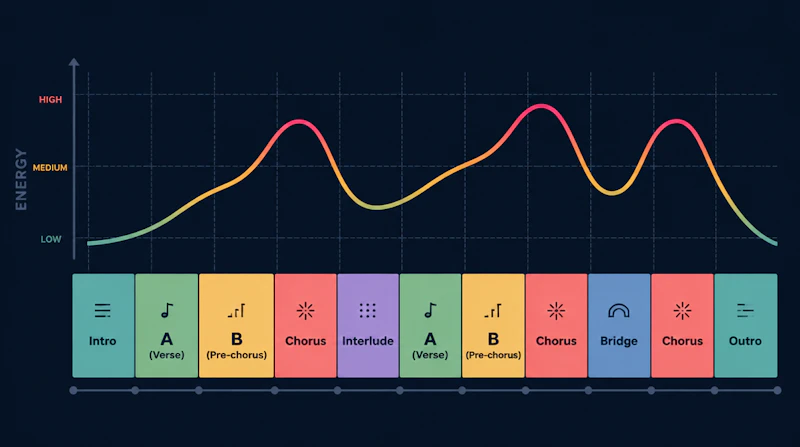
Song structure is the blueprint of a song: which sections you use—intro, verse, pre-chorus, chorus, bridge, outro—and in what order. If you have ever finished a great hook and then wondered how to turn it into a complete track, the answer is almost always structure. This guide explains what each section does, how the Japanese pop terms A-melo, B-melo, and sabi map onto verse, pre-chorus, and chorus, the song structures you will hear most often, and a step-by-step way to build your own song structure with a simple section chart.
Structure is a separate skill from writing melodies or chord progressions. A song can be full of strong ideas and still feel aimless if those ideas are not arranged clearly—listeners lose track of where the payoff is. Once you know a few reliable forms, getting from a loose sketch to a finished song becomes much more straightforward.
What Is Song Structure? The Basic Parts of a Song
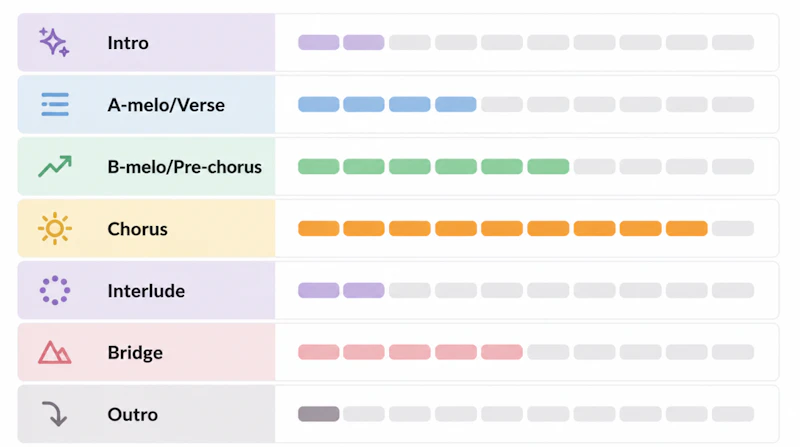
Song structure is the order of your sections
Most popular songs are made of a handful of sections that each have a job. In English, the core vocabulary is verse, pre-chorus, chorus, and bridge, framed by an intro and an outro. Native Instruments lists exactly these building blocks in its Song Structure 101 guide: intro, verse, pre-chorus, chorus, bridge, and outro.
Japanese pop (J-pop) uses its own names for the same ideas. The opening sung section is the A-melo (A melody), the section that leads into the chorus is the B-melo, and the chorus itself is the sabi. Whatever you call them, designing a song structure means deciding a sequence such as "intro → verse → pre-chorus → chorus → interlude → verse → pre-chorus → chorus → outro" and shaping the energy across it.
The parts of a song at a glance
Here is a quick reference for what each section typically does.
Section (Japanese term) | Main job | Typical energy |
|---|---|---|
Intro | Sets the mood and pulls the listener in | Low to medium |
Verse (A-melo) | Starts the story; lyrics change each time | Low |
Pre-chorus (B-melo) | Connects verse to chorus and builds anticipation | Medium, rising |
Chorus (sabi) | The heart of the song—the main hook and message | High |
Interlude / solo | Rests the vocal and switches scenes | Medium |
Bridge (C-melo) | A one-time contrasting section near the end | Medium, different |
Breakdown chorus / final chorus (ochi-sabi / ō-sabi) | Strip the last chorus down, then deliver the biggest lift | Low → peak |
Outro | Brings the song to a close | Falling |
The energy column describes common tendencies, not rules. A ballad may keep its chorus sparse, and a rock song may start its verse at full volume. What matters is that each section has a distinct role, so the listener always has a sense of where they are in the song.
Thinking in "first verse" and "second verse" cycles
Japanese songwriters often call one verse–pre-chorus–chorus cycle "ichiban" (the first round) and the next one "niban" (the second round). Both rounds usually share the same melody with new lyrics, and a bridge or interlude follows the second round before the final chorus.
- First round: present the song's core shape with verse, pre-chorus, and chorus
- Second round: move the story forward on the same melody, often with a changed arrangement
- Ending: add something new—a bridge, a breakdown chorus, or a lifted final chorus
Verse vs Pre-Chorus vs Chorus: How the Core Song Sections Differ
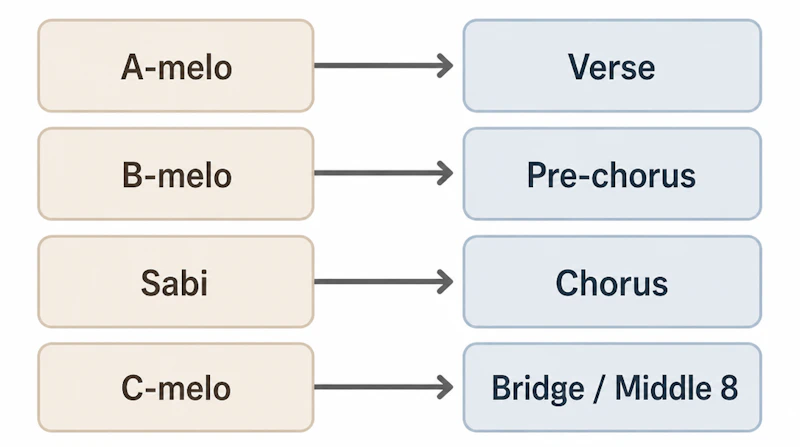
Verse (A-melo): the storytelling section
The verse is where the vocal begins and the story unfolds. Ableton's free course Making Music: Elements of Song Form describes the verse as a recurring section that serves as the main body of the song, and in songs with lyrics, it is usually where the story is told.
Verses are often written lower in range and calmer in rhythm than the chorus. If you go all-out in the verse, there is nowhere left to climb when the chorus arrives. Keeping melodic leaps modest and following the natural rhythm of speech helps the lyrics come across clearly.
Pre-chorus (B-melo): the run-up to the chorus
The pre-chorus sits between verse and chorus. The Wikipedia article on song structure calls it an optional section after the verse—also known as a "build," "channel," or "transitional bridge"—that connects the verse to the chorus with intermediary material. As "optional" suggests, plenty of songs skip it entirely.
The goal of a pre-chorus is to make anticipation peak right before the chorus. Common techniques include:
- Gradually raising the melodic range
- Switching to chords that sound different from the verse
- Using a drum fill or a short break (a moment of silence) to mark the chorus entrance
- Tightening the rhythm—or stretching notes out to create a sense of holding back
Chorus (sabi): the hook that defines the song
The chorus is the emotional peak and carries the melody and words you most want people to remember. Native Instruments describes the chorus as the climax of the song, and it is where the hook—the part people sing along to—usually lives.
Because it repeats, chorus lyrics tend to stay the same each time, and many songs place the title in the chorus. The chorus usually sits higher than the verse with a fuller arrangement, creating a clear contrast with everything around it. For a deeper look at writing the melody itself, see our guide to writing melodies.
How to make each section sound different
To make the difference between verse, pre-chorus, and chorus obvious to the listener, change these elements from section to section:
Element | Verse | Pre-chorus | Chorus |
|---|---|---|---|
Melodic range | Lower, narrower | Climbing | Higher, wider |
Rhythm | Speech-like | Changing | Catchy and repetitive |
Arrangement density | Sparse | Building | Fullest |
Harmony | Stable progression | Different color from the verse | Strongly establishes the key |
For go-to progressions and modulation tricks, see our chord progression basics.
Intro, Interlude, Bridge, and Outro: The Supporting Sections
Intro: grab attention in the first few seconds
The intro opens the song and establishes its world. Intros have been getting shorter. A researcher at The Ohio State University analyzed top-10 hits from 1986 to 2015 and found that intros averaging more than 20 seconds in the mid-1980s had shrunk to about 5 seconds (published in Musicae Scientiae in 2017).
The explanation offered is that streaming makes skipping effortless. On Spotify, for example, a play is counted as a stream once someone listens for at least 30 seconds. However, the same researcher's second analysis, which compared an artist's popular songs with that artist's less popular ones, did not find evidence that the attention-grabbing traits made the difference. So "shorter intros sell more" is not a law—choose the length that fits the genre and the purpose of the track.
Interlude: rest the vocal and change the scene
An interlude (or instrumental break) is a section with no vocals. Beyond showcasing a guitar solo or a synth lead, it moves the song from one stage to the next—from the first round to the second, or from the second round into the ending. Japanese retailer Shimamura Music's arrangement guide (in Japanese) lists adding a longer interlude or solo section that the original song did not have as one way to change a song's character through arrangement.
Interludes often reuse the intro's riff, which ties the whole song together.
Bridge (C-melo): a one-time change near the end
The bridge is a new section, usually after the second chorus, that appears only once. Ableton's Making Music explains that the bridge contrasts with both the verse and the chorus and typically occurs only once, often using a different key, unusual chord progressions, or a dramatically different level of density and energy.
After hearing the chorus two or three times, listeners get used to it. A bridge shows them a different view for a moment, so the final chorus feels fresh again.
Breakdown chorus, final chorus, and outro
The last chorus often gets special treatment. Japanese pop even has dedicated names for these moves:
- Ochi-sabi (breakdown chorus): strip the arrangement back to the vocal and one or two instruments. Shimamura Music's guide gives the example of dropping everything except vocal and piano (or guitar) to change the mood dramatically
- Ō-sabi (big final chorus): deliver the biggest lift of the song, often with a key change or added layers
- Outro: end the song by repeating the chorus into a fade, returning to the intro riff, or stopping cleanly
Pulling the energy down in a breakdown chorus and then bringing everything back for the final chorus turns the volume difference into an emotional swing. This "subtraction" approach is the same tension-and-release idea covered in our introduction to arranging.
Japanese vs Western Song Structure: Verse, Pre-Chorus, Chorus, Bridge
How Japanese terms map to English terms
If you collaborate with Japanese musicians or read J-pop analysis, this mapping is handy:
Japanese term | Common English term | Notes |
|---|---|---|
Intoro | Intro | Same idea |
A-melo | Verse | Storytelling; lyrics change each time |
B-melo | Pre-chorus (build, channel) | Optional; many songs skip it |
Sabi | Chorus (hook, refrain) | The repeated center of the song |
C-melo | Bridge / middle 8 | One-time contrasting section near the end |
Kansō | Interlude / instrumental break / solo | No vocals |
Autoro | Outro (coda) | Ending |
ABABCB and AABA: two forms you will hear everywhere
Song forms are often written with letters. In Ableton's Making Music, A is the verse, B the chorus, and C the bridge, and ABABCB—verse, chorus, verse, chorus, bridge, chorus—is described as the form used in probably the majority of contemporary pop songs.
The other classic is AABA. According to Wikipedia, it uses four sections, most often eight bars each (4 × 8 = 32), with two A sections, a contrasting B section (the bridge or "middle eight"), and a return to A. That is why it is also called 32-bar form, common in older standards.
Watch out: "bridge" means different things to different people
The word "bridge" does not always point to the same place. UK magazine MusicRadar's guide to song sections uses "Bridge/Pre-Chorus" for the link between verse and chorus, and calls the contrasting mid-song section the "Middle 8." In most American usage, by contrast, "bridge" means that late, one-time contrasting section.
- When a tutorial mentions a bridge, check from context whether it means the verse-to-chorus link or the late one-time section
- The Japanese B-melo usually corresponds to the pre-chorus
- The Japanese C-melo corresponds to the bridge or middle 8
Common Song Structures and When to Use Them
The standard form: two rounds, a bridge, and a final chorus
The most common structure in J-pop—and very common in Western pop—repeats two verse–chorus rounds, inserts a bridge, and finishes on the chorus.
Pattern | Example order | Why use it |
|---|---|---|
Standard | Intro → V → PC → C → Interlude → V → PC → C → Bridge → C → Outro | The safe default; easy to develop a story |
Chorus first | C → V → PC → C → … | Delivers the hook immediately |
No pre-chorus | Intro → V → C → V → C → Bridge → C | Close to classic verse-chorus; moves quickly |
ABAB | V → C → V → C | Native Instruments cites Miley Cyrus's "Flowers" as an example |
32-bar form | A → A → B → A | Classic form in standards |
The ABAB example comes from Native Instruments' Song Structure 101.
Starting with the chorus
Opening with the chorus is common enough in Japan to have its own name, "sabi-iri." Shimamura Music's arrangement guide lists switching to a chorus-first structure as one way to change a song's impression.
The advantage is that your strongest material lands in the first few seconds, which suits the trend toward shorter intros described above. The risk is that once the hook has been heard, the second chorus can feel less fresh—so add something new between the opening chorus and its return.
Dance music structure: build-ups and drops
Instrumental dance music is built differently. MusicRadar outlines a club arrangement of a drum-led beat intro, a breakdown where the drums drop out, a build-up that raises tension, a drop that acts as the equivalent of a pop chorus, and a beat outro that gives DJs room to mix out.
Ableton's Making Music similarly notes that electronic genres without vocals tend to avoid conventional verses and choruses, developing instead through the addition and subtraction of layers. If you start from a single loop, writing down where each layer enters and exits on a section chart makes it much easier to shape that loop into a full track.
How to Build a Song Structure in 5 Steps
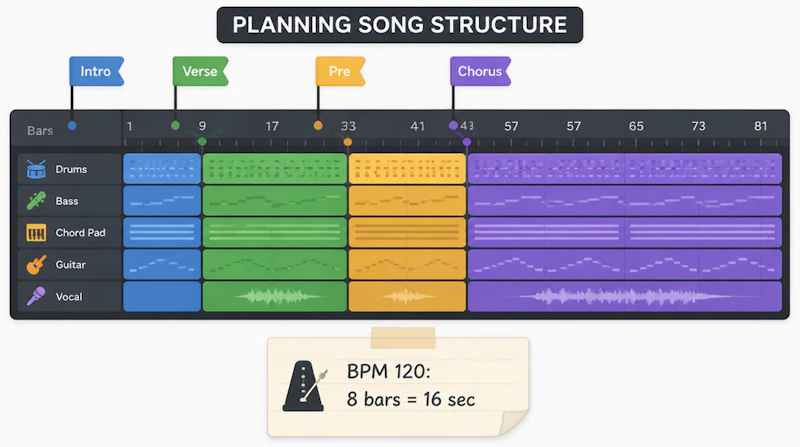
Step 1: Set the length and tempo
Start by deciding roughly how long the song should be and what tempo (BPM) it will use. In 4/4 time, one bar lasts 60 ÷ BPM × 4 seconds. At 120 BPM, a bar is 2 seconds, so 8 bars take 16 seconds and 16 bars take 32 seconds.
- 90 BPM: about 2.7 seconds per bar / about 21 seconds per 8 bars
- 120 BPM: 2 seconds per bar / 16 seconds per 8 bars
- 150 BPM: 1.6 seconds per bar / 12.8 seconds per 8 bars
With this math, you can work backward from a target length—"I want this under four minutes, so how many bars can each section have?" Locking your DAW tempo early also keeps the math consistent when you adjust bar counts later.
Step 2: Write a section chart
Next, list each section with its bar count. Paper or a DAW timeline both work. A starting point like this keeps things simple:
Section | Bars (example) | Length at 120 BPM |
|---|---|---|
Intro | 4–8 | 8–16 seconds |
Verse | 8–16 | 16–32 seconds |
Pre-chorus | 8 | 16 seconds |
Chorus | 8–16 | 16–32 seconds |
These numbers are not rules. MusicRadar notes that most choruses tend to be eight bars long but often double up to 16, while Native Instruments says verses are usually 16 or 32 bars. Grouping sections in multiples of four or eight helps listeners feel where one section ends and the next begins. Start there, and once you are comfortable, try adding or removing two bars to see how it changes the flow.
Step 3: Write the chorus first, then work backward
With the chart in place, one effective approach is to write the chorus first. Once the song's biggest moment is fixed, the other sections' jobs become clear: a verse that sits lower than the chorus, and a pre-chorus that climbs toward it.
- Write the chorus melody and chords
- Write a calmer verse in a lower range
- Write a pre-chorus that bridges verse and chorus (check that it leads naturally into the chorus's first note)
- Build the intro from a chorus or verse phrase
Step 4: Vary the arrangement in later rounds
If the second round sounds identical to the first, attention drifts. Shimamura Music's arrangement guide suggests contrasts such as a rim-shot groove in the verse and a full snare in the chorus, or making the second verse quieter than the first so the following chorus hits harder.
- Thin out the instruments or change the drum pattern in the second verse
- Add a counter-melody or harmonies in the second chorus
- Insert a break or a breakdown chorus before the final chorus
For harmony ideas, see our guide to writing vocal harmonies.
Step 5: Make the structure visible with DAW markers
Most DAWs let you label the timeline with markers or locators. Marking "Intro," "Verse," "Pre," and "Chorus" shows the balance of the whole song at a glance and makes copying or rearranging sections easy.
Whenever you rearrange, listen from the top all the way through. Problems like "it takes too long to reach the chorus" or "the same energy goes on too long" are hard to notice while working section by section, but obvious on a full play-through.
Common Song Structure Mistakes and How to Fix Them
The chorus doesn't lift
When a chorus falls flat, the cause is often in the verse and pre-chorus, not the chorus itself. If those sections are already as high and as dense as the chorus, there is no contrast left when the chorus arrives.
- Lower the verse's range and thin its arrangement
- Add a brief rest or break at the end of the pre-chorus
- Make the chorus's first note higher than the pre-chorus's last note
The song feels long and repetitive
Too many repeats of the same section make a song drag. Review your section chart and check:
- Is it taking too long to reach the first chorus? (Calculate the seconds from BPM and bar count.)
- Can the second verse or pre-chorus be shortened?
- Does the ending introduce something new, such as a bridge or breakdown chorus?
Fitting a structure into a fixed length
For ads, videos, or game music with a fixed duration, you do not need every section. Compress the structure to what matters—"intro → chorus" or "verse → chorus." The bar-to-seconds math from Step 1 does most of the work here.
For a worked example of building a beginning, development, and climax inside a strict time limit, see our article on structuring floor exercise music, where the whole piece has to fit a fixed competition length.
Summary
Song structure is the blueprint that assigns each section a role and decides the order they appear in.
- The verse tells the story, the pre-chorus builds toward the chorus, and the chorus is the song's identity. Separate them with range, rhythm, and arrangement density
- Japanese A-melo, B-melo, sabi, and C-melo roughly equal verse, pre-chorus, chorus, and bridge/middle 8 (in UK usage, "bridge" can mean the pre-chorus)
- The standard form is two rounds, a bridge, and a final chorus; chorus-first or no-pre-chorus versions fit other goals
- A section chart with bar counts, converted to seconds from the BPM, makes the overall length easy to control
- Vary the arrangement in later rounds and use a breakdown chorus and a lifted final chorus for the ending
The fastest way to improve is to fill in one standard section chart and take a single song all the way to the end. For an example of finished tracks to compare structures against, listen to Daito's releases on TuneCore Japan.