Music Copyright Basics: JASRAC and NexTone Explained
Learn how Japan's two major music copyright organizations, JASRAC and NexTone, work. Covers trust vs. agency contracts, fees, YouTube rules, and tips for music producers.
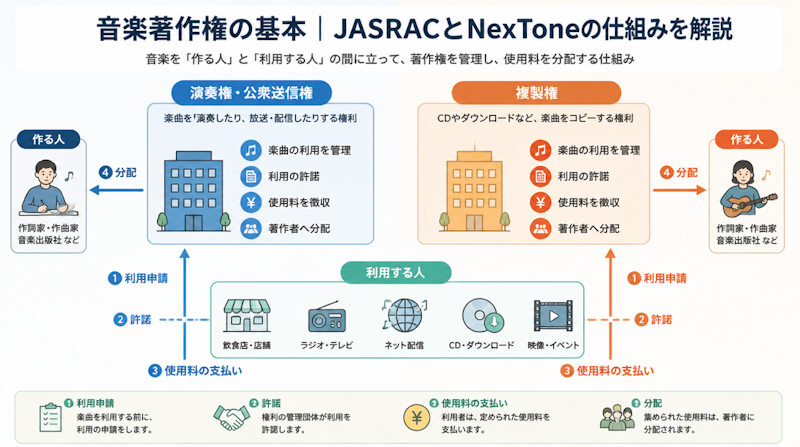
For independent music producers working from home studios, music copyright is an unavoidable topic. Most people have heard the names "JASRAC" and "NexTone," yet few fully understand how these organizations differ or how they actually operate. Without a solid grasp of copyright basics, producers risk unknowingly infringing on someone else's rights — or worse, failing to notice when their own music is used without permission. This article breaks down how JASRAC and NexTone work and how they differ, providing practical copyright knowledge every music producer should have.
What Is Music Copyright? The Rights That Arise in Music Production
Copyright Arises Automatically When a Work Is Created
In Japan, copyright comes into existence automatically the moment a work is created. No registration or application is required — as soon as lyrics are written or a composition is finished, the work is protected. This principle, known as the "no-formality system," is enshrined in Japan's copyright law and mirrors the standards set by the Agency for Cultural Affairs.
Copyright protection lasts for 70 years after the death of the creator (extended from 50 years following the 2018 amendment to Japan's Copyright Act). Original music produced in a DAW is no exception — protection begins the moment a project file is saved. Once the protection period expires, a work enters the public domain and may be freely used by anyone.
The same framework applies internationally. Under the Berne Convention, copyright arises automatically upon creation in all member countries, without any need for registration. This means music produced at home is protected not just in Japan but across the globe from the very moment it is completed.
The Bundle of Rights That Make Up Copyright
Copyright is not a single, monolithic right. It is composed of multiple individual rights — often called "exclusive rights" or "sub-rights" — each covering a different type of use. Music producers should be particularly familiar with the following:
Right | What It Covers | Practical Example for Producers |
|---|---|---|
Reproduction Right | The right to copy or duplicate a work | CD pressing, downloadable audio file distribution |
Public Transmission Right | The right to transmit a work over the internet | Streaming services, YouTube uploads |
Performance Right | The right to perform or present a work publicly | Live concerts, background music in shops |
Adaptation Right | The right to create derivative works from an existing work | Cover song arrangements, remixes |
Distribution and Lending Right | The right to sell or lend physical copies | CD sales, rental services |
Screening and Recitation Right | The right to screen or publicly recite a work | Background music in video productions, narrated streams |
JASRAC and NexTone manage these rights on behalf of rights holders. However, as discussed later in this article, the two organizations differ in how broad their coverage is and how they handle each category of rights.
Who Owns the Copyright in Music Created by Producers
For music produced independently, copyright belongs fundamentally to the lyricist and composer. When multiple people collaborate on a piece, it becomes a "joint work," with all authors sharing the rights equally. Any decisions about the work — including licensing and adaptation — then require the agreement of all co-creators.
When using sample packs or loop libraries, it is essential to review the license terms carefully. Even content marketed as "royalty-free" may restrict commercial use, prohibit redistribution, or limit resale. Always read the End User License Agreement (EULA) before incorporating third-party material into a release.
It is also important to distinguish copyright from neighboring rights (sometimes called related rights). Neighboring rights are granted to performers, phonogram producers, and broadcasters. If a producer wants to use audio from a commercially released recording — for example, sampling a track from a purchased CD — they need not only copyright clearance from the songwriter but also neighboring rights clearance from the record label that owns the master recording.
Why Copyright Management Organizations Exist and What They Do
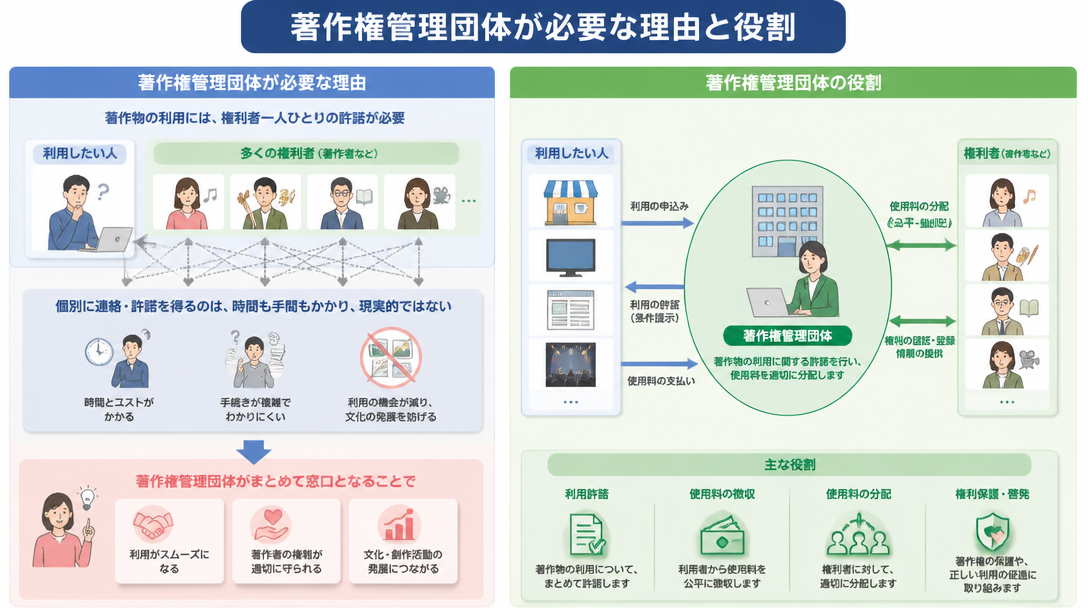
The Limits of Individual Copyright Management
Managing music copyright as an individual is, in practice, extraordinarily difficult. Consider a scenario where a self-produced track is used as background music on a television program. The rights holder would need to contact the broadcaster directly, prove the music was used, and then negotiate and collect payment — all while somehow tracking every instance of use across countless platforms and locations.
Music is consumed across an enormous range of environments: karaoke venues, streaming services, radio stations, television channels, retail store sound systems, and more. Negotiating individually with each of these parties and collecting fees from all of them is beyond the practical capacity of any individual creator, even a well-established professional. Delegating this responsibility to a specialist organization is the realistic approach.
The Three Core Functions of a Copyright Management Organization
Organizations like JASRAC and NexTone — formally known as "copyright management businesses" under Japanese law — perform three essential functions:
- Granting Licenses: Acting on behalf of rights holders, they grant blanket licenses to music users (broadcasters, karaoke operators, streaming platforms, etc.), enabling those parties to legally use managed works without negotiating with each rights holder individually.
- Collecting Royalties: They collect copyright royalties from licensed users based on established fee schedules and usage data.
- Distributing Royalties: After deducting their management fees, they distribute the collected royalties to rights holders — typically lyricists, composers, and music publishers.
This system benefits both sides. Rights holders receive royalty payments whenever their music is used, without having to track down users individually. Users, meanwhile, can access large catalogs of music under a single licensing agreement, greatly simplifying compliance.
The Current State of Japan's Music Copyright Management Market
Japan's music copyright management market is currently a two-player field: JASRAC and NexTone. JASRAC holds the dominant share by a wide margin, but since NexTone was established in 2016, a degree of competitive pressure has emerged in an industry that was long a monopoly. Industry observers have noted that NexTone's entry has contributed to greater flexibility in the market overall — for instance, prompting both organizations to improve their digital services and fee structures.
For music users, competition between the two organizations creates the expectation of lower management fees and more streamlined procedures over time. For rights holders, it means having a genuine choice between two organizations with different strengths and contract structures, allowing creators to select whichever best fits their professional needs.
How JASRAC Works: A Complete Breakdown
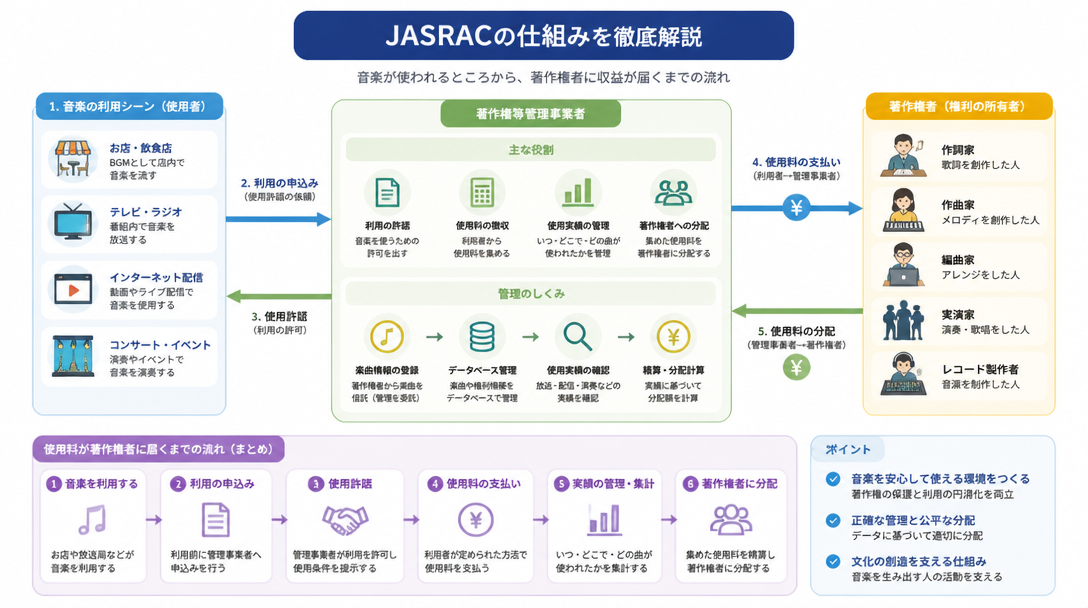
What Is JASRAC? A Non-Profit With Over 85 Years of History
JASRAC (the Japanese Society for Rights of Authors, Composers and Publishers) is Japan's largest music copyright management organization, founded in 1939. It operates as a general incorporated association — a non-profit — and covers virtually every form of music use: television and radio broadcasting, karaoke, live concerts, and internet distribution, among others.
JASRAC is a member of CISAC (the International Confederation of Societies of Authors and Composers), a global network of copyright management organizations spanning 125 countries and territories. Through this network, JASRAC can collect royalties when Japanese artists' music is used overseas, and can distribute earnings from foreign uses back to Japanese rights holders — a significant advantage for anyone with international audiences.
The Trust Contract: How Copyright Transfers to JASRAC
When a rights holder entrusts their works to JASRAC, they do so via a trust contract. Under this arrangement, the copyright itself is legally transferred to JASRAC for the duration of the contract. This means JASRAC becomes the legal copyright holder and can take direct legal action — including filing lawsuits — against parties that use managed works without authorization.
This legal standing is one of the key practical advantages of the trust model: if a song is used without permission, JASRAC can pursue enforcement independently, without requiring the original creator to initiate or fund litigation. The process of signing up and activating a JASRAC contract takes approximately 20 days from the point of application, and there are no application fees, contract fees, or song registration fees. Management fees are deducted from royalties at the time of distribution.
Key Advantages of Registering With JASRAC
- Comprehensive rights coverage: JASRAC manages performance rights, reproduction rights, public transmission rights, and more — covering virtually all categories of use.
- International royalty collection: Through the CISAC network, JASRAC can recover royalties from uses in 125 countries and territories worldwide.
- Transparent operations: As a non-profit, JASRAC is required to publicly disclose collection and distribution figures on a regular basis.
- Established track record: Over 85 years of operation provide institutional stability and a well-tested management infrastructure.
- No upfront cost: There are no application, contract, or song registration fees — management fees are only deducted when royalties are distributed.
- Blanket agreement with YouTube: JASRAC has a comprehensive licensing agreement with YouTube, meaning most JASRAC-managed songs can be legally used in YouTube videos without the uploader needing to seek individual permission.
Potential Drawbacks and Considerations for JASRAC Registration
- Copyright transfer during the contract period: Because ownership of the copyright moves to JASRAC under the trust structure, creators may face restrictions on independently offering free-use licenses, setting custom pricing, or distributing works at no charge for promotional purposes.
- Limited ability to manage works selectively: In general, all works submitted to JASRAC fall under its management — it is difficult to selectively exclude certain songs from the arrangement.
- Requirements for individual direct registration: Songwriters and composers wishing to register directly as individuals (rather than through a music publisher) must meet eligibility criteria including a registration fee and a documented track record of professional music activity.
- Implications for work-for-hire arrangements: Once works are entrusted to JASRAC, providing music as flat-fee buyouts to clients such as independent event producers or video production companies can become more complicated, since the copyright technically resides with JASRAC during the contract term.
How NexTone Works: A Complete Breakdown
What Is NexTone? A New-Generation Copyright Company Built for the Digital Age
NexTone was established in 2016 through the merger of two existing copyright management businesses, e-License and Japan Rights Clearance. Unlike JASRAC, NexTone is a for-profit corporation (kabushiki kaisha), and it was founded with a specific mission: to bring competition and flexibility to a copyright management market that had long been dominated by a single player. Its core strengths lie in digital and streaming-era rights management, and it offers services tailored to the needs of artists and labels whose work lives primarily online.
From the outset, NexTone has prioritized integration with digital platforms such as YouTube, Spotify, and Apple Music. In addition to rights management, it also operates a digital music distribution service, enabling artists to both manage their rights and deliver their music to global streaming platforms through a single company.
The Agency Contract: Copyright Stays With the Rights Holder
NexTone's arrangement with rights holders takes the form of an agency contract (also described as a "representation" or "consignment" model). The fundamental difference from JASRAC's trust contract is that copyright does not transfer to NexTone. Rights holders retain ownership of their copyright and simply authorize NexTone to act on their behalf in managing it.
This structure offers greater flexibility. Because the rights holder retains ownership, they can grant special permissions that would be difficult under a trust arrangement — for example, allowing a specific platform to use a song free of charge for promotional purposes, or negotiating custom licensing terms for particular use cases. The trade-off is that NexTone, as an agent rather than a rights owner, cannot directly initiate legal proceedings if a managed work is used without authorization. In cases of infringement, the rights holder must take legal action themselves.
Strong Integration With Digital Distribution
NexTone's digital distribution service is a meaningful differentiator. Rights holders can use NexTone to both manage their copyright and distribute their music to major streaming platforms — including Spotify, Apple Music, YouTube Music, and Amazon Music — under one roof. This one-stop approach reduces administrative overhead for digital-first artists and labels.
NexTone has also been expanding its rights management scope. Since 2022, the company has begun managing performance rights in certain categories — an area that was previously exclusive to JASRAC — signaling its gradual move into the full spectrum of music copyright management.
NexTone's Distinctive Approach to YouTube
NexTone has developed a particularly noteworthy relationship with YouTube. According to reporting by Musicman, from July 1, 2024, NexTone began directly collecting copyright royalties from Google LLC for YouTube video views worldwide. This arrangement improves the accuracy with which NexTone can identify uses of managed works on the platform and allows for faster distribution of royalties to rights holders.
For creators whose music falls under NexTone's management and is used in YouTube videos, NexTone's official guidance indicates that video uploaders generally do not need to take any special steps — the royalty payment is handled directly between YouTube and NexTone.
JASRAC vs. NexTone: A Detailed Comparison
Side-by-Side Comparison of Contract Type, Coverage, and Structure
Category | JASRAC | NexTone |
|---|---|---|
Founded | 1939 | 2016 |
Organizational Type | General Incorporated Association (non-profit) | Stock Corporation (for-profit) |
Contract Type | Trust contract (copyright transfers to JASRAC) | Agency contract (copyright stays with rights holder) |
Performance Rights (live, BGM, etc.) | Fully managed | Partially managed since 2022 |
Reproduction and Public Transmission Rights | Fully managed | Fully managed |
International Network | CISAC member (125 countries) | Not a CISAC member (partial digital coverage) |
Individual Direct Registration | Available with conditions | Generally available to corporations (music publishers) only |
Digital Distribution Service | Not offered | Available (Spotify, Apple Music, etc.) |
Infringement Litigation | JASRAC can file directly | Rights holder must take action |
Differences in Fees and Royalty Distribution
Both organizations charge management fees that are deducted from royalties before distribution to rights holders, but the specific fee rates differ. JASRAC's fees are filed with Japan's Agency for Cultural Affairs and vary by usage category — different rates apply to broadcasting, live performance, recording, and so forth. NexTone sets its own fee structure as a private company, with rates that can differ by rights category and that are generally designed to be competitive with JASRAC's.
The timing of royalty distributions also differs. JASRAC distributes royalties four times per year, typically in June, September, December, and March. NexTone, with its emphasis on digital-first management, aims for more granular, data-driven distribution cycles — particularly for streaming and digital platform royalties, where usage data is available on a more continuous basis.
For rights holders trying to evaluate the two organizations purely on fee grounds, the practical differences are often subtle and depend heavily on the specific mix of rights being managed and where the music is being used. It is worth requesting current fee schedules directly from each organization and comparing them against projected usage patterns.
Which Organization Can an Individual Music Producer Join?
This is a practical question that affects many independent producers. The short answer is that direct individual registration is restricted at both organizations, though for different reasons.
At JASRAC, individual songwriters and composers can register directly, but the process requires a registration fee (currently ¥27,000 including tax) and documented evidence of professional music activity within the past year — such as a commercially released CD, music used in a broadcast, or income from live performances. Without meeting these criteria, direct registration is not available.
NexTone, by contrast, generally limits direct contracts to corporate entities — primarily music publishers. Individual creators cannot typically register with NexTone on their own.
For independent producers who do not yet meet JASRAC's eligibility criteria or who prefer not to work through a music publisher, the practical options are:
- Sign with a music publisher, which will then register works with JASRAC or NexTone on the creator's behalf.
- Build up a qualifying track record of professional activity and then apply to JASRAC individually.
- Use a digital music distributor (such as TuneCore, DistroKid, or similar services) that offers copyright management features as part of their distribution package.
Practical Copyright Rules Every Music Producer Should Know
Using Someone Else's Music in YouTube Videos or Livestreams
If a producer wants to use another artist's music in a YouTube video or live broadcast, they generally need authorization from the copyright holder — or their designated management organization. The first step is to check whether the song in question is managed by JASRAC using the JASRAC Work Search database (J-WID). If it is, the situation for YouTube is relatively straightforward: JASRAC has a blanket licensing agreement with YouTube, meaning most JASRAC-managed songs can be included in YouTube videos without the uploader needing to seek individual clearance or pay a separate fee. The royalty flows from YouTube to JASRAC and then to the rights holder automatically.
However, there is an important caveat: this blanket agreement covers the copyright in the song itself (melody and lyrics). It does not cover neighboring rights in the specific recording. If a producer wants to use the actual recorded audio from a commercial release — rather than creating a new recording — they must also obtain clearance from the record label that owns the master recording. This is a separate and distinct rights category from the songwriting copyright.
For songs managed by NexTone, the same general principle applies: NexTone's agreement with YouTube means that video uploaders do not need to handle payment themselves. NexTone collects royalties directly from Google and distributes them to rights holders.
Cover Songs, Arrangements, and Sampling: What to Watch Out For
Recording and releasing a cover version of a song managed by JASRAC or NexTone is generally possible by paying the applicable royalty under each organization's published fee schedule. However, there are important nuances depending on what the cover involves:
- Arrangements: The right to create arrangements (derivative works) is the adaptation right. Even when a royalty is paid, the original creator retains moral rights — including the right of integrity, which protects the work from modifications that would harm the creator's honor or reputation. Significant alterations may therefore require direct approval from the original author, above and beyond the royalty payment.
- Parody and lyric rewrites: Changing the original lyrics requires prior consent from the rights holder. Royalty payment alone does not authorize lyric modifications.
- Sampling: Using a portion of an existing audio recording (rather than re-recording the underlying song) involves two separate layers of rights. Copyright clearance for the underlying composition must be obtained from the relevant management organization. Separately, neighboring rights clearance for the master recording must be obtained from the record label. Both are required — neither alone is sufficient.
- AI-generated music: The use of AI tools to generate music based on existing songs raises emerging legal questions around copyright ownership, training data rights, and the originality threshold for AI outputs. Regulatory frameworks are evolving in many jurisdictions, and producers using AI tools should stay current on the latest legal developments in their country.
What to Do If Your Own Music Is Used Without Permission
A producer who has not registered their works with a management organization and discovers that their music has been used without authorization must pursue enforcement independently. Without the institutional backing of an organization like JASRAC (which can file suit on a rights holder's behalf under a trust contract), the individual creator must gather evidence and initiate any legal action themselves.
Proactively maintaining good records of the creative process is the most effective way to establish rights in the event of a dispute. Useful practices include:
- Retaining DAW project files with creation timestamps intact in the file metadata.
- Keeping draft recordings, early sketches, and work-in-progress exports.
- Storing project backups in cloud services that record upload timestamps (such as Google Drive, Dropbox, or iCloud).
- Posting creation-process content — early demos, behind-the-scenes clips, production screenshots — to social media, creating a publicly visible and time-stamped record of development.
These records do not constitute formal copyright registration (which is not required in Japan), but they can significantly strengthen a creator's position when proving that a work was created at a specific point in time.
Getting Started With Copyright Management for Your Own Music
How Copyright Management Works Through a Music Publisher
The most common route to copyright management for professional musicians is through a music publisher. The typical structure works as follows:
- A songwriter or composer enters into a publishing contract with a music publisher, transferring some or all of the copyright (specifically, the publishing rights) to the publisher.
- The music publisher registers the works with JASRAC or NexTone on behalf of the creator.
- When the works are used commercially, the management organization collects the applicable royalties, takes its management fee, and distributes the remainder to the music publisher, which then passes the creator's share on to them according to the terms of their publishing agreement.
Understanding this structure is valuable for any producer who is considering signing a publishing deal. The terms of a publishing contract — including the percentage of rights transferred and the royalty split — have a direct impact on long-term earnings, so it pays to evaluate these agreements carefully before signing.
JASRAC Direct Registration: Eligibility and Process
For individual songwriters and composers who want to manage their rights through JASRAC without going through a music publisher, direct registration is possible once certain conditions are met:
Requirement | Details |
|---|---|
Ownership of original works | Must hold copyright in original songs or lyrics of their own creation |
Track record of professional activity | Must have documented, compensated music activity within the past year (e.g., commercially released recordings, broadcast use, live performance income) |
Registration fee | ¥27,000 (tax included) |
Applications can be submitted online or by post via the JASRAC rights holder registration page. From submission to contract activation typically takes around 20 days.
Using Digital Distribution Platforms for Copyright Management
For independent producers who have not yet met JASRAC's eligibility requirements and are not currently signed to a music publisher, digital music distributors such as TuneCore and DistroKid offer a practical intermediate option. These platforms handle digital distribution to streaming services and, in many cases, offer publishing or copyright administration features that can collect certain types of streaming royalties on the creator's behalf.
It is important to understand that these services are not direct substitutes for JASRAC or NexTone registration. The scope of rights covered, the types of royalties collected, and the fee structures differ significantly. Streaming royalty collection through a distributor typically covers mechanical royalties generated by plays on platforms like Spotify and Apple Music, but may not cover performance royalties, synchronization royalties, or royalties from uses outside the streaming context.
As a creator's profile and activity level grow, it becomes increasingly worthwhile to graduate from distributor-based copyright management to direct registration with JASRAC or a formal relationship with a music publisher. For more information on the tools and workflow involved in music production itself, see the Complete Guide to Choosing a DAW.
Summary
Here is a concise overview of the key points covered in this article:
- Music copyright arises automatically the moment a work is created — no registration is needed, and protection lasts for 70 years after the creator's death.
- JASRAC uses a trust contract, under which copyright temporarily transfers to the organization. This enables comprehensive rights management — including performance rights — and gives JASRAC the standing to pursue legal action against infringers directly. It also operates through the CISAC international network, enabling royalty collection in 125 countries.
- NexTone uses an agency contract, under which the rights holder retains copyright ownership. This allows for greater flexibility in licensing arrangements and offers strong integration with digital streaming platforms. However, rights holders must handle any legal enforcement themselves.
- Individual direct registration with JASRAC requires a ¥27,000 fee and a documented track record of professional music activity. NexTone generally only accepts direct contracts from corporate entities such as music publishers.
- When using JASRAC-managed music in a YouTube video, the blanket agreement between JASRAC and YouTube means uploaders generally do not need to file separate paperwork — but neighboring rights in the specific recording remain a separate matter.
- Protecting your own music requires keeping thorough records of the creative process, and choosing a copyright management approach suited to your current level of professional activity.
- The three realistic options for independent producers are: working through a music publisher, qualifying for and applying to JASRAC directly, or using a digital distributor that offers copyright administration features.