DistroKid vs TuneCore (2026): Pricing & Which Is Better
DistroKid vs TuneCore in 2026: compare pricing, royalties, and payout speed to decide which distributor is better for releasing on Spotify and Apple Music.
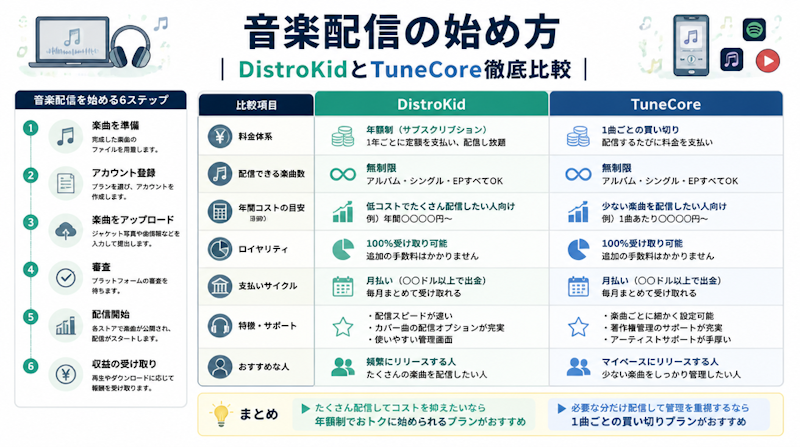
Quick Answer: DistroKid vs TuneCore in 2026
Which is better? For high-volume artists who release many singles a year, DistroKid (from $24.99/year, unlimited uploads) is the most cost-efficient. For Japan-based artists who want yen bank transfers, Japanese-language support, and karaoke (JOYSOUND / DAM) distribution, TuneCore Japan is the better fit. Want to test with minimal risk? TuneCore Japan's Pay Per Release (from ¥1,551/year for a single) is the cheapest way to start.
Below we compare both services on pricing, supported stores, distribution speed, royalties, and payout methods — updated for 2026 — so you can choose the right distributor before your next release.
For independent artists who want their music heard on Spotify, Apple Music, and beyond, choosing the right music distribution service is one of the most critical decisions in a modern music career. Two platforms dominate this space: DistroKid and TuneCore Japan. This guide delivers an in-depth comparison of both services across pricing, supported stores, royalty payouts, distribution speed, and features tailored to independent artists — so you can make an informed choice before your first (or next) release.
What Is a Music Distribution Service?
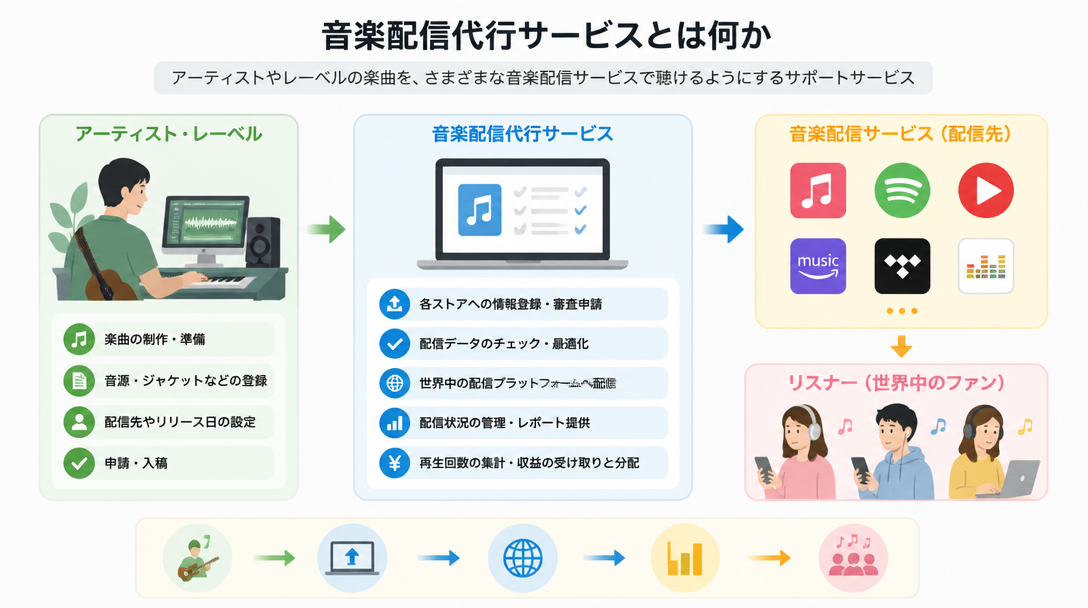
How Streaming Distribution Works
Getting your music onto Spotify or Apple Music is not as simple as uploading a file directly to those platforms. Streaming services do not typically accept music from individual artists — they work exclusively with licensed distributors. A music distributor acts as the middleman: it takes the audio files and metadata you provide, converts them to the required digital formats, and delivers them to hundreds of streaming services and download stores simultaneously.
Not long ago, commercial music distribution required a record label deal. Today, services like DistroKid and TuneCore have democratized the process entirely. Any independent artist can distribute music to over 150 countries and major platforms worldwide without signing away their rights or paying upfront advances. When your tracks are streamed, the platform pays royalties to the distributor, who then passes that revenue on to you.
What Independent Distribution Makes Possible
Using a music distribution service gives independent artists access to opportunities that were once reserved for signed acts. Specifically, self-distribution allows you to:
- Deliver music to 150+ platforms simultaneously — including Spotify, Apple Music, YouTube Music, Amazon Music, TikTok, Instagram, and more
- Retain 100% ownership of your master recordings and publishing rights
- Collect streaming royalties based on play counts across all platforms
- Set a specific release date, including pre-save campaigns to build anticipation
- Access detailed analytics on streams, listener demographics, geographic data, and follower growth
The scope of independent distribution continues to expand. TuneCore Japan, for example, offers a karaoke distribution feature that places your songs into major Japanese karaoke systems — a unique avenue for artist exposure and royalty generation that most global distributors do not offer.
DistroKid vs TuneCore Japan: Pricing Compared
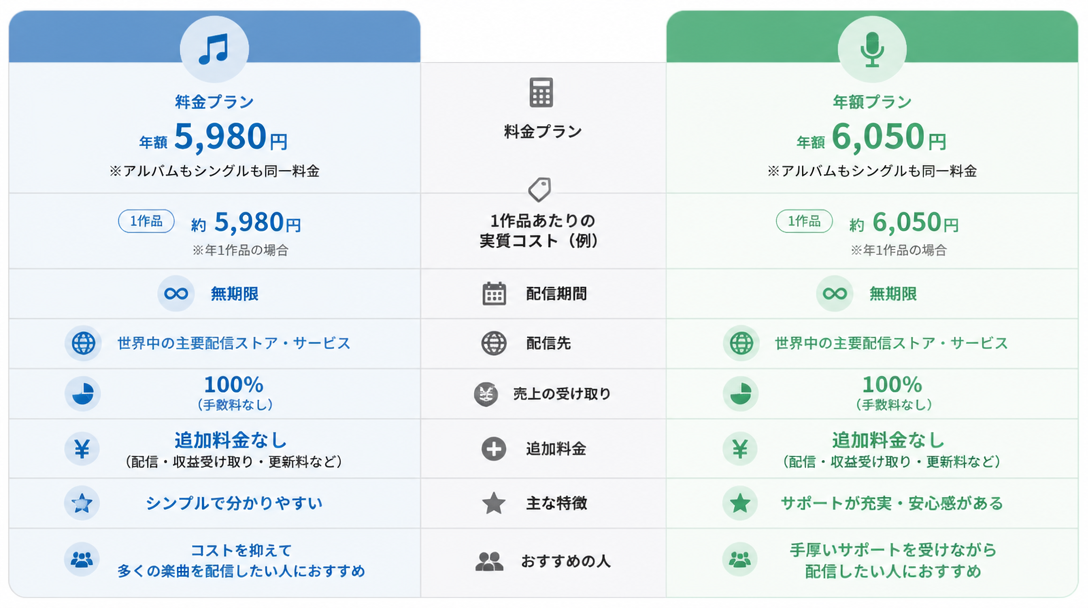
DistroKid Pricing Plans
DistroKid's defining feature is its flat-rate annual subscription with unlimited releases. No matter how many singles, EPs, or albums you put out in a year, the cost remains the same. As of 2026, DistroKid offers the following plans:
Plan | Annual Price (USD) | Artists Covered | Key Features |
|---|---|---|---|
Musician | $24.99 | 1 artist | Unlimited releases, 100% royalty payout |
Musician Plus | $44.99 | 2 artists | Custom release dates, Spotify pre-save, detailed analytics |
Ultimate | $89.99 | Up to 100 artists | Team management, label-style multi-artist dashboard |
For artists who release music frequently throughout the year, DistroKid's flat-rate model delivers exceptional value. One important caveat: YouTube Content ID monetization is not included by default. Registering a release for Content ID costs an additional $4.95 per release plus a 20% revenue share, which can add up if you have a large back catalog (Chartlex 2026 Comparison).
TuneCore Japan Pricing Plans
TuneCore Japan provides a Japanese-language interface, yen-based billing, and local payment methods, making it particularly accessible for artists based in Japan. According to the official TuneCore Japan pricing page, the current plans as of 2026 are as follows:
Plan | Annual Price (JPY, tax included) | Key Features |
|---|---|---|
Starter (Unlimited) | ¥4,400 | 1 artist, unlimited releases |
Standard (Unlimited) | ¥9,900 | Daily analytics, revenue splitting tools |
Pro (Unlimited) | ¥23,100 | 2+ artists, playlist pitching, Spatial Audio support |
Pay Per Release (Single) | From ¥1,551/year | Per-release billing, no subscription required |
Pay Per Release (Album) | From ¥5,225/year | Per-release billing for full-length projects |
The Pay Per Release option is cost-effective for artists who only release one or two tracks per year, since there is no ongoing subscription fee. However, for anyone releasing three or more singles annually, an Unlimited plan quickly becomes more economical.
How CD Baby Compares on Price
It is worth benchmarking both services against CD Baby, another widely used global distributor. CD Baby operates on a one-time upfront fee model — you pay once per release and are not charged an annual renewal fee. Here is how the three services compare at a glance:
Service | Billing Model | Approximate Single Cost | Royalty Rate |
|---|---|---|---|
DistroKid | Annual flat rate | $24.99/year (unlimited) | 100% |
TuneCore Japan | Unlimited subscription or per-release | From ¥1,551/year (Pay Per Release) | 100% |
CD Baby | One-time upfront fee | $9.99 (one time) | 91% |
CD Baby's low upfront cost and lack of annual renewals can be appealing, especially for artists testing the waters. However, the 9% royalty cut taken on every payout means revenue loss that compounds over time, particularly as streaming numbers grow (DTMer.info Music Distribution Comparison).
Supported Stores and Distribution Speed
Platform Coverage
DistroKid, TuneCore Japan, and CD Baby all distribute to 150+ stores and streaming platforms. The major destinations covered by all three services include:
- Streaming platforms: Spotify, Apple Music, YouTube Music, Amazon Music Unlimited, Deezer, Tidal, Pandora (US)
- Download stores: iTunes/Apple Music, Amazon MP3
- Social and short-form video: TikTok, Instagram/Facebook (music stickers and reels), Snapchat
- Discovery tools: Shazam
- Japan-specific platforms: LINE MUSIC, AWA, mora
TuneCore Japan holds a particular advantage in the Japanese domestic market through deeper integrations with LINE MUSIC and AWA, two of Japan's most popular streaming services. TuneCore Japan also supports Spatial Audio distribution (Dolby Atmos format) via its Pro plan, allowing artists to deliver immersive audio experiences to Apple Music listeners — a feature becoming increasingly important as spatial audio adoption grows.
Time to Release: How Fast Will Your Music Go Live?
Distribution lead times matter, especially when coordinating a release campaign with press, playlist pitching, and social media. Here is what to expect from each service:
Service | Typical Delivery Time | Notes |
|---|---|---|
DistroKid | 1–5 business days | TikTok: 1–2 days; Spotify: 2–5 days |
TuneCore Japan | 2–10 days (plan-dependent) | Standard and above: ~2 days; Starter: ~10 days |
CD Baby | 3–5 business days | Slightly slower than DistroKid on average |
Regardless of which distributor you choose, submitting your release at least two weeks before the intended release date is strongly recommended. For Spotify editorial playlist pitching, the submission must be completed at least seven days before the release date — and the earlier the better (ArisTake Digital Distribution Comparison).
Royalties: How You Get Paid
What "100% Royalties" Actually Means
Both DistroKid and TuneCore Japan advertise 100% royalty payouts to artists. This means the distributor does not take a percentage cut of what the streaming platform pays out — the full amount passes through to you. However, this figure refers to what the distributor receives after the streaming platform has already taken its own share of subscription and advertising revenue.
To put concrete numbers on streaming income, here are the approximate per-stream payout rates across major platforms as of 2026:
- Spotify: approximately $0.003–$0.005 per stream
- Apple Music: approximately $0.007–$0.010 per stream
- Amazon Music: approximately $0.004–$0.006 per stream
These rates fluctuate based on the listener's country, their subscription tier (free vs. premium), and the proportion of total streams your track accounts for in a given period. Maximizing streaming income generally means distributing to as many platforms as possible rather than relying on a single service.
Getting Paid: Bank Transfers and Payment Methods
One of the most practical differences between these two distributors — especially for artists based in Japan — is how royalties are paid out.
- TuneCore Japan: Supports direct bank transfers to Japanese bank accounts in Japanese yen. The minimum withdrawal amount is ¥1,000, and the process is straightforward with no currency conversion required.
- DistroKid: Pays out primarily via PayPal or Payoneer. Transferring funds from PayPal to a Japanese bank account incurs foreign exchange conversion fees of approximately 2–3%, and requires a verified PayPal account to be set up in advance.
For artists operating entirely within Japan, TuneCore Japan's direct yen-denominated payouts eliminate both the administrative hassle and currency risk associated with international transfers (MASTER SOUND Distribution Guide). DistroKid does support Payoneer for international transfers, but direct transfers to Japanese bank accounts are not available natively.
Features Tailored for Independent Artists
Karaoke Distribution: JOYSOUND and DAM
One of TuneCore Japan's most distinctive offerings — and one with no equivalent at DistroKid — is its karaoke distribution service. Through a partnership with JOYSOUND, independent artists can have their songs available for customers to sing at karaoke venues across Japan. This is a genuinely unique monetization channel unavailable through most global distributors.
According to the TuneCore Japan karaoke distribution page, the service details as of 2026 are as follows:
- Initial fee: ¥4,400 (tax included) per song — a 50% introductory discount of ¥2,200 is available through December 31, 2026
- Annual management fee: ¥1,100 (tax included)
- Estimated delivery time: JOYSOUND approximately 3–7 days; DAM requires a separate review process
- Required materials: Audio file (or video) plus lyrics data
JOYSOUND provides daily performance reports showing how many times your song has been sung in venues nationwide. For songs with registered copyright management, performance royalties are also payable based on the number of karaoke plays — creating an additional passive income stream for eligible artists.
Language Support and User Interface
TuneCore Japan offers a fully Japanese-language interface, Japanese-language email support, and a dashboard where all revenue, stream counts, and release data are displayed in Japanese. This significantly lowers the barrier to entry for artists who are not comfortable navigating English-only platforms.
DistroKid, by contrast, is English-only across its interface and customer support. While DistroKid's design is clean and intuitive enough that non-native English speakers can generally navigate it without difficulty, there is no official Japanese-language assistance available. For artists who prioritize simplicity and speed over localization, DistroKid's streamlined workflow is genuinely efficient. The choice is somewhat analogous to selecting a DAW: just as with choosing between Logic, Ableton, and FL Studio, the right tool depends on how you work and what features you actually need.
DistroKid vs TuneCore Japan: Which Should You Choose?
DistroKid Is Better for High-Volume Releases
Artists who plan to release four or more singles per year will find that DistroKid's annual flat-rate model offers the best cost efficiency. Releasing four singles via TuneCore Japan's Pay Per Release option would cost at least ¥6,204 per year. DistroKid's Musician plan, priced at approximately $24.99 annually (roughly ¥3,750 at 2026 exchange rates), covers unlimited releases regardless of output volume.
DistroKid is also the stronger choice for anyone managing multiple project names — separate solo and band aliases, remix-only project names, collaborative projects — since the Musician Plus plan covers two artists and the Ultimate plan scales up to 100. The dashboard makes it easy to switch between projects and track performance separately across all of them.
TuneCore Japan Is Better for Japan-Focused Artists
For artists whose primary audience is in Japan, TuneCore Japan's domestic features are unmatched. The combination of Japanese-language support, direct yen bank transfers, deep integrations with LINE MUSIC and AWA, karaoke distribution to JOYSOUND and DAM, and Spatial Audio support makes TuneCore Japan the natural choice for artists building a fanbase in the Japanese market.
TuneCore Japan is also well-suited to artists navigating Japan's music copyright landscape. Its infrastructure aligns naturally with JASRAC and NexTone registration workflows, making it easier to manage music copyright alongside your distribution activity without dealing with the added complexity of operating through an overseas-based platform.
Which Is Better for Beginners?
For a first-time distributor who is comfortable in English and wants to keep initial costs as low as possible while reaching a global audience, DistroKid is hard to beat. The onboarding process is fast, the interface is clear, and $24.99 gets you access to unlimited releases from day one.
For artists who prefer navigating the process in Japanese, want access to a Japanese-speaking support team, or are unsure about committing to an annual subscription, TuneCore Japan is the more reassuring starting point. Neither service offers a free trial, but the TuneCore Japan Pay Per Release option — starting from ¥1,551 for a single — is the lowest-risk way to experience a live release, evaluate the platform, and decide whether a full subscription makes sense down the line.
How to Start Distributing Your Music: A Step-by-Step Overview
Account Setup and Release Submission
The core workflow is broadly similar across all major distributors. Here is what the process looks like from start to finish:
- Create an account on the distributor's website, select a plan, and complete payment
- Set up your artist name and label name (if applicable)
- Upload your audio file (WAV format, minimum 16-bit/44.1 kHz recommended)
- Enter your track metadata: title, artist name, release year, genre, ISRC code, and any featured artist credits
- Select your target stores and set your release date
- Submit for review — once approved, your music goes live on the specified date across all selected platforms
What to Prepare Before You Submit
Having all required assets ready before starting the submission process will save significant time. Here is what you need:
- Cover artwork: Minimum 3,000 × 3,000 pixels, RGB color mode, JPEG or PNG format. Must be original or royalty-free — no copyrighted imagery without permission
- ISRC code: International Standard Recording Code, used to identify individual tracks. Most distributors generate this automatically at no extra cost
- UPC/EAN barcode: Required for albums and product identification. Also typically auto-generated by the distributor
- Lyrics: Used for integration with lyrics platforms such as Genius and Musixmatch. Required if pursuing karaoke distribution via TuneCore Japan
Preparing a high-quality audio file is arguably the most important step. Streaming platforms apply loudness normalization — Spotify targets approximately −14 LUFS, Apple Music targets −16 LUFS — so understanding mastering fundamentals and loudness standards before you submit is essential to ensuring your music sounds its best across all platforms.
From Submission to Live Release
After submission, the distributor's review team checks both the audio file and metadata for technical compliance and content policy adherence. Assuming everything passes review, your release will go live on all selected stores on your specified date.
For first-time releases, it is worth setting up your Spotify for Artists and Apple Music for Artists profiles in parallel with your distribution submission. These verified artist profiles give you access to real-time streaming analytics, allow you to customize your artist profile page, and — on Spotify — enable you to pitch unreleased tracks directly to editorial playlist curators before your release date.
Strong distribution starts with strong audio. Developing your understanding of mixing fundamentals including EQ and compression and refining your approach to home vocal recording will ensure the music you release represents your abilities at their best — no distribution platform can compensate for a poorly mixed or recorded track.
Summary
Both DistroKid and TuneCore Japan are reputable, well-established music distribution services capable of getting your music onto every major streaming platform worldwide. The right choice depends on your release frequency, your primary audience, how you prefer to receive payments, and what language you want to use when managing your catalog.
- For unlimited releases at a flat annual rate, DistroKid (from $24.99/year) offers the best cost efficiency for prolific artists
- For Japanese-language support and direct yen bank transfers, TuneCore Japan (from ¥4,400/year) is the more practical choice for Japan-based artists
- Karaoke distribution to JOYSOUND and DAM is available exclusively through TuneCore Japan
- Both services offer 100% royalty payouts to artists (after streaming platforms take their own cut)
- First-time artists who want to test distribution with minimal risk should consider TuneCore Japan's Pay Per Release option (from ¥1,551/year for a single)
Related Articles
- Custom Music Production: Commission Original Tracks — for artists who want original music produced, not just distributed
- Music Copyright Basics: How JASRAC and NexTone Work
- Mastering Fundamentals: Loudness Standards and Pre-Release Finishing
- Mixdown Essentials: A Beginner's Guide to EQ and Compression