Sidechain Compression Guide: Pumping & Ducking Explained
Master sidechain compression in music production. Learn pumping, ducking, key parameters, and step-by-step DAW setup for Ableton Live, Logic Pro, and FL Studio.
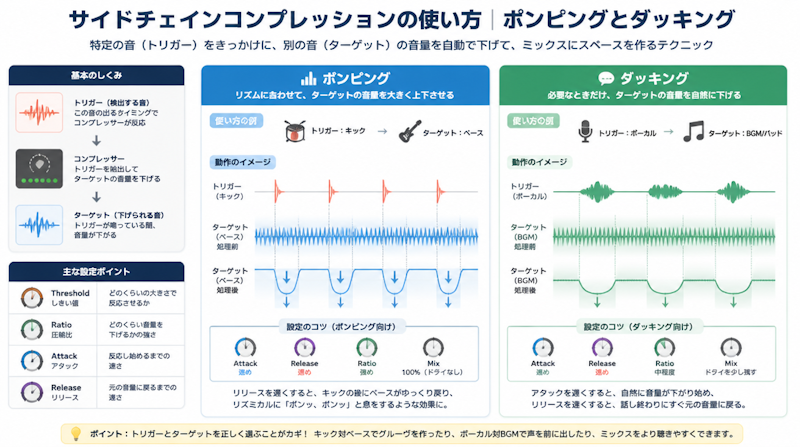
Sidechain compression is one of the most essential techniques in modern music production. From the iconic pumping effect in EDM to transparent vocal clearing in pop and rock mixes, this method is used across virtually every genre. Understanding how it works — and how to apply it deliberately — can dramatically elevate the quality of a mix. This guide covers everything from the fundamental mechanics of sidechain compression to step-by-step DAW setup instructions and advanced creative techniques.
What Is Sidechain Compression?
How It Differs from Standard Compression
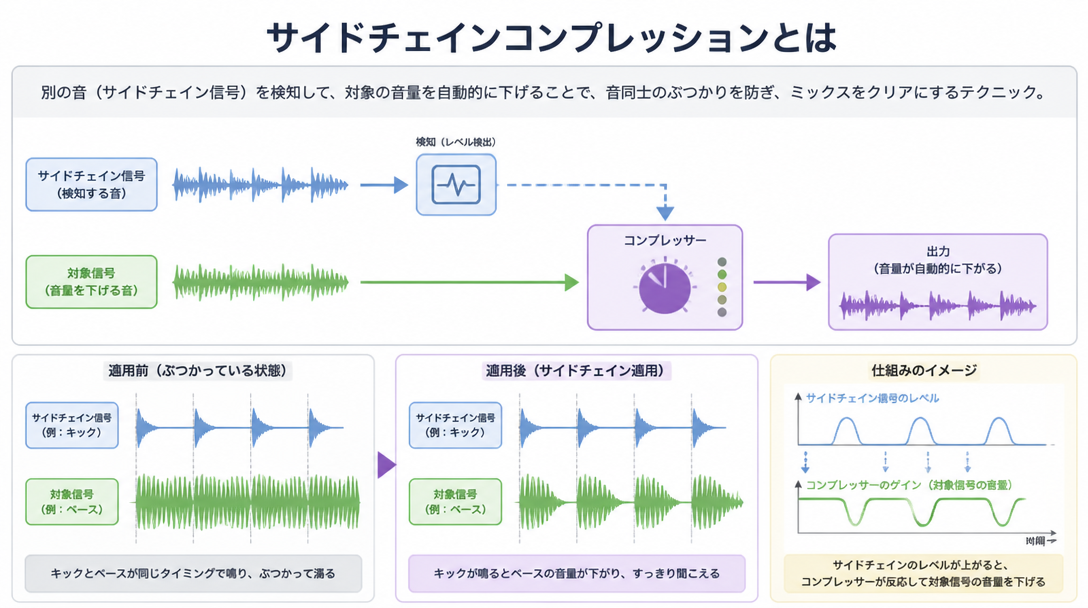
A compressor is an audio processor that automatically reduces the volume of a signal whenever it exceeds a set level, known as the threshold. A standard compressor monitors its own input signal and compresses itself accordingly — it listens to what it's processing and responds to that.
Sidechain compression changes this dynamic entirely. Instead of reacting to its own input, the compressor is instructed to listen to a completely separate audio signal — known as the sidechain, key, or trigger input — and use that signal to determine when to apply gain reduction. As iZotope explains, "when the sidechain input exceeds the threshold, gain reduction is applied to the target track." In other words, the compressor is responding to one sound while compressing another.
A familiar real-world example is radio broadcasting: when a DJ speaks into the microphone, the background music automatically dips in volume. That automatic dip is sidechain compression in action.
Ducking vs. Pumping: Understanding the Difference
Sidechain compression produces two distinct categories of effect, depending on how aggressively it's applied:
- Ducking: A subtle, transparent dip in one instrument's volume whenever another plays. The classic example is a bass synth that gently recedes each time the kick drum hits, reducing frequency masking and creating a cleaner, more separated low end. The effect is intentionally imperceptible to the listener — ideally, it just makes the mix feel cleaner without drawing attention to itself.
- Pumping: A more dramatic, rhythmic rise and fall in volume that is deliberately audible. When synth pads or bass lines visibly "breathe" in sync with a kick drum in a house or EDM track, that's pumping — and it's used as a musical effect, not just a technical fix.
The distinction comes down to intent and settings. Both effects use the same signal chain; the difference lies in how extreme the parameters are and whether the result is meant to be heard.
A Brief History of Sidechain Compression
Origins in Film Sound (1930s)
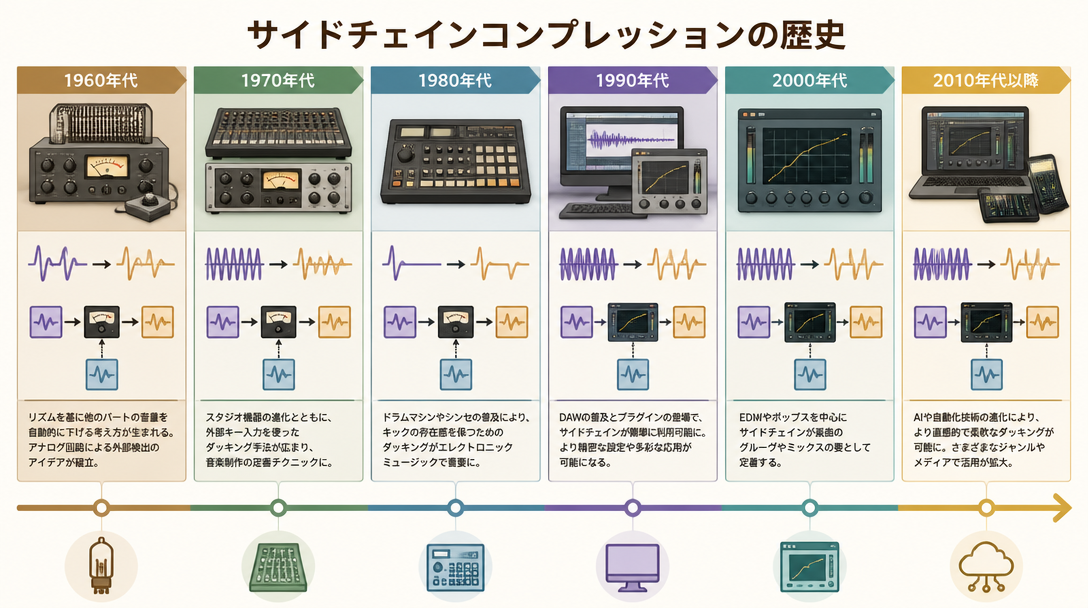
The concept of sidechain processing dates back to the film industry of the 1930s. According to Ableton's official blog, film sound engineer Douglas Shearer developed an early form of sidechain processing to automatically tame sibilance — the harsh "s" and "sh" sounds — in dialogue recordings. This became the conceptual foundation for the de-esser, a tool still widely used in vocal production today.
Through the 1960s, broadcasters adopted similar techniques to automate the balance between narration and background music, allowing a presenter's voice to trigger automatic attenuation of any underlying audio bed.
Mainstream Adoption Through EDM (1990s–Present)
Sidechain compression became a defining sound of popular music in the late 1990s, driven largely by the French house movement. Artists like Daft Punk used heavy kick-triggered ducking on synths and pads to create a distinctive rhythmic pumping sensation that soon spread worldwide and became synonymous with electronic dance music.
Interestingly, the technique has older pop roots than many realize. The Beatles experimented with sidechain-like processing as early as "Tomorrow Never Knows" (1966), using a cymbal signal to trigger dynamic changes on other elements. Since the 2000s, sidechain compression has been embraced across hip-hop, techno, pop, and beyond — making it one of the most versatile and widely used tools in contemporary music production.
Common Applications of Sidechain Compression
Kick and Bass Ducking
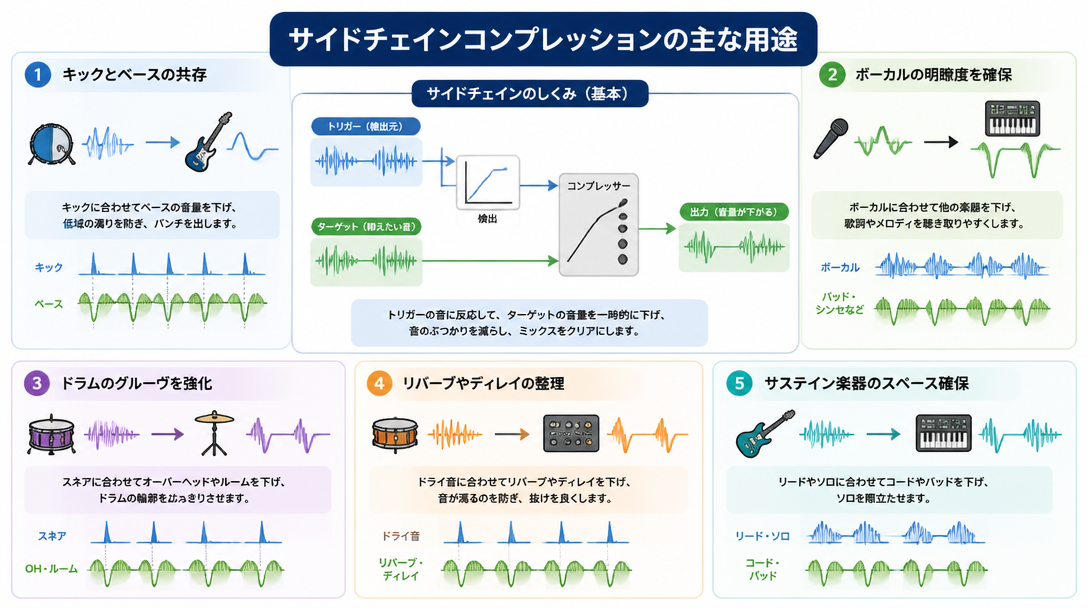
The most common use of sidechain compression in modern mixing is managing the relationship between kick drum and bass — whether that's a bass guitar or a bass synthesizer. Both instruments occupy the same low-frequency range, and when they hit simultaneously, the low end can become congested, muddy, and undefined.
As EDMProd notes, "kick and bass occupy the same frequency range and will naturally compete in the low end by default." By routing the kick drum as the sidechain trigger for a compressor on the bass track, the bass briefly dips each time the kick hits. The result is a punchier, more defined kick without having to sacrifice the presence or weight of the bass line.
Recommended starting settings for this application: ratio around 5:1, attack around 4ms, release around 60ms. The effect should be noticeable in the mix but not dramatically audible on its own.
Vocal Clearing
In sections where a lead vocal is present, sidechain compression can be used to gently push backing instruments out of the way whenever the vocalist sings. The vocal track acts as the sidechain trigger, and a compressor on the guitars, synths, or even the full backing bus applies light gain reduction in response.
The key here is subtlety. Typical settings for vocal clearing: ratio around 2:1, attack around 30ms, release around 250ms. The backing track should simply feel like it has more space — listeners shouldn't consciously notice the compression happening. This technique is particularly effective in dense arrangements where the vocal tends to get buried during chorus sections.
EDM Pumping Effects
In EDM and house music, sidechain compression isn't used as a transparent fix — it's a deliberate sonic statement. The rhythmic, pulsating motion of synth pads rising and falling in sync with a four-on-the-floor kick drum is one of the most recognizable sounds in electronic music, and it's entirely the product of intentional, heavy-handed sidechain pumping.
For this application, high ratios (8:1 to infinity:1) are combined with a slightly slower attack (10–30ms) so the kick's initial transient punches through before compression clamps down. The release time is arguably the most critical parameter — it determines how quickly the compressed signal recovers before the next kick hit, and it should be synced to the tempo of the track.
Use the following formula to calculate tempo-synced release times:
60,000 ÷ BPM = duration of one quarter note in milliseconds
BPM | Quarter Note (ms) | Eighth Note (ms) | Recommended Release Range |
|---|---|---|---|
120 BPM | 500ms | 250ms | 200–400ms |
128 BPM | 468ms | 234ms | 180–350ms |
140 BPM | 428ms | 214ms | 160–320ms |
150 BPM | 400ms | 200ms | 150–300ms |
Setting the release so the gain fully recovers just before the next kick hit produces the most musical and rhythmically cohesive pumping effect.
Key Parameters and How to Set Them
Threshold
The threshold determines the level at which the compressor begins responding. In a sidechain configuration, the compressor monitors the trigger track's signal level — not the track being compressed — and applies gain reduction to the target whenever the trigger exceeds this threshold.
A practical starting point is to set the threshold low enough (around -20 to -30 dB) to ensure the trigger signal reliably activates the compressor on every hit. From there, raise the threshold gradually until the compressor only fires when intended. If the trigger signal is inherently weak, some compressors offer a dedicated sidechain gain control to boost the incoming signal before it's compared to the threshold.
Attack
Attack controls how quickly the compressor reaches full gain reduction after the trigger signal crosses the threshold. This parameter has a major impact on the character of the effect:
- Fast attack (1–5ms): The compressor clamps down almost immediately, catching even the initial transient of the kick. This is useful when fast, precise ducking is needed, but can reduce the perceived punch of the kick drum itself.
- Slower attack (10–30ms): The compressor allows the kick's initial transient to pass through before gain reduction kicks in. This preserves the kick's snap and attack while still creating a clear pumping effect — the preferred choice for most EDM pumping applications.
Release
Release determines how long it takes for the compressor to return to its uncompressed state after the trigger signal falls below the threshold. In sidechain compression, this is arguably the single most important parameter.
- Short release (under 50ms): The compressor recovers quickly, making the volume dip brief and barely perceptible. Best for transparent ducking where the effect should not be consciously heard.
- Long release (200–500ms): The compressor recovers slowly, allowing the target signal to gradually swell back up between kick hits. This sustained, rhythmic motion is the defining characteristic of the pumping effect.
As eMastered emphasizes, tempo-syncing the release time is the single most important factor in achieving a pumping effect that feels natural and musically intentional rather than arbitrary or sloppy.
Ratio
Ratio sets the intensity of compression applied once the threshold is crossed. For sidechain compression, the appropriate ratio depends heavily on the intended use:
- Transparent ducking: 2:1 to 4:1 — subtle, largely inaudible compression that simply tidies up the low end.
- Moderate pumping: 6:1 to 10:1 — a clearly audible but controlled pumping effect.
- Heavy EDM pumping: 10:1 to ∞:1 (limiter-style) — maximum gain reduction for the most dramatic, full-on pumping sound.
Setting Up Sidechain Compression in Major DAWs
Ableton Live
Ableton Live's built-in Compressor and Glue Compressor both support sidechain routing natively, making the setup process relatively straightforward. Based on guidance from RouteNote's producer guide, here's how to configure it:
- Insert a Compressor (or Glue Compressor) on the track you want to compress — for example, the bass track.
- Click the small triangle (▼) in the upper-left corner of the Compressor to reveal the Sidechain panel.
- Enable the Sidechain switch to activate external sidechain input.
- Use the Audio From dropdown to select the kick drum track as the trigger source.
- Adjust Threshold, Attack, Release, and Ratio to dial in the desired amount of pumping or ducking.
Ableton's compressor also includes a built-in sidechain EQ, allowing producers to filter the trigger signal so only certain frequencies activate the compression — for example, isolating just the low-frequency kick content to prevent hi-hats from inadvertently triggering the effect.
Logic Pro X
Logic Pro X uses a bus-based routing approach for sidechain compression. Here's the process using Logic's native Compressor plugin:
- Insert the Compressor plugin on the target track (e.g., the bass track you want to duck).
- In the Compressor's interface, locate the Side Chain selector in the upper-right corner and choose the bus or auxiliary channel that carries the trigger signal.
- On the kick drum track, set up a Send routed to that same bus — but set the bus output to No Output so the kick signal reaches the sidechain path without being doubled in the mix.
- Dial in Threshold, Attack, Release, and Ratio on the Compressor to achieve the desired effect.
Logic's native Compressor also includes a sidechain Listen feature, which lets engineers hear the filtered sidechain signal in isolation — helpful for verifying the trigger signal is properly isolated before committing to the full routing.
FL Studio
FL Studio offers several methods for implementing sidechain compression, as outlined in TRIVISION STUDIO's FL Studio guide. The most common approach uses the Fruity Peak Controller or the built-in Fruity Limiter:
- Insert Fruity Limiter on the target track (e.g., bass or synth pad).
- In the Mixer, set up a sidechain routing from the kick drum's mixer channel to the target track's mixer channel using the Send → Sidechain option.
- In Fruity Limiter's COMP section, select the kick drum channel as the sidechain source.
- Adjust THRES (threshold), ATT (attack), and REL (release) to shape the pumping character.
As with other DAWs, the release time formula — 60,000 ÷ BPM — provides a useful starting point for tempo-locked pumping. FL Studio users also have access to volume automation tools like Gross Beat, which can simulate sidechain pumping using LFO-shaped volume curves without a traditional compressor — a popular alternative in certain production styles.
Advanced Techniques: 5 Types of Pumping Effects
Most producers default to the same basic sidechain pumping setup. But as Pro Audio Files documents in their breakdown of pumping techniques, there are at least five distinct approaches — each with its own sonic character and best-use scenarios.
1. Traditional Linear Release
This is the most widely used method. A processed version of the kick drum — trimmed so that only the transient remains, with the sustain and tail removed — is used as a dedicated trigger clip fed into the sidechain input. By using a clean, gate-processed version of the kick (with the low end cut if necessary), the compressor responds more precisely and quickly than it would to a full, untreated kick signal. The result is a tighter, more controlled pumping effect that cuts cleanly between beats.
2. Logarithmic Curve
Achieved using an optical compressor or a compressor with a soft knee setting, this approach produces a release curve that behaves logarithmically — recovering quickly at first, then slowing down as it approaches full gain. The result is a smoother, more musical pumping sensation with a sense of depth and warmth. This works well in contexts where the pumping should feel organic and somewhat refined rather than robotic.
3. Exponential Curve
The inverse of the logarithmic approach: the release recovers slowly at first, then accelerates toward the end of the cycle. This makes the opening moment of release feel more gradual and restrained — the audio seems to hang for a beat before the gain snaps back. The practical advantage is that overall perceived loudness stays more consistent, since the aggressive recovery phase is kept brief. It's a subtler pumping feel that works well in contexts where dynamics need to feel controlled.
4. S-Curve / Gate-Style
This extreme technique uses dedicated volume shaper plugins — such as LFO Tool (by Xfer Records) or Gross Beat (by Image-Line) — to draw a custom S-shaped volume envelope that cuts to near-silence and then returns to full volume almost instantaneously. This isn't achievable with a standard compressor's gain reduction circuit, so a dedicated volume-shaping tool is required. The effect is dramatic and highly artificial — almost a gated stutter — making it best suited for sound design moments, drop builds, and stylized rhythmic breakdowns rather than standard mixing applications.
5. Reverse Pumping
Where traditional sidechain compression causes the target signal to duck downward when the kick hits, reverse pumping uses an expander instead of a compressor — causing the target signal to boost upward in response to the trigger. The effect adds a wave-like, surging rhythmic texture to the mix that is rhythmically synchronized but physically opposite to standard pumping. It's a less common technique but can be highly effective for adding unusual forward momentum or tension to a track, particularly during build-up sections.
Tips for Using Sidechain Compression Effectively
Using Ghost Triggers
A ghost trigger is a muted kick drum track — one that exists solely to trigger the sidechain compressor and is never heard in the final mix. This technique is particularly useful in breakdown sections where the main kick drum drops out, but the producer wants the pumping motion of the synths and pads to continue. By keeping a muted kick pattern running throughout, the sidechain effect remains consistent even when the audible beat pauses, creating a sense of rhythmic tension in sections that would otherwise feel static.
For a broader introduction to compressor fundamentals and how they fit into the mixing workflow, see Mixdown Basics: How to Use EQ and Compression Correctly.
Multiband Sidechain Compression
Standard sidechain compression reduces the overall volume of the target signal. Multiband sidechain compression takes a more surgical approach, applying gain reduction only within specific frequency ranges. For example, it's possible to configure a multiband compressor so that only the sub-bass frequencies (below 100 Hz) on the bass track are ducked by the kick drum, while the mid-range character and presence of the bass remain fully intact.
This allows producers to resolve low-end frequency conflicts without sacrificing the tonal presence that makes a bass line feel alive in the upper registers. It's a more complex setup, but the results can be significantly more transparent than broadband sidechain ducking. For more on managing frequency balance through the full production chain, see Mastering Fundamentals: Loudness Standards and Preparing for Distribution.
Combining Sidechain with EQ Filtering
Rather than feeding the raw trigger signal directly into the compressor's sidechain input, EQ filtering the trigger first can dramatically improve precision. For example, if the goal is to have the bass track respond only to the low-frequency thump of the kick drum rather than its entire frequency content, applying a bandpass filter (centered around 80–120 Hz) to the sidechain signal isolates the relevant content and discards everything else.
This means a busy hi-hat pattern or snare hits won't accidentally trigger the compressor and cause unwanted pumping at the wrong moments. Both Ableton Live and Logic Pro include integrated sidechain EQ within their native compressor plugins, eliminating the need for additional tools.
DAW Choice and Sidechain Workflow
The ease of setting up sidechain routing varies between DAWs. Ableton Live and FL Studio are generally considered the most intuitive, offering visual routing systems that make the signal flow easy to understand at a glance. Logic Pro requires familiarity with aux bus routing, which involves a few more steps before the sidechain path is fully established. For a detailed comparison of these platforms and how to choose between them, refer to The Complete DAW Buyer's Guide: Logic, Ableton, and FL Studio Compared.
Avoiding Overuse
Sidechain compression is a powerful technique, but as EDMProd rightly warns, applying it indiscriminately undermines a mix. Pumping applied to too many elements simultaneously, or in contexts where it serves no clear musical purpose, creates a fatiguing, cluttered listening experience. Before inserting a sidechain compressor on any track, it's worth asking: what specific problem is this solving, or what specific effect is this adding? A purposeful, targeted approach will always outperform blanket application of any mixing technique — sidechain compression included.
Summary
Sidechain compression is one of the most versatile tools available to a mixing engineer or music producer. Here are the key takeaways from this guide:
- Sidechain compression uses a separate "trigger" track to control gain reduction on a target track — producing either transparent ducking or deliberate pumping effects depending on the settings used.
- The technique originated in 1930s film sound engineering and was popularized in mainstream music by the French house movement of the late 1990s.
- Primary applications include kick-and-bass frequency management, vocal clearing in dense arrangements, and rhythmic pumping effects in EDM and electronic music.
- Release time is the single most critical parameter for pumping effects — use the formula
60,000 ÷ BPMto calculate a tempo-synced starting point. - Ableton Live, Logic Pro X, and FL Studio each have distinct approaches to sidechain routing, but all support the technique natively.
- Advanced users can choose from five different pumping curve types — traditional linear, logarithmic, exponential, S-curve/gate, and reverse — each producing a distinct sonic character.
- Combining sidechain compression with EQ filtering and multiband processing enables far more precise, transparent frequency management than broadband ducking alone.