Sports Coaching Certifications in Japan: JSPO, NSCA & NESTA
A guide to sports coaching certifications in Japan: compare JSPO coach grades, NSCA-CPT, CSCS, and NESTA-PFT by eligibility, cost, and difficulty.
Sports coaching certifications are the foundation for guiding athletes effectively and earning trust on the field. For athletes planning a second career in coaching, understanding the types of certifications and how to obtain them early can be a major advantage. This guide compares Japan's JSPO licensed coach system with private credentials such as NSCA and NESTA, covering eligibility, cost, and difficulty, plus a goal-based way to choose the right path.
What Coaching Certifications Are and Why They Matter
Why coaching certifications are increasingly required
Japanese sports coaching once relied heavily on the personal experience of individual coaches. Today, evidence-based instruction and safe, harassment-free environments are strongly expected. As the Ministry materials on JSPO coach development show, Japan is steadily building out its licensed coaching system as part of national competitiveness plans.
Holding a certification objectively proves your knowledge and skills, and it often satisfies hiring conditions for school coaching staff, sports clubs, and federation registration requirements.
The big picture: three families of credentials
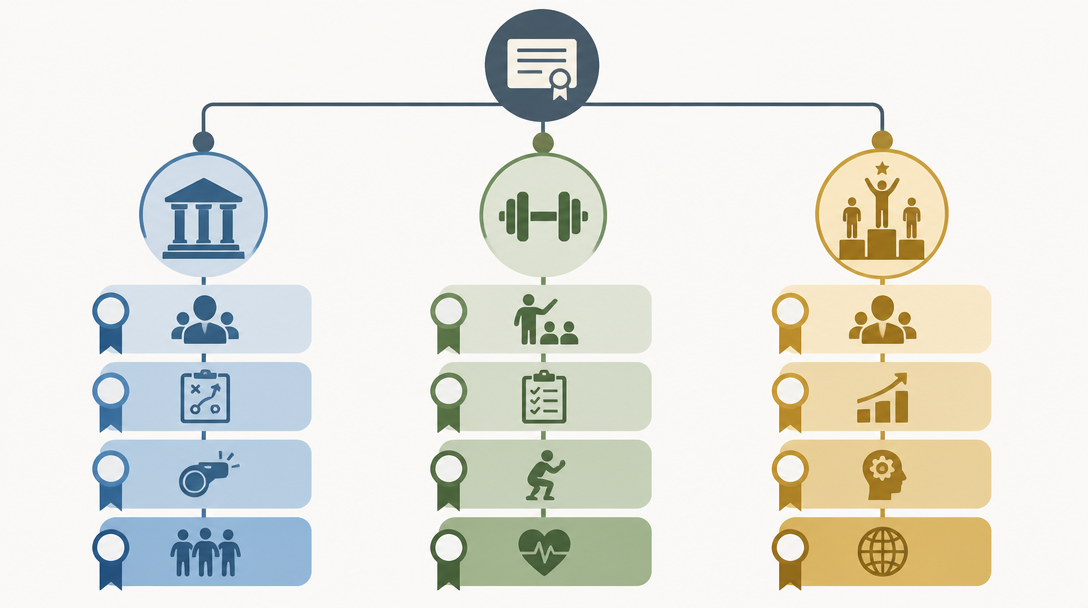
It helps to organize Japanese coaching credentials into three families:
- Sport coaching (JSPO licensed coaches): publicly oriented licenses tied to federations, tiered from community to international level.
- Training instruction (NSCA, NESTA, JATI): private credentials for personal trainers and strength & conditioning specialists.
- Elite coach development (JOC): advanced programs for national team staff.
Which family fits you depends on who you want to coach and at what level. If you are planning around retirement, see our guide to athlete second-career design.
Types of JSPO Licensed Coach Certifications
Coaching Assistant and Start Coach
The Japan Sport Association (JSPO) offers licenses across several grades based on role and target athletes. Entry-level options include the "Coaching Assistant," which supports coaches, and the "Start Coach," used in junior sports clubs. These have relatively low barriers and help widen the base of community sport.
The Coach 1 to Coach 4 hierarchy
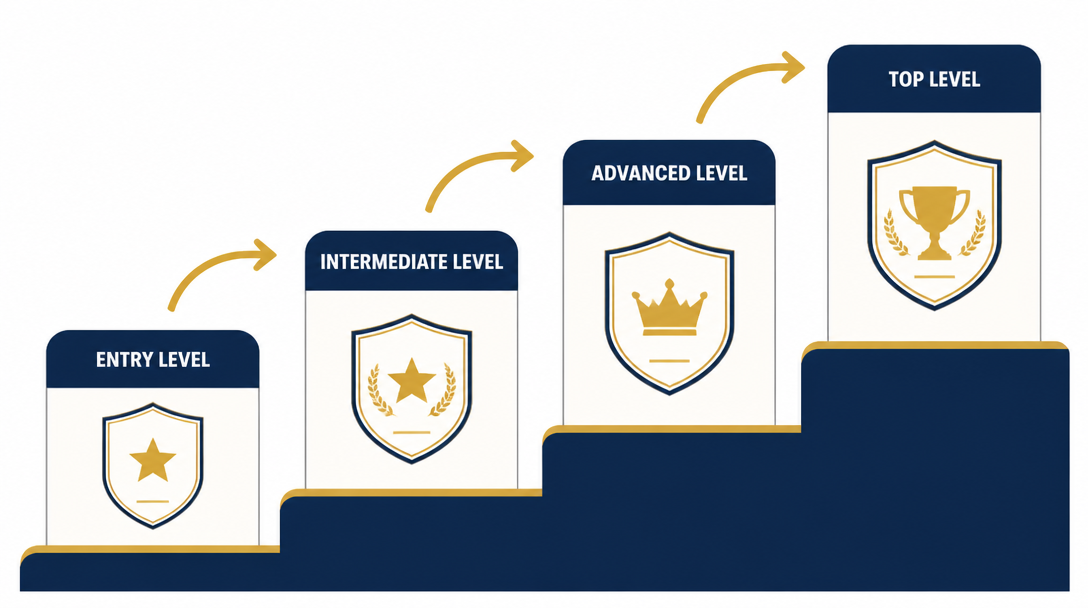
The core competitive coaching grades run from Coach 1 to Coach 4. According to the official JSPO Coach 1 page, Coach 1 covers basic instruction in community clubs, junior sports clubs, and school clubs. Higher grades require higher athlete levels and stronger track records.
License | Main scope | Positioning |
|---|---|---|
Coach 1 | Community clubs, junior sports, school clubs | Entry / basic |
Coach 2 | Regional top-level athletes and teams | Intermediate |
Coach 3 | National-level leagues and corporate teams | Advanced |
Coach 4 | National teams, international-level athletes | Highest (former "Senior Coach") |
The official JSPO Coach 4 page states that Coach 4 is for staff coaching international-level athletes on national teams and top leagues. It is no longer just about finishing a course; accumulated coaching experience is heavily weighted.
Teacher and Senior Teacher tracks
Alongside the coach grades, there are "Teacher" and "Senior Teacher" tracks for instructing the general public at fitness clubs. Each federation sets its own specialized curriculum, and bodies like the Japan Association of Athletics Federations publish their own certification routes.
How to Obtain JSPO Certifications and Their Costs
The certification flow
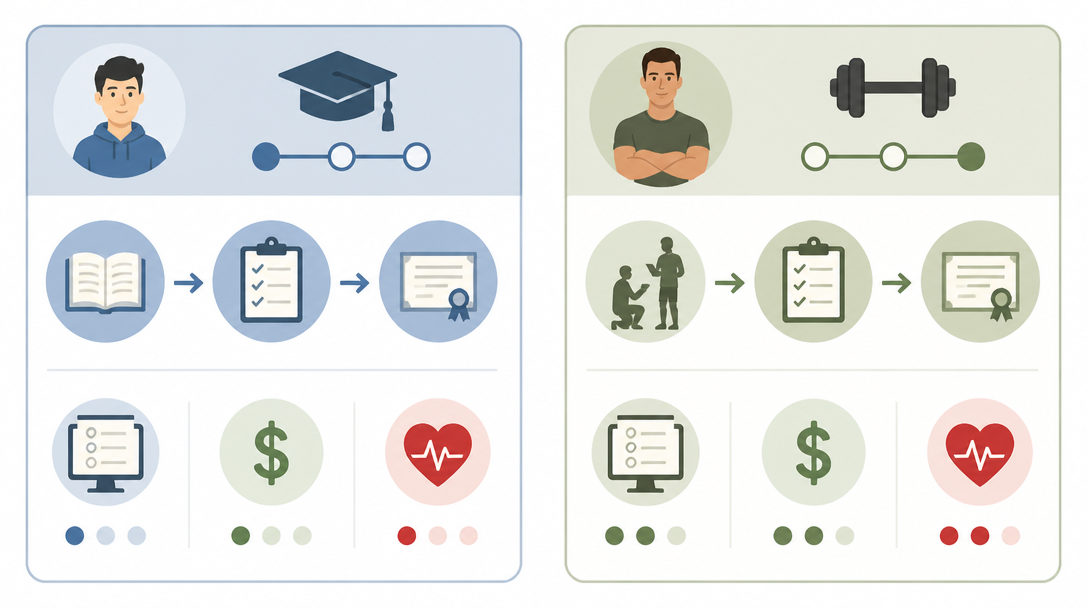
JSPO certification generally follows "attend and complete the course → register → get certified." For Coach 1, applicants must be at least 18 as of April 1 of the enrollment year, with some sports requiring age 20. The steps are:
- Apply through the relevant federation or prefectural sports association.
- Complete both the common subjects and the sport-specific subjects.
- Complete registration (pay the registration fee, confirm details).
- Get certified and registered as a licensed coach.
Common subjects and specialized subjects
Coursework is split into "common subjects" shared across all sports and "specialized subjects" for each sport. Coach 1 requires 45 hours in Common Subjects I and 20+ hours in specialized subjects. Common subjects cover coaching philosophy, sports medicine and science, and safety management, while specialized subjects build sport-specific technique and methodology. The basics of mental training are among the themes covered in common subjects.
Fees and validity period
Fees are set per subject. Per JSPO's official pages, Coach 1 Common Subjects I costs 18,040 yen (15,400 yen tuition plus a 2,640 yen reference book), and specialized subjects cost 15,400 yen (varies by sport). A basic four-year registration fee is roughly 13,000 yen (digital) or 17,000 yen (printed). Certifications are valid for four years including the enrollment year and require renewal.
Item | Coach 1 guideline (as of 2026) |
|---|---|
Eligibility | Age 18+ (age 20+ for some sports) |
Common Subjects I hours | 45 hours |
Specialized subject hours | 20+ hours |
Common Subjects I tuition | 18,040 yen (incl. reference book) |
Specialized subject tuition | 15,400 yen (varies) |
Registration fee (4 years) | 13,000 yen digital / 17,000 yen printed |
Validity | 4 years (renewable) |
Fees and hours may change, so always confirm the latest figures with each federation or the official JSPO site.
Obtaining NSCA Certifications (NSCA-CPT and CSCS)
NSCA-CPT eligibility and cost
Among training credentials, the U.S.-founded NSCA certifications are widely recognized in Japan. The NSCA-CPT (Certified Personal Trainer) requires being at least 18, a high school graduate, an NSCA Japan member, and holding a valid CPR/AED certification. The official page lists the exam fee at 46,090 yen (tax included).
Because membership is required, budget for an annual membership fee (around 13,200 yen) in addition to the exam fee. With relatively low barriers, it is often the first target for those entering the field.
NSCA-CSCS eligibility and cost
The other major credential is the NSCA-CSCS (Certified Strength and Conditioning Specialist). It specializes in training athletes and requires a degree or advanced diploma. The exam fee is around 50,200 yen (tax included), and it is more academically demanding than the CPT.
Difficulty and pass considerations
CPT and CSCS differ clearly in scope and difficulty. CPT focuses on general clients; CSCS focuses on athlete strength and conditioning. CSCS is harder, demanding deeper anatomy, physiology, and biomechanics.
Item | NSCA-CPT | NSCA-CSCS |
|---|---|---|
Main audience | General clients | Competitive athletes |
Eligibility | 18+, HS grad, member, CPR/AED | Degree/advanced diploma, member, CPR/AED |
Exam fee (incl. tax) | 46,090 yen | ~50,200 yen |
Difficulty | Standard | High |
For athletes moving into training instruction using their competitive background, CSCS is a strong option. Because much reference material is in English, it pairs well with building a career on English skills.
Other Private Credentials (NESTA-PFT and JATI)
Features of NESTA-PFT
The NESTA-PFT (Personal Fitness Trainer) is a practice-oriented credential often required to work as a freelance personal trainer at fitness clubs. Beyond being 18+ and a high school graduate, applicants must hold CPR/AED skills and satisfy one of several conditions such as relevant work experience, related education, or an approved prep course. Its textbooks are rich in diagrams, making on-site application easier to picture.
NSCA vs. NESTA
Both are popular for aspiring personal trainers but differ in character. NSCA-CPT has looser entry conditions and academic strengths, while NESTA-PFT requires practical experience and includes more field application and business content such as client acquisition and counseling.
- Academic focus, starting from scratch → NSCA-CPT
- Serious about athlete S&C → NSCA-CSCS
- Field practice and independence → NESTA-PFT
All renew on a four-year cycle and require continuing-education credits. If you want to diversify income as an independent trainer, review the thinking in athlete side businesses.
Toward JOC and Elite Coaching
JOC National Coach Academy
To become an elite coach on national team staff, the advanced JOC National Coach Academy (NCA) exists. Top coaches and staff from each sport exchange knowledge on coaching, management, and communication to raise the quality of coaches sent to major international events, as explained in the JOC announcement of the 2025 program.
The NCA uses JSPO Coach 3 status as a recommendation requirement, connecting directly to the public certification system. Building up from Coach 1 ultimately leads toward the elite coaching path.
Coach developers
As a credential for "coaching the coaches," JSPO has trained coach developers since 2018, with roughly 450 people commissioned—most of them university or vocational school faculty. They raise the quality of the entire coach-development system and represent a career endpoint for those pursuing research or education in coaching.
Choosing a Coaching Certification by Goal
For community and school coaching
To coach at community clubs or school clubs, JSPO Coach 1 or Start Coach is a realistic starting point, with low barriers and links to school coaching-staff systems.
For personal training
To work as a trainer in the fitness industry, NSCA-CPT and NESTA-PFT are the main options—CPT if starting from scratch, NESTA-PFT if leveraging experience toward independence.
For coaching top athletes
To coach national-level athletes, the royal road is building JSPO Coach 3 and 4 and connecting to the JOC National Coach Academy. For athlete S&C specifically, NSCA-CSCS is powerful.
Direction | Recommended credential | Key point |
|---|---|---|
Community / school | JSPO Coach 1 / Start Coach | Low barrier, public in nature |
Personal trainer | NSCA-CPT / NESTA-PFT | Well recognized in fitness |
Athlete S&C | NSCA-CSCS | Specialized, academically rigorous |
Elite coach | JSPO Coach 3/4 → JOC NCA | Requires stacked licenses and record |
Summary
The best coaching certification depends on your target athletes and level. Key points:
- Think in three families: sport coaching (JSPO), training instruction (NSCA/NESTA), and elite development (JOC).
- JSPO licenses are tiered Coach 1–4, obtained via coursework plus registration, valid four years with renewal.
- NSCA-CPT suits beginners; NSCA-CSCS targets athlete coaching and is harder; NESTA-PFT is practice- and independence-oriented.
- For elite coaching, higher JSPO licenses connect to the JOC National Coach Academy.
- Fees and eligibility change—always confirm the latest details on official sites.
Coaching expertise is a powerful way to convert an athlete's competitive strengths into skills that work in society. Treat certification as part of a long-term career design.