Floor Exercise Artistry: How Music & Choreography Affect Scores
Discover how music selection and choreography directly impact women's floor exercise scores under FIG Code of Points, including artistry deductions and CR requirements.
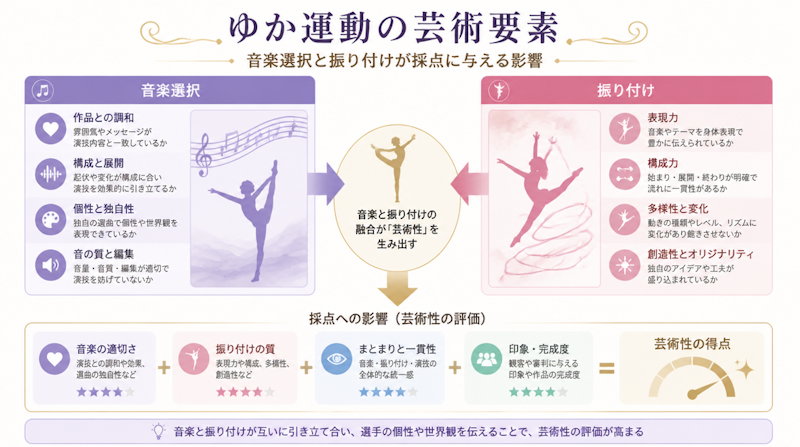
In artistic gymnastics, women's floor exercise stands apart from virtually every other event by requiring athletes to perform in synchrony with accompanying music. The choice of music and the quality of choreography are not aesthetic afterthoughts — they directly influence the final score. This article breaks down how the Fédération Internationale de Gymnastique (FIG) Code of Points evaluates artistic elements in women's floor exercise, from the structure of artistry deductions to the strategic role of music selection.
Key Differences Between Men's and Women's Floor Exercise
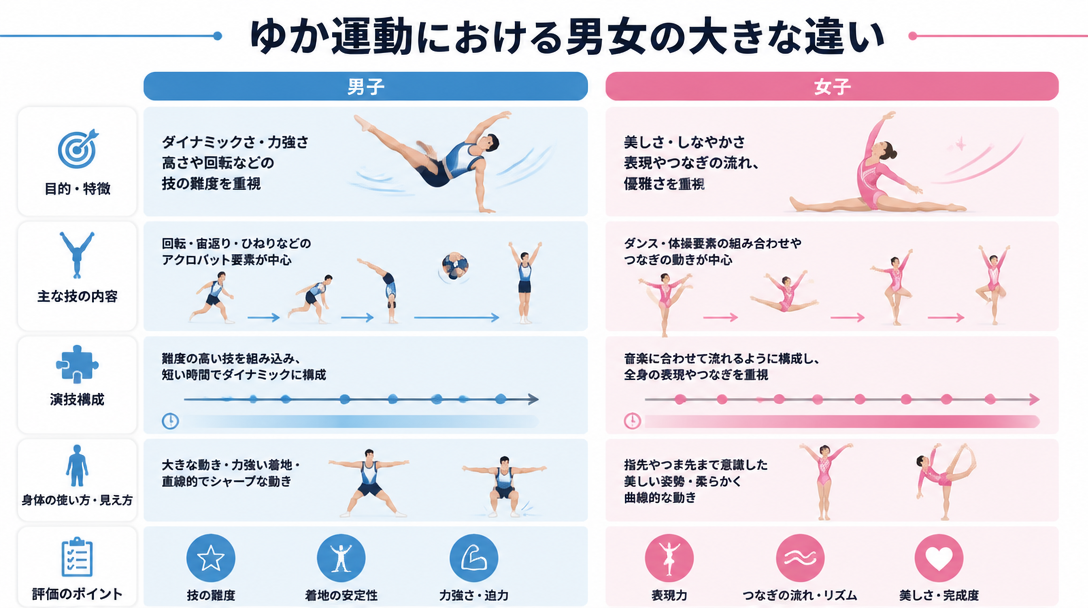
Men's Floor: Power and Acrobatics Without Music
Men's floor exercise is performed on a 12m × 12m sprung floor with a maximum routine duration of 70 seconds under the 2025 Code of Points. No music is used. The evaluation centers on the difficulty and execution of high-intensity acrobatic passes — primarily backward somersaults — with an emphasis on landing precision and dynamic power. The primary scoring factors are the Difficulty score (D-score) and the Execution score (E-score), with technical mastery taking clear precedence over artistic expression.
Routine construction must comply with Composition Requirements (CR), which include somersaults in different directions and a high-value dismount element. Because there is no music, judges focus almost entirely on the explosive quality of acrobatic skills, body tension, and the sharpness of landings.
Women's Floor: A Fusion of Athleticism and Artistic Expression
Women's floor exercise uses the same 12m × 12m surface but allows up to 90 seconds of performance time, with one defining difference: accompanying music is mandatory. Unlike the men's event, women's floor rewards a blend of acrobatic skill — tumbling passes, saltos, and twists — alongside leaps, jumps, turns, and dance passages. Expressiveness and musicality are built directly into the scoring framework, not treated as bonus qualities.
The result is an event that demands both elite athleticism and refined artistic communication, where a gymnast must move with intention at every moment of the routine.
Category | Men's Floor | Women's Floor |
|---|---|---|
Time Limit | 70 seconds (2025 Code) | 90 seconds |
Music | None | Mandatory (instrumental only) |
Skills Counted | Top 8 skills | Top 8 skills |
Primary Scoring Axes | Difficulty, execution precision | Difficulty, execution, artistry |
Floor Size | 12m × 12m | 12m × 12m |
Artistry Deductions | None | Yes (cumulative, significant impact) |
How Artistry Fits Into the FIG Scoring Framework

The Relationship Between D-Score and E-Score
Every score in artistic gymnastics is the sum of a D-score and an E-score. The D-score accounts for the difficulty value of skills, element group requirements, connection bonuses, and composition requirements. In women's floor exercise, four Composition Requirements (CR) are each worth 0.5 points within the D-score, meaning a gymnast who satisfies all four earns a maximum of 2.0 additional D-score points.
The E-score, by contrast, starts at 10.0 and is reduced through deductions. What makes women's floor exercise distinctive is that the E-score is vulnerable not only to technical errors — wobbles, bent knees, flexed feet — but also to artistic deficiencies. As outlined in the D-panel and E-panel judging system, E-panel judges are responsible for assessing artistry alongside execution quality.
Artistry Deductions: What They Are and How They Apply
The FIG Code of Points establishes clear deduction benchmarks for artistic shortcomings in women's floor exercise. Choreographer Grégory Milan of the French National Institute of Sport (INSEP) has noted that gymnasts often default to "forceful" movement patterns and that developing expressive quality suited to a music style remains a persistent challenge at the elite level. The following deficiencies each carry specific deductions:
- Poor body posture and carriage (port de bras / port de corps): 0.10–0.20 point deduction
- Lack of facial expression or mechanical movement quality: 0.10–0.20 point deduction
- Meaningless "filler" choreography between skills: 0.10–0.20 point deduction
- Lack of continuity and flow between movements: 0.10 point deduction
- Movement style inconsistent with the music's character: 0.10–0.30 point deduction
These deductions are applied independently and accumulate over the course of a routine. A gymnast who consistently demonstrates expressionless transitions, poor carriage, and music-movement mismatch can lose a substantial fraction of a point — enough to shift placement in a competitive field. This is precisely why artistic training must be treated with the same rigor as physical conditioning and technical skill development.
How Music Selection Influences Scoring

FIG Music Requirements for Women's Floor Exercise
The FIG Code of Points mandates accompanying music for all women's floor exercise routines. Competing without music results in a 1.0 point deduction — one of the largest single penalties in the rulebook. The specific regulations governing music include the following:
- Instrumental music only: Lyrics in any language are prohibited.
- Non-lyrical vocalizations are permitted: Humming, scat singing, wordless vocal sounds, and similar techniques are allowed as long as no intelligible words are present.
- Custom editing is expected: Athletes work with coaches and choreographers to select and edit music that fits their routine's duration and dramatic arc.
- Personalization matters: The music is intended to reflect the athlete's personality, strengths, and artistic identity — not simply serve as a rhythmic backdrop.
According to JudgeMate's scoring guide, judges evaluate "musicality, expressiveness, choreographic creativity, and the quality of dance elements." This means music selection is not a cosmetic decision — it is a competitive strategy with direct scoring consequences.
Music-Movement Synchronization: The Art of Performing the Music
In high-scoring routines, the body and the music function as a single integrated performance. Gymnasts who simply move to the beat are doing the minimum. Elite competitors align the climactic moments of their tumbling passes with the crescendos of their chosen score, use quiet, introspective musical passages for turns or sustained balance elements, and allow the natural phrasing of the music to give their choreography shape, tension, and release.
As explained in Gymnast Gem's breakdown of the 2025–2028 Code of Points, gymnasts are expected not just to "move with the music" but to genuinely "perform the music" — to embody its style, emotional content, and internal structure through their bodies. The capacity to understand a piece of music deeply and translate it into physical expression is itself a competitive skill.
Genre Selection as Competitive Strategy
Different musical genres demand fundamentally different expressive vocabularies. The most successful routines are built around music that aligns naturally with the gymnast's physical characteristics, technical strengths, and personal stage presence.
- Classical: Calls for refined port de bras, elongated lines, graceful carriage, and smooth, legato movement quality. Well-suited to gymnasts with exceptional flexibility and spatial awareness.
- Latin (flamenco, salsa, tango, samba): Demands rhythmically precise hip and shoulder mobility, passionate dynamics, and crisp accents. Advantages gymnasts with strong rhythmic sensitivity and physical expressiveness.
- Contemporary / Electronic: Allows for unconventional movement vocabulary, strong body isolations, and dramatic contrasts. Rewards gymnasts who can commit to an avant-garde stage persona.
- Symphonic / Dramatic: Requires broad dynamic range — from stillness to explosive power — and the ability to convey complex emotional narratives through movement.
Actively exploiting the tempo shifts, dynamic contrasts, and structural drama within a piece of music creates variety and impact in a routine. Conversely, choosing music whose character is fundamentally mismatched with the gymnast's movement style is a direct pathway to artistry deductions. The strategic pairing of athlete and music is one of the most consequential decisions a coaching team makes in preparing a floor exercise routine.
Composition Requirements (CR): The Intersection of Artistry and Technical Structure
The Four CRs and Their Role in the D-Score
Women's floor exercise includes four Composition Requirements (CRs), each valued at 0.5 points within the D-score. Satisfying all four contributes a maximum of 2.0 points — a meaningful base that shapes the competitive ceiling of any routine.
CR | Requirement | Deduction if Not Met |
|---|---|---|
CR1 | Acrobatic line containing at least two saltos | −0.50 pts |
CR2 | Forward or sideward acrobatic elements plus backward acrobatic elements | −0.50 pts |
CR3 | Salto with a minimum of 360° twist | −0.50 pts |
CR4 | Dance passage containing at least two leaps/jumps with 180° split | −0.50 pts |
CR4 — the dance passage — is the Composition Requirement most directly linked to artistry. It requires a connected sequence of leaps, hops, and/or jumps demonstrating 180-degree split positions, and it must be executed with the movement quality and expressiveness that the broader artistic framework demands. A gymnast who satisfies CR4 technically but performs the passage mechanically or without musical connection risks incurring artistry deductions even while earning the compositional credit. Achieving both simultaneously — technical CR fulfillment and genuine artistic quality — is one of the central challenges of women's floor exercise at the elite level.
Full-Body Choreography: What It Means in Practice
The FIG Code of Points explicitly requires "full-body choreography" throughout a women's floor routine. This means the arms, torso, head, and legs must all participate meaningfully in the expressive content of the routine — not just the legs propelling the gymnast through space. Ideally, a gymnast's arm pathways have intention and shape, the head responds to the music's phrasing, the torso creates waves, contractions, and spirals that add depth to the movement, and the leg lines are maintained even during transitional moments.
Critically, choreography must be present at both the beginning and the end of the routine. A routine that opens abruptly with a tumbling pass, or concludes with an acrobatic skill rather than a choreographed finish, invites deductions. In addition, remaining stationary in a corner for two or more seconds incurs a −0.10 point deduction — meaning unnecessary pauses anywhere on the floor carry a measurable cost. Every moment of a floor routine must be purposefully inhabited.
Strategies for Maximizing Artistic Score
Moments Under the Artistic Microscope
Artistry evaluation occurs continuously throughout a routine, but certain moments carry heightened scrutiny. Understanding where judges focus their attention allows coaches and gymnasts to prioritize artistic development strategically.
- The opening: Does expressive performance begin with the first note? Does the opening choreography establish a clear artistic identity and connect the gymnast to the music immediately?
- The dance passage (CR4): Are the leaps and jumps rhythmically integrated with the music? Is there genuine flow and continuity between elements?
- Before and after tumbling passes: Does expressive quality continue through the landing and the approach to the next skill, or does the gymnast "switch off" artistically during these transitions?
- Sustained moments — turns, balances: Even when the gymnast is relatively still, is the music being embodied through posture, focus, and physical intention?
- The finale: Does the finishing pose align precisely with the music's conclusion, creating a unified artistic statement?
Transitional choreography — the movement between defined skills — is the area where artistry most commonly deteriorates. When a gymnast uses these moments simply to travel from one floor position to another, it becomes "filler," and filler is a named deduction category under the Code of Points. The ability to invest transitional movement with choreographic meaning is one of the clearest markers separating elite-level artistic execution from merely competent physical performance.
Spatial Design: Using the Floor Strategically
The 12m × 12m floor is not just a performance surface — it is a compositional canvas, and how a gymnast uses it is part of the evaluation. Under the Code of Points, gymnasts are required to travel to each corner of the floor a minimum number of times, and failing to reach corners results in deductions. Additionally, stepping on or beyond the floor boundary with one foot or hand incurs a −0.10 point deduction, while leaving the floor entirely with both feet or the whole body costs −0.30 points.
Routine construction typically organizes the floor into functional zones. The diagonal lines — running corner to corner — provide the maximum distance for tumbling passes and are the primary setting for acrobatic content. The sidelines and the central area of the floor are used for dance passages, turns, and more intimate choreographic moments. Seiko's gymnastics viewing guide describes the relationship between spatial design and the dynamism of skills as a key element of floor exercise artistry worth watching as a spectator.
Beyond meeting the corner requirement, thoughtful spatial design communicates narrative intentionality. Contrasting a wide-ranging tumbling pass with a contained, detailed dance passage in the center of the floor creates the kind of dynamic variety that registers as sophisticated artistry. Tempo control — placing a quiet, lyrical sequence immediately after an explosive tumbling sequence — is among the most effective tools available to the choreographic team.
Code Updates: How the 2022 and 2025 Rules Have Shaped Artistic Requirements
Changes in the 2022 Code and Their Artistic Implications
The 2022–2024 Code of Points extended men's floor exercise from 70 to 75 seconds (subsequently reduced back to 70 seconds in the 2025 Code). The rationale offered by governing bodies was that the additional time encouraged routines to include expressive movement quality rather than consisting exclusively of back-to-back acrobatic passes. While men's floor remains non-musical, the acknowledgment that artistic elements merit space in routine construction represents a broader philosophical direction in the sport.
For women's floor, the 2022 Code brought greater specificity to artistry deduction categories. Terms such as "lack of expressiveness," "non-continuity of movement," and "inconsistency with the music's style" were explicitly defined as individual deduction triggers rather than left to broader interpretive discretion. This increased transparency made the artistic scoring framework more legible — and more consequential — for coaches and athletes planning competitive routines. The 2022 Code also introduced a restriction limiting the use of the same diagonal to a maximum of three consecutive passes, requiring greater spatial variety in routine choreography.
The 2025 Code: Artistry Standards Tightened Further
The 2025–2028 Code of Points, as analyzed by Gymnast Gem, strengthens artistry evaluation across multiple dimensions. Judges are directed to apply a finer lens to "expressiveness, choreography, posture, and musicality," and the penalties for "mechanical movement," "meaningless filler choreography," and "poor posture and carriage" — each in the 0.10–0.20 point range — are explicitly codified as consistent application standards rather than discretionary judgments.
The same-diagonal restriction has been tightened from three consecutive uses to two, further incentivizing spatial creativity in routine construction. Perhaps most significantly for competitive strategy, the 2025 Code requires a skill involving two or more saltos at the end of the routine, with a −0.30 point deduction for non-compliance. This creates a demanding dual mandate: gymnasts must close their routines with high-difficulty acrobatics while simultaneously maintaining the choreographic quality and musical connection that artistry standards require all the way to the final pose. The simultaneous pressure to maximize acrobatic difficulty and uphold artistic integrity makes women's floor exercise one of the most technically and creatively complex events in the gymnastics Code of Points.
Summary
The relationship between artistry and scoring in women's floor exercise can be distilled into several core principles:
- Music is mandatory for women — and consequential: Only instrumental music is permitted; routines performed without music incur a 1.0 point deduction. The choice of music defines the expressive framework for the entire routine.
- Artistry deductions directly reduce the E-score: Poor expressiveness, weak posture, non-continuous movement, and a mismatch between movement style and music character each carry deductions of 0.10–0.30 points. Cumulatively, these can produce a devastating score reduction.
- The four Composition Requirements include artistry-linked criteria: All four CRs contribute to the D-score at 0.5 points each, totaling a potential 2.0 points. CR4 — the dance passage — connects directly to artistry evaluation as well as technical fulfillment.
- Music selection is a strategic decision: The genre and character of the chosen music defines the expressive demands placed on the gymnast. The goal is not to move "to" the music, but to perform "as" the music — embodying its style, phrasing, and emotional content.
- The 2025 Code raises the bar: Filler choreography, mechanical movement, and poor carriage are now subject to explicitly codified deductions. Full-body artistic expression throughout the entire 90 seconds is not optional — it is a scoring requirement.