Sports Scholarships for International Athletes: Complete Guide
Learn how to earn a sports scholarship at a US university. Covers NCAA, NAIA, eligibility requirements, recruiting emails, and preparation timelines for athletes.
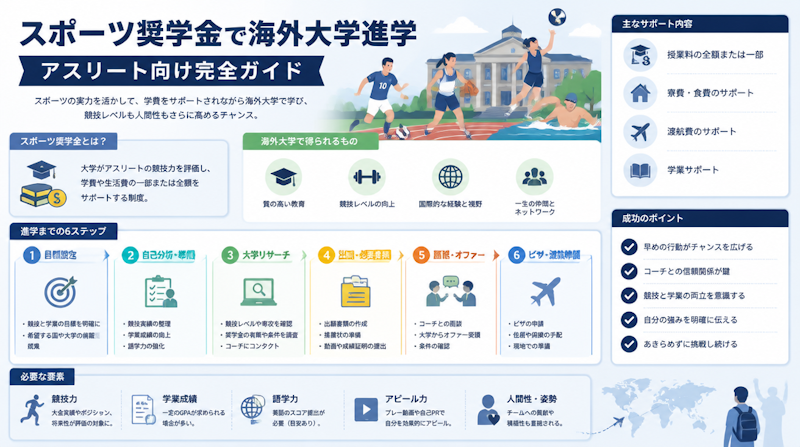
Every year, thousands of athletes around the world use sports scholarships to pursue a university education abroad — competing at the highest level while earning a world-class degree. The NCAA (National Collegiate Athletic Association) alone distributes more than $4 billion in athletic scholarships annually to over 196,000 student-athletes (NCAA official data). For international athletes, this represents a life-changing opportunity to study at top American universities while continuing to develop their sport.
Many athletes outside the United States assume that studying abroad is either too difficult or too expensive, or that a lack of English fluency makes it impossible. In reality, with a thorough understanding of how athletic scholarship systems work and a well-structured preparation plan, the path to a US university is far more accessible than it might appear. This guide breaks down everything international athletes need to know — from the structure of NCAA, NAIA, and NJCAA programs, to eligibility requirements, English proficiency standards, coach outreach strategies, and a step-by-step preparation timeline.
What Is a Sports Scholarship? Understanding the Full Scope of Athletic Financial Aid
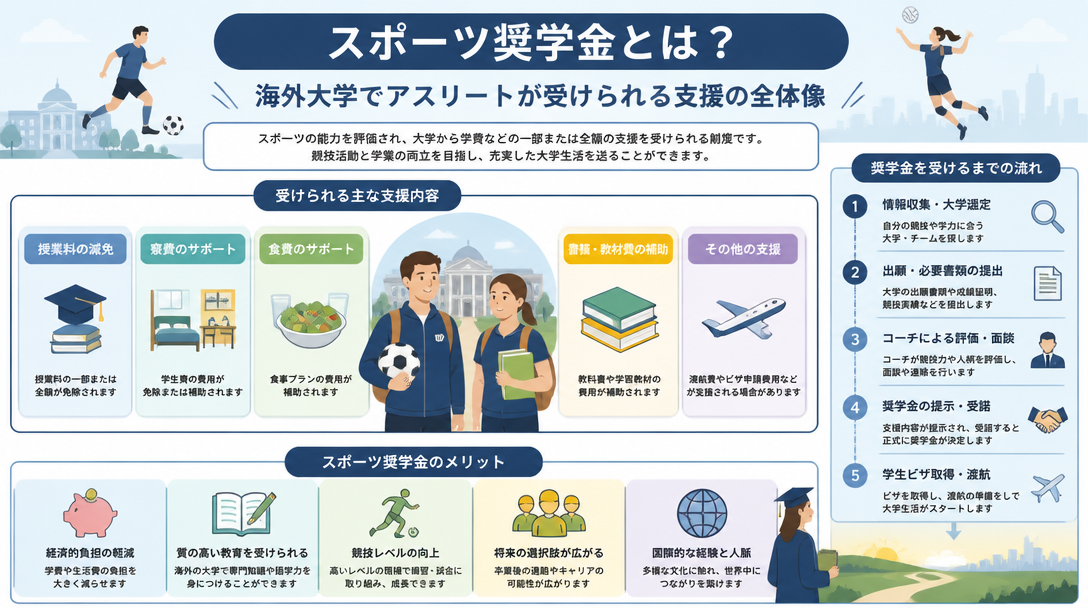
What a Full Athletic Scholarship Actually Covers
An athletic scholarship — often called a "full ride" when it covers all costs — is financial aid awarded by a university to a student-athlete based on their athletic ability and potential contribution to the team. A full scholarship (Full Scholarship) typically covers all of the following expenses:
- Tuition (course instruction fees)
- Mandatory university fees (enrollment, facility, activity fees)
- Room (on-campus or university-affiliated housing)
- Board (meal plans)
- Course-related books and supplies
At many well-known American universities, the total annual cost of attendance can reach $40,000–$70,000 or more. Over four years, a full scholarship can be worth $160,000–$280,000 or greater — effectively providing a debt-free university education in exchange for athletic participation. Partial scholarships cover a portion of these costs, with the remaining balance covered by the student, academic merit aid, or need-based financial assistance. According to NCAA official resources, most student-athletes layer athletic scholarships with academic scholarships and federal aid programs (such as Pell Grants) to cover their total cost of attendance.
Athletic Scholarship Options Beyond the United States
While the United States has the most developed and well-funded athletic scholarship system in the world, international athletes should know that similar — though smaller-scale — opportunities exist in other English-speaking countries. Universities in the United Kingdom, Canada, and Australia offer athletic excellence awards and tuition reduction schemes based on sporting performance. However, these programs are far less standardized than the NCAA model and vary significantly by institution. Athletes interested in these options should research each university's sports scholarships individually or consult with study-abroad advisors. The remainder of this guide focuses primarily on the US system, which offers the broadest range of opportunities and the highest scholarship values for international student-athletes.
NCAA, NAIA, and NJCAA: Understanding the Three Major Collegiate Athletic Associations
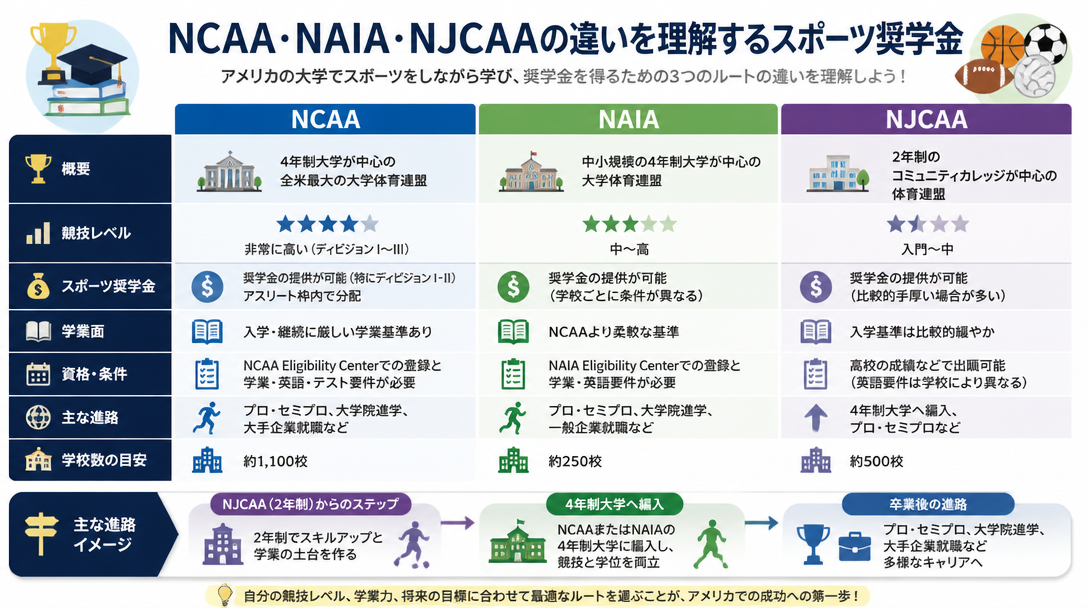
The NCAA: The World's Largest College Sports Organization
The NCAA (National Collegiate Athletic Association) governs college athletics at more than 1,100 member institutions across the United States. It is the largest and most influential college sports organization in the world. More than 25,000 international student-athletes currently compete in NCAA programs (NCSA Sports), making it a truly global pathway for athletes who want to combine elite competition with a university education.
The NCAA is divided into three divisions — Division I, Division II, and Division III — each with distinct differences in competitive level, scholarship availability, and the balance between academics and athletics. Only Division I and Division II programs are permitted to offer athletic scholarships; Division III schools do not award athletic aid, though they may offer merit-based academic scholarships.
NAIA and NJCAA: Valuable Alternatives for International Athletes
Athletes who may not meet the eligibility requirements for NCAA programs, or who are looking for a less intense recruiting environment, should consider the NAIA (National Association of Intercollegiate Athletics) and NJCAA (National Junior College Athletic Association) as strong alternatives.
Association | Member Schools | Competitive Level | Scholarships Available | Key Characteristics |
|---|---|---|---|---|
NCAA Division I | ~350 schools | Highest | Full to partial | Large universities, highest athletic demands |
NCAA Division II | ~310 schools | High | Primarily partial | Strong emphasis on balancing academics and athletics |
NCAA Division III | ~440 schools | Moderate to high | None (academic aid permitted) | Academics first, still competitive athletics |
NAIA | ~250 schools | Moderate to high | Full to partial | Smaller schools, relatively flexible eligibility rules |
NJCAA | ~500 schools | Moderate | Full to partial | Two-year community colleges; pathway to 4-year universities |
NAIA eligibility requirements are less stringent than the NCAA's. An athlete is eligible to compete in the NAIA if they meet at least two of the following three criteria:
- ACT score of 18 or higher, or SAT score of 970 or higher
- Graduated in the top half of their high school class
- High school GPA of 2.0 or higher (on a 4.0 scale)
The NJCAA pathway is particularly valuable for athletes who need additional time to develop their English proficiency, academic credentials, or athletic skills before competing at the four-year university level. Completing two years at an NJCAA school and then transferring to a four-year institution is a legitimate and increasingly common route to earning a bachelor's degree with athletic support.
NCAA Division I, II, and III: A Detailed Comparison of Athletic Scholarships
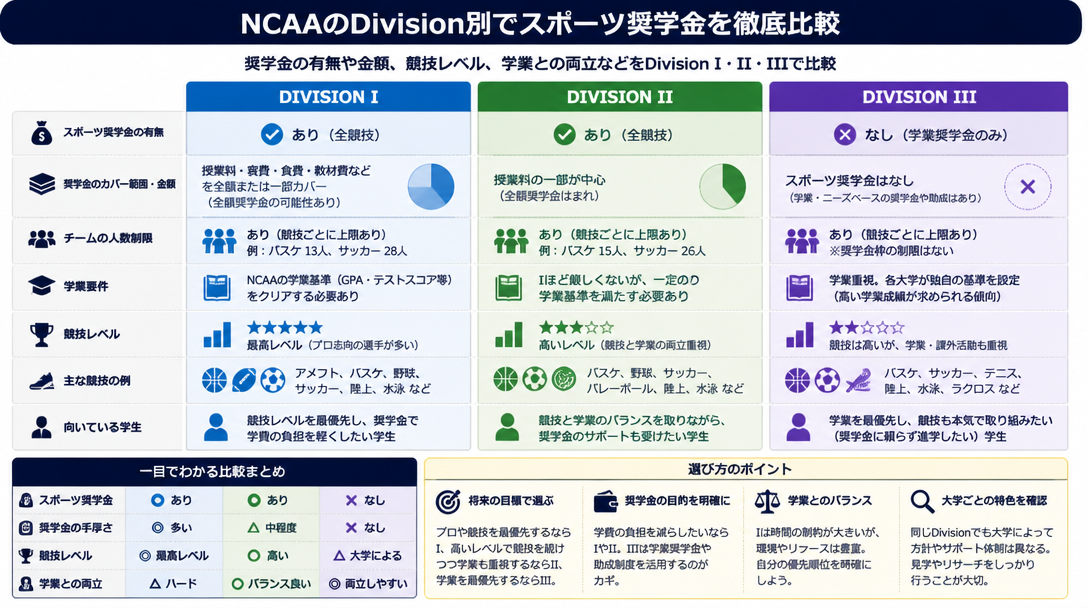
Division I: Elite Competition and Maximum Scholarship Support
Division I represents the pinnacle of college athletics in the United States. Programs at schools such as Stanford University, UCLA, and the University of Florida operate at a near-professional level, with extensive coaching staffs, state-of-the-art training facilities, and national media exposure. For athletes who earn a full scholarship at a Division I program, all standard college expenses — tuition, fees, room, board, and course-required books — are covered entirely. In some cases, additional provisions are made for graduate-level study after an athlete's playing eligibility expires (NCAA official).
The trade-off is extraordinary competition for roster spots and scholarships. According to NCSA Sports data, only approximately 2% of high school athletes go on to earn any form of college athletic scholarship. At the Division I level, international athletes generally need results at a national or international competition level to be seriously considered.
Division II: The Balance Between Athletics and Academics
Division II occupies a middle ground that many athletes find ideal. The level of competition is high but not as demanding as Division I, and schools actively promote a healthy balance between athletic participation and academic achievement. Scholarships at the Division II level are predominantly partial, distributed using what the NCAA calls an "equivalency model" — coaches have a set dollar amount of scholarship funding to distribute across their roster, and they divide it among athletes as they see fit. This means a single scholarship can be split between multiple players.
For many international athletes, Division II offers a realistic path to meaningful financial support while competing in a serious athletic environment. It is important to note that choosing a division is not a matter of ranking schools from best to worst — it's about finding the right fit for your athletic ability, academic goals, and personal priorities.
Full Scholarships vs. Partial Scholarships: What's the Difference?
Understanding the distinction between full and partial scholarships is essential when evaluating offers from coaches.
Type | What It Covers | Primary Division |
|---|---|---|
Full Scholarship | 100% of tuition, fees, room, board, and course books | NCAA Division I |
Partial Scholarship | A percentage of total costs (determined by the coach) | NCAA Division I & II, NAIA |
Combined Aid Package | Athletic aid + academic scholarships + need-based aid | All divisions |
A partial scholarship should not automatically be viewed as less desirable. Many student-athletes at Division II and NAIA programs stack a partial athletic scholarship with academic merit awards and need-based financial aid to cover the full cost of attendance. In practice, a well-assembled financial aid package at a Division II or NAIA school can rival — or in some cases exceed — the total support available at a Division I program, particularly for academically strong athletes.
Eligibility Requirements for Sports Scholarships: What Coaches and Schools Look For
Athletic Requirements: How Coaches Evaluate International Athletes
The most fundamental requirement for an athletic scholarship is demonstrating that you can meaningfully contribute to a college team. According to guidance from US Lighthouse, coaches evaluate international athletes on the following criteria:
- Competition results (placements and achievements in domestic and international events)
- Current athletic level and future development potential
- Fit with the team's specific roster needs
- Technical skill, decision-making, and physical attributes visible in highlight footage
- Communication ability and coachability
Sports that see particularly active international recruiting in the NCAA include tennis, golf, swimming, track and field, and soccer. Gymnastics, given its technical depth and the scarcity of elite domestic talent in the US, also draws from international recruiting pools — athletes with national-level results in their home country often have genuine opportunities to attract interest from college programs. Beyond physical performance, mental resilience and composure under pressure are qualities that experienced coaches value highly when evaluating prospects.
Academic Requirements: The NCAA's 16 Core Courses and GPA Standards
Athletic ability alone is not enough to compete in NCAA Division I or II. All student-athletes must also satisfy academic eligibility standards set by the NCAA Eligibility Center's international student guidelines. The primary requirements are as follows:
Requirement | Division I | Division II |
|---|---|---|
Core Courses Required | 16 courses | 16 courses |
Minimum GPA (4.0 scale) | 2.3 | 2.2 |
Standardized Test Score | Sliding scale with GPA | Sliding scale with GPA |
The 16 core courses must be drawn from specific subject areas including English, mathematics, natural or physical sciences, social sciences, and foreign languages. High school curricula in many countries — including Japan's standard academic track — frequently align with these requirements, but this should always be confirmed on an individual basis. The NCAA publishes a searchable database of approved high school courses at its Eligibility Center website. If a student's school is not listed, it may be necessary to work with the Eligibility Center directly to have courses reviewed and recognized.
It is also worth noting that the NCAA uses a sliding scale between GPA and standardized test scores — a higher GPA can partially compensate for a lower test score, and vice versa. This gives academically strong athletes more flexibility in meeting the requirements.
English Language Requirements: TOEFL and IELTS Score Guidelines
For international athletes whose first language is not English, proof of English proficiency is a non-negotiable part of the university application process. Very few institutions will waive or substantially lower this requirement based on athletic status alone. General benchmarks for commonly required English tests are as follows:
- TOEFL iBT: 79–100 (varies by university and department)
- IELTS: 6.0–6.5 or higher
- SAT (Evidence-Based Reading and Writing): Some Division I and II programs request SAT results in addition to TOEFL/IELTS
The earlier an athlete begins serious English study, the better their overall application will be. Beginning TOEFL or IELTS preparation in the first year of high school — rather than treating it as an afterthought — significantly increases the likelihood of reaching target scores before the recruiting timeline accelerates. Some universities do offer English language support programs or conditional admission pathways for students who are close to but haven't yet met the minimum proficiency threshold, but athletes should never rely on these as a fallback plan.
NCAA Eligibility Center: Registration Steps and Required Documents
When and How to Register
Any athlete wishing to compete in NCAA Division I or Division II is required to register with the NCAA Eligibility Center (eligibilitycenter.org). The NCAA recommends beginning this process as early as possible — typically during the junior year of high school (the academic year approximately two years before planned enrollment) (NCAA official guide).
The registration process follows three main steps:
- Create an account: Visit the Eligibility Center website and open an "Academic and Athletics Certification" account (required for Division I and II prospects).
- Submit documents: Provide official high school transcripts and graduation certificates with certified English translations.
- Connect with coaches: Share your NCAA ID number with coaches at schools you are interested in. The university then initiates the eligibility review by requesting the athlete's file from the Eligibility Center.
A critical point that many international athletes overlook: the Eligibility Center only begins processing a student's file once an NCAA member institution has added that athlete to their request list. This is why establishing contact with coaches early — ideally before the formal application process begins — is so important. Without a coach initiating the institutional request, the Eligibility Center review cannot proceed.
Document Checklist for the NCAA Eligibility Center
The following documents are required when registering with the NCAA Eligibility Center, as outlined in the NCAA International Student Guide (PDF):
- Official transcripts covering all grades from the 9th grade equivalent onward (original documents plus certified English translations)
- Graduation certificate or diploma (with certified English translation)
- Amateur status certification (documentation showing no professional contracts or prize money received)
- SAT or ACT scores (required for Division I and II eligibility reviews)
- Registration fee: $170 USD for international students
Certified English translation of academic documents typically requires a professional translator or a licensed translation service, and can be both time-consuming and costly. Starting this process early — well before application deadlines — is essential to avoid delays. For Division III, only amateur status certification is required (not academic certification), making the Eligibility Center process considerably simpler and less expensive.
Recruiting Outreach: How to Approach Coaches and Win a Sports Scholarship
Building Your Athletic Profile and Highlight Video
Because college coaches in the United States rarely have the opportunity to watch international athletes compete in person, the highlight video is the single most important recruiting tool an international athlete can have. According to the NCSA Sports recruiting guide, an effective highlight video should include the following elements:
- Footage from real competitions and events — not just practice sessions
- Scenes that clearly demonstrate technical precision, athletic decision-making, and physical capability
- A total length of approximately 3–5 minutes (coaches will rarely watch a video longer than this in its entirety)
- Uploaded to YouTube or a similar platform with a shareable link
Alongside the highlight video, athletes should prepare an English-language Athletic Profile — a concise 1–2 page PDF document summarizing the following:
- Name, nationality, and current grade/year
- Competition results and rankings (domestic and international)
- Academic information: GPA, TOEFL/IELTS score (if available)
- Physical measurements: height and weight
- Contact information and availability for official visits
- Link to highlight video
Think of this document as a sports résumé. It should be clear, professional, and easy for a coach to scan quickly. Including a personal statement about athletic goals and why the athlete is interested in studying in the US adds an additional layer of authenticity.
Writing an Effective First Email to a College Coach
The pathway to a sports scholarship flows through the coaching staff. As explained by US Lighthouse, the process works as follows: a coach identifies and selects an athlete, supports their admission application, and awards scholarship funding from the program's budget. No amount of preparation matters if coaches never hear from you.
A well-crafted introductory email to a college coach should include the following elements:
- Introduction: Name, nationality, current school, and year of expected graduation
- Athletic résumé: Key competition results, records, or rankings — keep it concise and specific
- Highlight video link: A direct YouTube URL or equivalent
- Academic credentials: Current GPA and TOEFL/IELTS score (if already obtained)
- Expressed interest: A specific, genuine explanation of why this team and university appeal to the athlete
Coaches receive a high volume of emails from prospective recruits. A message that is specific, respectful of the coach's time, and clearly presents the athlete's value is far more likely to receive a response than a generic, template-style message. Athletes should also follow up appropriately — a lack of immediate response does not necessarily mean a lack of interest.
One of the most effective strategies for maximizing scholarship opportunities is to cast a wide net geographically. Rather than limiting outreach to a handful of well-known schools, athletes should contact coaches at multiple programs across Division I, II, and NAIA — being open to schools in regions or states they may not have initially considered. Scholarship budgets operate on a first-come, first-served basis to a significant degree, and coaches at mid-sized programs who find an athlete early in the recruitment cycle may be more willing and able to offer stronger financial support. Ideally, initial coach contact should begin 2–3 years before the target enrollment date.
Preparation Timeline: A Year-by-Year Roadmap Starting in High School
Earning a sports scholarship at an American university is not something that happens overnight. It requires a sustained, multi-year effort across athletic development, academic performance, English language acquisition, and active recruiting engagement. The following roadmap provides a practical framework for planning the process from the beginning of high school through to enrollment.
Years 1–2 of High School (3–4 Years Before Enrollment): Building the Foundation
The first two years of high school are about laying the groundwork in both athletics and academics. This is also the right time to start developing the habits and systems needed to manage the demands of being both a competitive athlete and a committed student — a balance that will become even more critical at the university level.
- Begin structured English study with a focus on TOEFL/IELTS preparation, listening comprehension, and spoken English
- Actively compete in national and, where possible, international competitions to build a résumé
- Maintain strong academic grades — high school GPA directly impacts NCAA eligibility
- Start researching the US college athletic system: NCAA divisions, NAIA, recruiting timelines, and scholarship structures
- Begin systematically recording competition footage for future use in highlight videos
Year 3 of High School (Approximately 2 Years Before Enrollment): Moving Into Action
This is the phase where preparation shifts from foundation-building to active recruiting. The decisions and actions taken during this period have a direct and significant impact on scholarship outcomes.
- Sit the TOEFL or IELTS exam — plan for multiple attempts if needed to reach target scores
- Create a tiered list of target schools across Division I, Division II, and NAIA categories
- Produce a polished highlight video and English-language Athletic Profile
- Send initial contact emails to coaches at target schools
- Begin NCAA Eligibility Center registration (create an account and start gathering required documents)
Final Year of High School Through Application Year: Negotiations and Official Paperwork
As conversations with coaches progress and interest becomes mutual, the focus shifts to formalizing offers and completing the administrative requirements for admission and eligibility certification.
- Take the SAT or ACT exam (required for Division I and II eligibility)
- Submit all required documents to the NCAA Eligibility Center (certified translated transcripts and graduation certificates)
- Receive and evaluate scholarship offers from coaches — review terms carefully, and do not hesitate to ask questions or negotiate
- Complete university admission applications (many US schools use the Common Application platform)
- Apply for an F-1 student visa after receiving an official admission offer
Choosing the right university involves more than evaluating the scholarship amount. From the perspective of long-term career planning as an athlete, it is worth thinking early about academic major options, the university's career services resources, and post-graduation pathways — all factors that will matter long after competitive playing days are over.
Summary
Studying at a university in the United States on an athletic scholarship is a realistic goal for international athletes who prepare strategically. The following key points summarize what every prospective student-athlete should keep in mind:
- Understand the NCAA/NAIA structure: Division I, II, and III all offer different levels of scholarship support and competitive demands. Choosing the right division based on your athletic ability, academic profile, and personal goals is more important than simply aiming for the highest division possible.
- Athletic talent and English proficiency must go hand in hand: No matter how strong an athlete's sporting credentials are, English language requirements (generally TOEFL iBT 79 or higher) are non-negotiable for admission. Early, consistent English study is essential.
- Proactive coach outreach is the gateway to scholarships: Scholarships are awarded by coaches, not admissions offices. Prepare a professional highlight video and Athletic Profile in English, and reach out to multiple coaches across divisions and regions.
- Register with the NCAA Eligibility Center early: Aim to begin registration during the junior year of high school. Certified document translation takes time and money — starting the process early prevents unnecessary delays.
- Work backwards from your enrollment target date: A preparation window of 3–4 years from the start of high school dramatically expands the range of schools and scholarship opportunities available. The earlier the process begins, the more leverage an athlete has.