English Skills & Global Careers: How Athletes Go International
Learn how English proficiency unlocks global careers for athletes. From TOEIC score targets and study strategies to sports scholarships and international career paths.
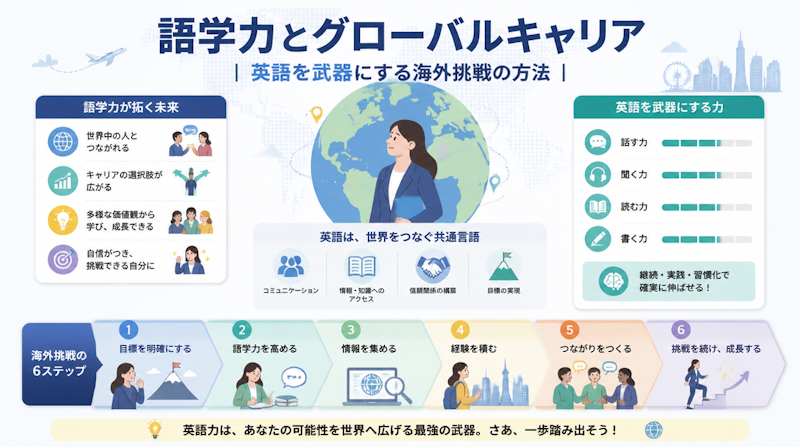
English proficiency is one of the most powerful and immediately actionable assets an athlete can develop for a global career. For athletes transitioning out of competitive sport, the feeling that "more doors would open if I could speak English" is remarkably common. According to a 2022 survey by Bizmates, a striking 92.8% of athletes expressed interest in studying English as part of building their post-retirement second career. When the mental toughness, adaptability, and discipline forged through sport are combined with strong English skills, the result is a career profile that transcends borders. This article provides a practical, comprehensive guide to using English as a catalyst for international competition, overseas study, and a globally competitive career.
Why Language Skills Matter for Athletes
The Language Barrier in International Competition
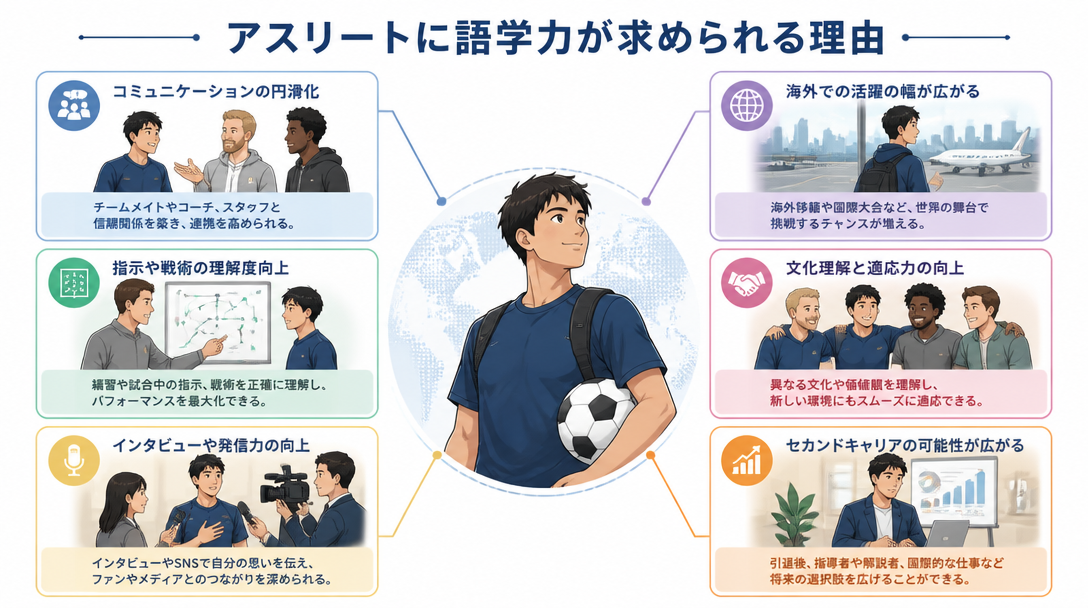
In an era where competing in international tournaments and training abroad have become standard for serious athletes, English is no longer optional — it is fundamental infrastructure for a competitive career. As highlighted by EF Education's analysis of athletes and language learning, some elite competitors spend as many as nine months per year traveling internationally, placing them in environments where English communication is an everyday necessity.
When working with foreign coaches or trainers, relying on interpreters means critical nuances inevitably get lost. Technical instruction is inseparable from linguistic precision. Athletes who can communicate directly in English gain a significant advantage in training quality — whether receiving corrections on form, guidance on mental performance, or detailed nutritional protocols. The higher the level of instruction, the more directly language proficiency affects athletic output.
International recruitment is also shifting earlier. Elite clubs and university programs in the United States and Europe are increasingly scouting at the youth level. Even athletes with exceptional talent risk having to return home prematurely if they cannot adapt to daily life in another country. English fluency is the foundational skill that determines whether an overseas sports education succeeds or fails.
How Top Athletes Talk About the Importance of English
Numerous high-profile athletes have spoken publicly about their investment in English language skills. Japanese goalkeeper Eiji Kawashima recognized early in his career that playing overseas required mastering multiple languages and committed to language study from a young age. Tennis star Ai Sugiyama built her international career in part on her ability to communicate fluently with coaches, agents, and media worldwide. Yuzuru Hanyu and Yu Darvish have similarly engaged with English as a professional necessity rather than an extracurricular pursuit.
In professional sport, speaking English enables athletes to articulate their playing style, communicate preferences to coaching staff, and build genuine trust with teammates and support personnel. Removing the language barrier expands an athlete's world from the domestic stage to the global one. One key reason athletes often progress quickly in language learning is the strength of their motivation: English is not an abstract academic subject but a daily tool for winning, for survival, and for connection. Through real communicative experience, the psychological barriers to speaking — fear of errors, worry about grammar — tend to diminish rapidly. Athletes learn that small vocabulary mistakes are easily corrected in context, while clear intent and persistence carry conversations forward.
The Accelerating Globalization of the Sports Business
The sports industry is increasingly a global business. Sports marketing, sponsorship negotiations, broadcast rights deals, athlete representation, and event management are all conducted within international frameworks. For athletes who have accumulated competitive expertise and professional networks, adding English proficiency opens doors to meaningful participation in this expanding global ecosystem.
Organizations operating at the intersection of sport and language education — offering programs for athletes who want to build careers that leverage both their competitive background and international communication skills — reflect a growing market demand. The rise of English-speaking sports educators, international coaching specialists, and globally certified technical officials demonstrates that "sport plus English" is a viable and increasingly in-demand professional identity, both during and after a competitive career.
How Language Skills Expand Global Career Opportunities

The Real Demand for English in Athlete Second Careers
Data on post-retirement career transitions provides compelling evidence of how central English has become to athletes' professional futures. The 2022 Bizmates survey of 111 professional, semi-professional, and corporate-team athletes found that 90.1% had experienced uncertainty or anxiety about their post-retirement career path. Among those planning for a second career, 41.4% indicated that language acquisition was a priority in their preparation.
Even more striking, 92.8% of respondents expressed interest in learning English specifically to enrich their second career — with 33.3% describing themselves as "very interested" and 59.5% as "somewhat interested." The primary motivations they cited were:
- English is required in the profession or role they want to pursue: 62.1%
- Desire to expand business opportunities internationally: 43.7%
- English proficiency creates a career advantage: 40.8%
These figures make clear that English is no longer a "nice to have" supplementary skill — it is becoming an essential qualification for athletes who want to compete in the global job market after retirement. Starting language study during an active competitive career represents one of the highest-return investments an athlete can make in their professional future.
TOEIC Score Benchmarks for Global and Multinational Companies
For athletes targeting careers at global companies or foreign-affiliated firms in Japan and abroad, TOEIC scores serve as an important initial benchmark. According to JAC Recruitment's analysis of the international job market, 32.7% of positions at global companies require a score of 700 or above, with particularly high rates in trading companies (14.7%) and legal/intellectual property roles (13.9%).
TOEIC Score | Assessment | Example Target Positions |
|---|---|---|
600–700 | Sufficient to list on a résumé | English support roles, procurement, IT |
700–800 | Demonstrates ability to function in English at work | Research, back-office positions |
800–900 | Recognized as strong communicator in business English | Sales, management roles |
900+ | Business results and leadership are the primary evaluation criteria | Executive and senior management candidates |
As a general benchmark by career stage, candidates in their twenties can differentiate themselves with a score in the 600–700 range, while those in their thirties typically need 700 or above to be considered competitive. Roles that involve overseas postings or regular international client interaction often require 750–800 or higher. Setting a clear target score and building a structured study plan to reach it well before a career transition is critical.
The Unique Value Created When Athletes Add English Skills
Athletes represent the top fraction of one percent in their discipline. When that competitive specialization is combined with English proficiency and international experience, the result is a professional profile that is genuinely difficult for other candidates to replicate. In the job market, the combination of "sport-specific expertise + English fluency + overseas experience" is a powerful differentiator that stands apart from generalist profiles.
Consider the concrete examples: a gymnastics official who can explain FIG Code of Points rules directly in English; a sports medicine professional who can consult with international athletes and medical teams without an interpreter; a sports agent who has negotiated with overseas clubs and sponsors firsthand — each of these profiles represents a combination of skills that the market values highly and that relatively few candidates can offer. For a broader look at how athletes can approach career design after retirement, see Athlete Second Career Planning: Skills and Job Transition Strategies.
Building English Skills and Career Capital Through Sports Study Abroad

How American University Athletic Programs Work
For athletes looking to develop English proficiency and international career credentials simultaneously, athletic programs at American universities offer a uniquely powerful opportunity. According to Global Study's overview of sports study abroad in the United States, the primary advantages include:
- Immersive English language development through daily academic and social life
- Training alongside athletes from around the world in a highly competitive environment
- Access to evidence-based, scientifically advanced coaching methodologies
- Earning an internationally recognized American university degree
- The potential to access athletic scholarships that substantially offset or eliminate costs
American university culture is built around the concept of the "student-athlete" — the expectation that competitors maintain strong academic performance alongside their sport. This dual emphasis means graduates emerge with both a rigorous academic credential and a proven track record of performing under pressure. Upon graduation, pathways include continued elite competition, professional sport, graduate school, or entry into the corporate world. For a detailed guide to the scholarship application process and how to find the right program, see Sports Scholarships for Overseas Universities: A Complete Guide for Athletes.
NCAA Scholarships: An Overview of Eligibility and Evaluation
The NCAA (National Collegiate Athletic Association) governs the majority of elite university sports in the United States and administers one of the world's most substantial athletic scholarship systems. Specialist resources on American university athletic recruitment explain that scholarship decisions are based on a holistic evaluation that includes:
- Athletic ability relative to the team's specific roster needs and competitive position
- Academic performance meeting minimum GPA requirements
- English language proficiency, demonstrated through TOEFL scores or enrollment in ESL programs
- Enrollment timing aligned with the coach's recruitment cycle
Full scholarships — covering tuition, room and board, textbooks, and in some cases travel — are available at the highest division levels, but require competitive strength in both athletics and academics. For athletes whose English is not yet at the TOEFL threshold, conditional admission with an ESL (English as a Second Language) bridge program is a legitimate pathway that allows language development to happen alongside or before full academic enrollment. Beyond NCAA programs, the NAIA and NJCAA systems offer scholarship opportunities at institutions across a wider range of competitive levels, making it more accessible for athletes to find a good fit.
Why Living Abroad Accelerates English Acquisition
The consensus among those who have done it is clear: immersive living in an English-speaking country is among the most effective language learning experiences available. When every aspect of daily life — classes, practices, dormitory living, meals, friendships — occurs in English, the practical language competency gained far exceeds what is achievable through textbook study alone.
For athletes specifically, the immersion context is especially powerful because the motivation for English is visceral and immediate: understanding the coach's tactical instructions, coordinating with teammates during play, and making oneself understood in the locker room are not abstract exercises — they are prerequisites for performance. Even beginning with limited vocabulary, language ability builds steadily through repeated communicative practice with high stakes. The international networks built during this period also have direct long-term value, often forming the foundation of professional relationships that support a global career for years after returning home.
Effective English Learning Strategies for Athletes
Designing a Learning Path: From Input to Output
Approaching English study as a structured, phased plan — rather than an unplanned series of efforts — dramatically improves efficiency. A logical progression for athletic schedules typically follows these stages:
- Foundation Building (Target: TOEIC 400–600): Focus intensively on vocabulary acquisition, grammar patterns, and listening comprehension. Daily use of flashcard apps and English-language podcasts during commutes or rest periods is especially effective. Consistency matters more than volume at this stage.
- Transition to Active Use (Target: TOEIC 600–700): Elevate input quality through shadowing (repeating audio in real time), extensive reading, and regular exposure to news English. Watching films and documentaries with English subtitles builds vocabulary in context and trains the ear for natural rhythm and intonation.
- Output Acceleration (Target: TOEIC 700+): Shift emphasis to speaking and writing practice. Online English conversation platforms used three to five times per week, combined with regular written English practice with feedback, produce the fastest gains at this stage.
- Professional Proficiency (Target: TOEIC 800+): Repeated practice of presentation delivery, professional email writing, and negotiation in English. At this level, reading English-language books, reports, and academic articles in one's field of interest becomes both feasible and rewarding.
A key mindset shift for athletes at all stages: releasing perfectionism. Grammatical errors rarely prevent understanding — context, gestures, and goodwill bridge most gaps. What blocks progress most is the fear of imperfection. Maximizing the volume of speaking and writing attempts, even imperfect ones, is the fastest route to genuine fluency.
Practical Learning Resources for Busy Athletes
The resources below are selected for their compatibility with an athlete's demanding schedule, enabling consistent study during training gaps, travel, and recovery periods.
Category | Recommended Resources | Best Use / Timing |
|---|---|---|
Vocabulary & Phrases | Anki, Duolingo | Commutes and short breaks (15–30 min/day) |
Listening | TED Talks, BBC Learning English | After training or before sleep; exposure to natural spoken English |
Speaking | Cambly, Bizmates, or similar online conversation platforms | 3–5 sessions per week, 30 minutes each |
Writing | ChatGPT for drafting and feedback, Grammarly | English email and report practice, 2–3 times per week |
Sports-Specific English | ESPN, Sports Illustrated (English editions) | Daily 10-minute reading to build sport-domain vocabulary |
Strategies for Sustaining Motivation Over the Long Term
The most powerful tool an athlete can bring to language learning is the same one that drives performance: clear, specific, measurable goal-setting. Just as competitive preparation is organized around definite targets — a specific score at a specific competition on a specific date — English study benefits from the same discipline. Setting a concrete goal such as "TOEIC 700 within six months" or "TOEFL iBT 80 before applying to universities" provides the structure that sustains effort through inevitable plateaus.
Integrating English study into the existing training routine — rather than treating it as a separate, additional obligation — makes consistency far more achievable. Dedicating 30 minutes before morning practice to vocabulary review, using commutes for listening, and treating the competitive off-season as an intensive language study period are all effective approaches. For insights on applying mental training principles — including goal-setting and focus management — to challenges outside sport, Mental Training for Athletes: Performing Under Pressure offers relevant strategies.
Specific Career Paths That Leverage English Skills
Sports Management and Athlete Representation
Sports agencies and management companies that operate internationally depend heavily on staff who can conduct contract negotiations, communications, and relationship management in English. Professionals who combine a background in competitive sport with English proficiency and a working knowledge of contract law or finance are in particularly short supply — and correspondingly high demand. Athletes who regularly used English during international competitions or overseas training stints are frequently well-positioned to move directly into roles involving foreign athletes, overseas clubs, or international sponsors, without requiring the extensive onboarding that non-sport backgrounds would need.
Beyond English, a career in sports representation typically requires grounding in marketing principles, contract and sports law, and financial management. Postgraduate programs in sports management at international universities provide a structured route for athletes who want to formalize this knowledge as part of a deliberate career transition.
Working for International Sports Organizations and Governing Bodies
International governing bodies such as the FIG (International Gymnastics Federation), FIFA (Fédération Internationale de Football Association), and the IOC (International Olympic Committee) regularly recruit experienced athletes and sport professionals who bring language skills — primarily English and French — to technical, educational, communications, and governance roles. Positions as judges, technical committee members, education program coordinators, and international media officers all benefit directly from the combination of sport knowledge and language capability.
Closer to home, national bodies such as the Japan Gymnastics Association (JGA) and the Japan Olympic Committee (JOC) also require English proficiency for international liaison roles — coordinating overseas competitions, managing relationships with international federations, and supporting athlete delegations abroad. The range of positions available to competitive-background candidates with strong English is broad, and the demand for this profile grows as sports organizations deepen their international engagement. Developing language skills during the active career creates the maximum range of post-retirement options in this area.
Leveraging Athletic Experience in Global Companies
In global corporate environments, the qualities that competitive sport develops — team orientation, goal management under pressure, resilience, and rapid adaptation — are highly valued by recruiters and hiring managers. Career guidance resources on TOEIC and employment consistently cite 700 or above as the practical benchmark for demonstrating English business capability at global firms. An athlete who holds a TOEIC score in this range alongside a competitive track record presents a combination that is both rare and compelling in the job market.
In interviews and personal statements, athletes can construct a memorable, distinctive narrative: the experience of competing internationally, communicating across language barriers with coaches and teammates, and developing a genuinely global perspective through sport. This framing is far more powerful than a résumé line item alone. For broader strategies on communicating athletic experience effectively in job applications, Winning Job Search Strategies for Student Athletes: Self-Presentation That Gets Results provides detailed guidance. Resources such as Athlete LIVE's second career coverage also document how athletes have successfully leveraged competitive backgrounds in corporate hiring processes. The combination of sport expertise, English proficiency, and international experience creates a professional identity that is genuinely difficult for other candidates to replicate.
Essential Preparation Before Going Overseas
Self-Assessment and Goal-Setting for English Proficiency
The first step toward any international opportunity is an honest, objective assessment of current English ability — followed immediately by a clear, structured plan for reaching the required level. The process follows a straightforward sequence:
- Establish a baseline: Take an official TOEIC practice test to obtain a reliable current score.
- Define the target: Research the English proficiency requirements of the specific roles, programs, or universities being considered.
- Analyze the gap: Calculate the point difference between current and target scores, and estimate the realistic study time required to close it.
- Build a phased study plan: Design a structured learning schedule in 3–6 month blocks, aligned with the phases described earlier in this article.
- Monitor and adjust regularly: Sit an official test or rigorous practice exam every 2–3 months to measure progress and recalibrate the plan as needed.
This approach mirrors the PDCA (Plan-Do-Check-Act) cycle that athletes apply instinctively to training and competition preparation. The analytical skills developed through sport — setting targets, working backward from goals, and adjusting based on feedback — are directly applicable to language acquisition. Athletes who approach English study with the same intentionality they bring to their sport typically make faster and more sustained progress than those who study without a framework.
Visas, Scholarships, and Travel Costs: What to Know Early
The logistical and financial planning required for an international athletic or academic program should begin well before the intended departure date. Key areas to address include:
- Student visa (e.g., F-1 visa for the United States): Requires an I-20 document issued by the accepting institution. English proficiency scores (TOEFL or equivalent) are typically part of the application. Allow significant lead time for visa processing.
- Athletic scholarships: NCAA institutions evaluate candidates on athletic ability, academic performance, and English proficiency. Highlight reel videos and coach communication are central to the recruitment process. Begin outreach 12–18 months before the intended enrollment date.
- Estimated costs without a scholarship: Annual costs at American universities, covering tuition, housing, and living expenses, commonly range from approximately $30,000–$50,000 USD. Full scholarships can offset this entirely, but partial scholarships are more common and require careful financial planning for the remaining balance.
- International health and accident insurance: Comprehensive coverage that explicitly includes sports injuries and competitive activity is essential. Standard travel insurance policies frequently exclude or limit coverage for athletic injuries.
For a thorough walkthrough of the scholarship application process, eligibility requirements, and how to identify suitable programs, see Sports Scholarships for Overseas Universities: A Complete Guide for Athletes.
Designing the Return: Thinking Backward from Post-Overseas Goals
The most strategically effective approach to international experience is to treat it as a means, not an end. Before committing to an overseas program, clearly articulate what the experience is intended to produce — what career, credential, network, or capability will exist on the other side — and then work backward to ensure the specific program, location, and duration align with those outcomes.
The profile of an athlete who has studied or competed internationally — combining sport-specific expertise, functional English, and genuine cross-cultural experience — is highly attractive to global employers and increasingly to domestic sports industry organizations as well, as Japan's sports sector deepens its international engagement. Building a personal brand that reflects this profile during the overseas period, rather than after returning, multiplies the long-term career impact. Social media and digital platforms are valuable tools for this purpose. For practical guidance on personal branding through social media, see How Athletes Can Use Social Media for Personal Branding and Building a Fan Base.
Summary
This article has covered the relationship between language skills and global career development for athletes, with the following key takeaways:
- 92.8% of athletes are interested in learning English for their post-retirement second career, reflecting a broad recognition that English proficiency is becoming a prerequisite for globally competitive careers.
- A TOEIC score of 700 or above is the general benchmark for global and foreign-affiliated companies, with 800+ recognized as strong business-level communication ability suitable for sales and management roles.
- American university athletic programs offer a simultaneous opportunity to develop English skills and competitive ability, with NCAA scholarships potentially eliminating or significantly reducing the financial burden.
- Structuring English study in clear phases — foundation building, transition to active use, output acceleration, and professional proficiency — maximizes efficiency relative to unplanned study.
- The combination of athletic expertise, English proficiency, and international experience creates a professional profile that stands apart from other candidates in virtually any hiring context.
- Early action on English self-assessment, target-setting, scholarship research, and visa planning is the most important factor in successfully executing an international career strategy.