Athlete Portfolio Guide: Turn Sports Achievements into Career Success
Learn how to build a winning athlete portfolio. Translate sports achievements into business skills, structure your second career job search, and impress recruiters.
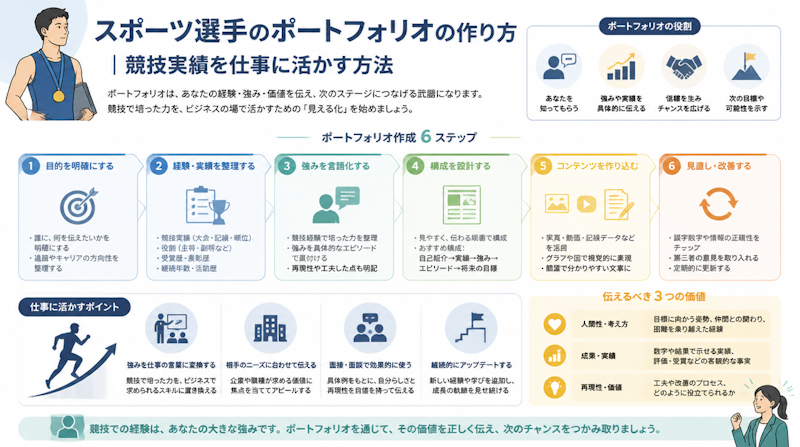
For athletes transitioning out of competitive sport, a well-crafted portfolio is one of the most powerful career tools available. According to a 2024 second career survey conducted by Luxas (n=115 athletes), 85.1% of athletes retire in their twenties, and 80.0% go through a formal job search after retiring. Yet 30.4% reported not knowing how to navigate the job market, and 32.6% struggled to identify which careers suited them best. These numbers make one thing clear: athletes need a structured, compelling way to communicate their value to employers — and a portfolio is the essential first step.
Why Athletes Need a Portfolio

The Reality of the Athletic Second Career
When a competitive athletic career ends in the mid-to-late twenties, a professional working life of 40 years or more follows. The skills and discipline developed through sport are genuinely valuable in the workplace — but they don't communicate themselves. Organizations like the United States Olympic & Paralympic Committee (USOPC), which operates dedicated athlete career services, and equivalent bodies in many countries recognize that helping athletes articulate their transferable skills is essential both for the athletes themselves and for the broader benefit of society.
In Japan, the Japan Olympic Committee (JOC) has been running career counseling, employment support, and educational programs for active athletes since 2008. Through its Asnavi initiative, it had placed nearly 400 athletes with approximately 230 companies as of March 2024. Even when leveraging these kinds of official support programs, athletes who arrive with a well-organized portfolio get far more out of career counseling sessions and make significantly stronger impressions on employers.
What Recruiters Actually Want from Athletes
Recruiters evaluating athletes are not simply looking at competition results — they want evidence that the capabilities forged through sport can be reproduced in a business environment. Analysis from second-career support services highlights the following qualities that employers consistently value in athlete candidates:
- Mastery mindset — the drive to perfect every detail and relentlessly pursue excellence
- Tenacious execution — the ability to keep going in difficult conditions and over extended time horizons
- Goal achievement — a proven track record of setting measurable targets and hitting them
- High stress tolerance — experience managing pressure in high-stakes competitive environments
- Strong networks — broad human connections built through sport across teams, clubs, and institutions
A portfolio is the document that translates these qualities from the language of sport into the language of business. It moves beyond verbal self-promotion and provides objective, verifiable evidence of capability — which measurably improves success rates at each stage of the hiring process. For guidance on structuring the self-introduction and personal pitch that accompanies a portfolio, see Self-PR Strategy for Student Athletes: How to Win Job Offers in Competitive Hiring.
The 6 Core Sections of an Athlete Portfolio
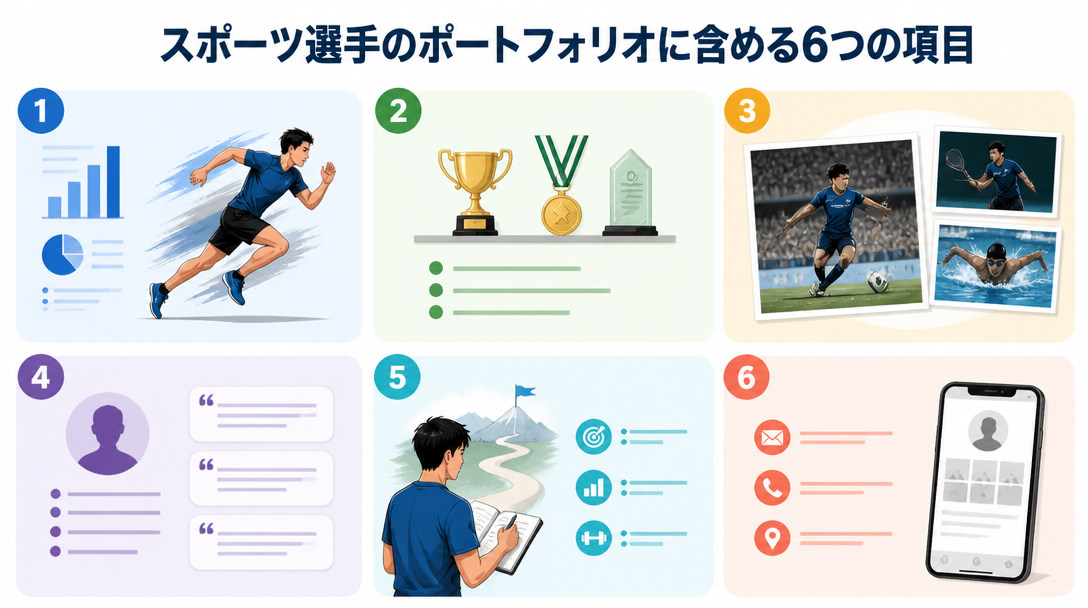
1. Profile and Athletic Background
The opening section of the portfolio should give recruiters an immediate, clear overview of who the athlete is and what sport they came from. The athletic history should be organized chronologically, listing each team, coach, and the duration of involvement.
- Name and professional headshot
- Sport, discipline, and position or event specialty
- Years active and retirement year (or note if still competing)
- Teams, clubs, universities, and company-sponsored teams attended
- Highest level of education and relevant certifications or licenses
2. Quantified Competition Results
The cardinal rule when presenting athletic achievements is to avoid vague, impressionistic language and anchor everything in numbers. Recruiters are not sports experts — a competition name and a placing alone give them little sense of what that result actually means in context. Every achievement should be framed with figures that convey scale, competition level, and the effort involved.
Weak phrasing | Strong phrasing (quantified with context) |
|---|---|
Competed at the national championships | Qualified for the National High School Championships three consecutive years; best finish 8th out of 64 competitors |
Served as team captain | Led a 32-person squad as captain: developed annual training schedules, ran monthly team meetings, and directly mentored 20 junior athletes |
Trained hard every day | Maintained a training volume of 6 hours per day, 6 days per week for 5 consecutive years — approximately 1,800 hours annually |
Overcame an injury | Sustained a complete right ankle ligament tear (12-week recovery); independently designed a rehabilitation protocol and returned to competition 6 weeks before the target event, achieving the planned performance goal |
3. Translating Athletic Skills into Business Language
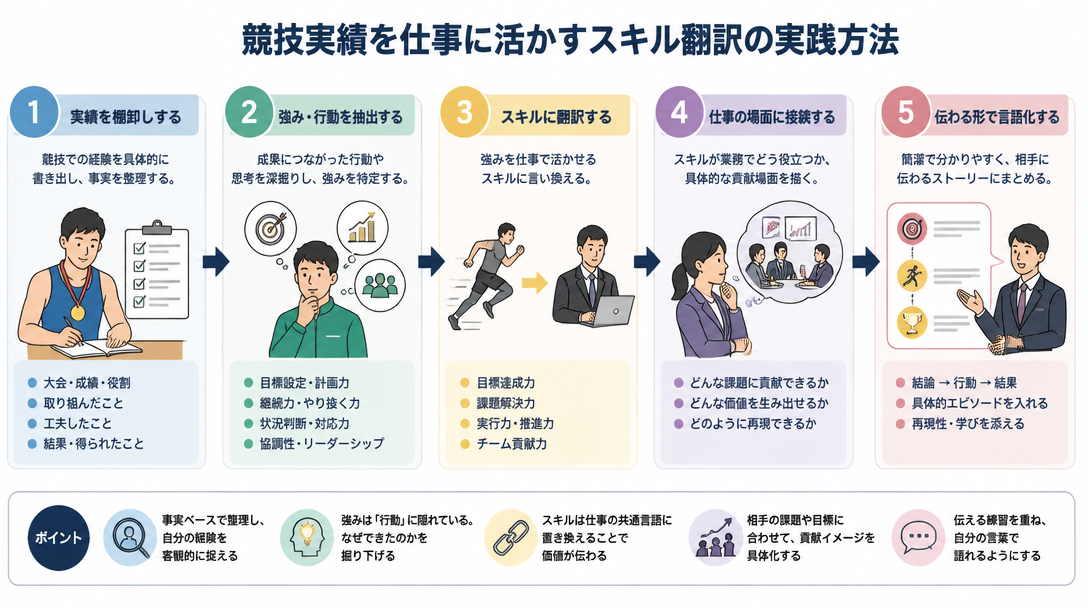
Listing competition results in isolation is not enough. What recruiters need to see is a direct mapping from athletic experience to professional capability — a process often called "skills translation." This is where a portfolio does its most important work. For example, designing a training periodization plan translates directly into Plan-Do-Check-Act (PDCA) cycle management. Analyzing opponents and adjusting team tactics maps onto data analysis and strategic decision-making. Every athletic experience has a business equivalent, and making that connection explicit is what separates a memorable portfolio from a forgettable one.
4. Personal Statement and Career Vision
The personal statement should follow a clear three-part structure: lead with the core strength, support it with a specific episode or achievement, then explain how that strength will create value in the target role. Recruiters consistently want to understand not just what a candidate has done, but what they intend to do next. A clearly articulated career vision — where the candidate wants to go and why — is one of the most effective differentiators between otherwise similar applicants. Vague aspirations like "I want to use my experience" are far less compelling than a specific direction grounded in genuine reflection on post-athletic purpose.
5. Awards, Media Coverage, and Certifications
Formal recognition strengthens the credibility of a portfolio significantly. This section should include competition awards, sport-specific certifications (such as officiating licenses or coaching qualifications), and any media appearances or features. For athletes competing in sports that are less widely known, it is especially important to provide context: the size of the competition, number of participants, and the governing body that sanctioned the event. Without this framing, recruiters who are unfamiliar with the sport cannot accurately assess the significance of the achievement.
6. Competition Photos and Video Links (Optional)
Including high-quality competition photography and links to match or performance footage adds a powerful dimension of authenticity to the portfolio. However, links should point to publicly accessible content — official competition archives, YouTube uploads, or sports federation channels — rather than private social media accounts. Before using any images, confirm that usage rights are not restricted by the event organizer or sports governing body.
How to Translate Athletic Skills into Business Competencies
Individual Sports (Gymnastics, Track and Field, Swimming, etc.)
Athletes from individual sports develop an exceptionally strong capacity for self-management, personal goal-setting, and solitary mental discipline. A useful framing for this translation is to think of the athlete as simultaneously the project manager and sole executor of a multi-year performance initiative. In gymnastics, for instance, the process of analyzing a complex scoring code and designing a routine that maximizes difficulty while controlling execution risk translates directly into KPI design and prioritization work familiar to marketers, product managers, and analysts.
- Designing and optimizing a competition routine → Data analysis and strategic decision-making
- Working with coaches to build a multi-season strategy → Collaborative goal-setting with managers and stakeholders
- Pre-competition mental and physical preparation routines → Risk management and performance condition monitoring
- Incorporating real-time coaching feedback into execution → Agile iteration and rapid improvement cycles
Team Sports (Soccer, Basketball, Volleyball, etc.)
Team sport athletes bring particularly strong assets in leadership, interpersonal communication, and role clarity within a collective structure. Experience as a captain or vice-captain maps closely to project leadership and team management responsibilities that employers actively seek. Research published in 2024 found that interpersonal communication ability was rated as a valuable business-applicable skill in athletes by 30.4% of respondents — and team sport athletes are well-positioned to illustrate this through concrete examples of how they navigated conflict, motivated peers, or adapted to changing team dynamics under competitive pressure.
A Five-Step Process for Quantifying Athletic Achievements
- Audit the full athletic history: Create a chronological list of every competition, result, and affiliation from the beginning of competitive involvement to the present.
- Gather quantitative data: For each entry, record hard numbers — number of competitors, years of participation, average weekly training hours, team size, number of junior athletes mentored.
- Select three to five defining episodes: Identify experiences that involved overcoming adversity, leading others, contributing to a team outcome, or achieving a significant personal goal.
- Map episodes to business competencies: For each episode, determine which professional capability it demonstrates — strategic planning, execution, analytical thinking, communication, or leadership.
- Edit for a non-sports audience: Rewrite every section so that someone with no background in the sport can clearly understand what was achieved, how hard it was, and why it matters professionally.
Portfolio Format and Tool Selection
Website Portfolio vs. PDF Document: Key Differences
Athlete portfolios generally take one of two forms: a website or a PDF document. Each has distinct advantages, and choosing the right one depends on the industry being targeted and the stage of the hiring process.
Format | Advantages | Limitations | Best suited for |
|---|---|---|---|
Website | Shareable via URL; supports embedded video; easy to update in real time | May require more time to set up initially | Sports business, creative industries, technology companies |
PDF document | Fast to produce; consistent formatting across all devices; printable | Must be re-sent after each update; no video playback | Large corporations, financial services, manufacturing, document-heavy hiring processes |
Recommended Tools for Building an Athlete Portfolio
- Notion: Offers a wide range of templates and can be published as a public web page. Excellent for organizing profiles, achievements, and skills in a clean, block-based layout.
- Canva: Enables the rapid creation of visually polished PDF portfolios. Sports-themed templates make it easy to produce professional-looking documents without design experience.
- Wix or similar no-code website builders: Ideal for athletes who want a fully functional website portfolio without writing code. Suitable for those targeting industries where an online presence carries more weight.
- Google Slides: Practical for athletes who want to integrate their portfolio into a presentation format for interviews, combining speaking points with visual evidence of achievements.
Tailoring the Portfolio to Different Hiring Contexts
A dual-track approach works well across most hiring processes: submit the PDF version with the initial application, then send the website URL by email the day before the interview as a reminder and supplementary resource. Career development resources recommend preparing both a concise three-to-five-minute overview version and a comprehensive ten-to-twenty-minute version of the portfolio narrative — the short version for initial conversations and screening stages, the full version for in-depth interviews where more time is available to walk through achievements in detail.
Using the Portfolio Throughout the Job Search Process
Connecting the Portfolio to Application Documents
The portfolio is not a standalone document — it works as an extension of the resume and cover letter. Where a resume might note "competed at the national championships," the portfolio expands that entry into a full account: the size of the competition field, the training structure that led to qualification, the athlete's specific role or event, and the strategies used to achieve the result. The design principle is simple: whenever a recruiter reading the resume wants to know more, the portfolio provides the depth that a one-page document cannot.
Presenting the Portfolio in Interviews
Proactively offering a portfolio at the start of a job interview immediately signals preparation and professionalism. Walking an interviewer through selected portfolio sections — rather than simply leaving it on the table — turns the document into a conversation framework and makes the athlete's story much more memorable. The mental toughness developed through years of high-pressure competition is itself a compelling talking point; for guidance on how to articulate this effectively, see Mental Training for Athletes: How to Overcome Pressure and Perform at Your Best, which provides language and frameworks that can be incorporated directly into portfolio narratives.
Combining Portfolio Preparation with Athlete Career Support Programs
Organizations such as the USOPC's athlete career services and equivalent national programs offer career counseling, job placement assistance, and professional development resources specifically for athletes. Arriving at these consultations with a complete, well-organized portfolio dramatically improves the quality of guidance received. Career advisors can focus immediately on strategy and fit rather than spending session time on basic fact-gathering. For a broader look at how to structure a post-athletic career transition, including skills assessment and industry targeting, see Athlete Second Career Planning: Skills Assessment and Job Change Strategy After Retirement.
Common Portfolio Mistakes and How to Avoid Them
Mistake 1: Listing Results Without Context
A portfolio that does nothing more than enumerate competition names and rankings functions as a results ledger — not a professional document. The real value lies not in the outcome itself but in the thinking, decisions, and actions that produced it. For every significant result included in the portfolio, four questions should be answered: Why was this goal chosen? What obstacles had to be overcome? How were those obstacles addressed? What was learned in the process? Without this layer of narrative, a recruiter has no basis for evaluating what the result says about the person behind it.
Mistake 2: Failing to Frame Achievements in Business Terms
A statement like "competed at the state or national games" means little to a recruiter who has no reference point for how competitive that event was. Reframing the same achievement — "selected as one of approximately 200 regional finalists to represent the state; prepared through an intensive six-month training program culminating in a qualifying competition" — gives the recruiter the context they need to evaluate the achievement using familiar professional criteria: selectivity, preparation, and demonstrated performance under pressure.
Mistake 3: Treating the Portfolio as a Finished Document
A portfolio created once and never updated loses value rapidly. During the competitive career, new results, certifications, coaching qualifications, and media appearances should be added as they occur. After retirement, work experience, new professional skills, and continuing education achievements should be incorporated as the second career develops. Integrating the portfolio with an ongoing digital presence — discussed further in Athlete Social Media Strategy: Personal Branding and Building a Following — means that the accumulated record of consistent effort and development reinforces the portfolio's credibility over time.
Summary
An athlete portfolio is a strategic document that translates competitive achievement into business language and presents professional value in a form that recruiters can evaluate and act on.
- With 85.1% of athletes retiring in their twenties and a working life of 40+ years ahead, early preparation is essential — ideally beginning while still competing.
- A complete portfolio covers six areas: profile and athletic background, quantified competition results, skills translation, personal statement and career vision, awards and certifications, and supporting media.
- Every achievement should be framed with numbers and context: event name, field size, the athlete's specific role, and the process used to achieve the result.
- Individual sport athletes should emphasize self-management and goal-setting; team sport athletes should foreground leadership and communication.
- Use a website format for industries that value digital presence; use PDF for document-heavy hiring processes; prepare both short and long versions for different interview stages.
- Athlete career support programs offered by national Olympic committees and government sport agencies become substantially more effective when the athlete arrives with a portfolio already prepared.