Mental Training for Athletes: Overcome Pressure & Perform
Discover 6 science-backed mental training techniques for athletes—imagery, self-talk, breathing, routines & more—to overcome pressure and peak on competition day.
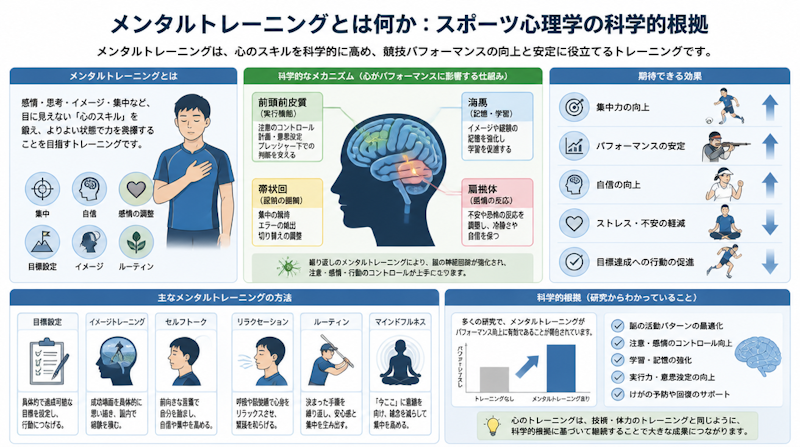
Mental training has become the "third pillar" of elite sport, standing alongside physical conditioning and technical skill. Whether an athlete can deliver their best performance when it matters most depends enormously on the quality of their psychological preparation. This article draws on sports psychology research to explain proven mental training techniques and practical strategies for maximizing performance under pressure.
What Is Mental Training? The Sports Psychology Science Behind It
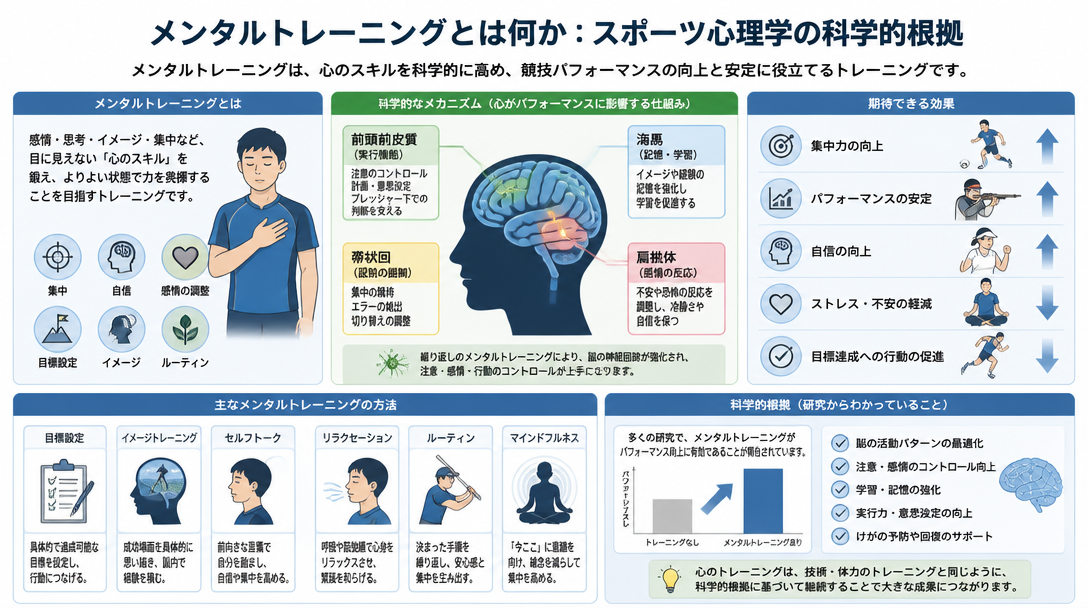
From Grit to Science: The Evolution of Mental Training
For much of sporting history, psychological preparation amounted to little more than calls for "willpower," "toughness," and "perseverance." That began to change in the 1970s, as the emerging field of sports psychology reframed mental skills not as innate character traits but as learnable competencies—techniques that could be systematically trained and refined just like a jump shot or a clean lift.
Today, institutions such as the United States Olympic & Paralympic Committee (USOPC) Mental Performance division offer structured, evidence-based mental performance programs to national-team athletes across dozens of sports. Mental training is formally defined as a systematic program of psychological skill development aimed at enhancing competitive performance. It draws on a suite of techniques—goal setting, imagery, self-talk, concentration training, and relaxation—that are combined and tailored to each athlete's needs. From a sports psychology standpoint, these are not measures of "mental toughness" as a personality trait; they are trainable psychological skills that respond to deliberate practice in the same way physical qualities do.
How Much Does Psychology Actually Affect Performance?
Among the factors that separate elite athletes in competition, how large a role does psychology play? A 2025 study published in Frontiers in Psychology found that psychological factors can account for up to 30% of the variance in performance outcomes among high-level competitors. The implication is striking: at the top levels of sport, where technical and physical preparation is broadly equivalent across competitors, mental skills frequently determine who wins and who falls short.
In artistic gymnastics, mental state influences both the Difficulty Score and the Execution Score that make up a routine's total under the Code of Points. A technically flawless release move on the high bar can end in a costly stumble if excess muscle tension—triggered by anxiety—disrupts the landing. Stable performance under pressure is simply not achievable without deliberate psychological skill development.
Why Performance Drops Under Pressure: The Mechanisms
The Science of Choking: Arousal, the Inverted-U, and the Optimal Zone
"Choking under pressure" is the everyday name for a well-documented phenomenon: performance deterioration caused by arousal levels that climb too high. Sports psychologists describe this using the Inverted-U Hypothesis (Yerkes–Dodson Law), which holds that both very low and very high arousal produce sub-optimal results, with peak performance occurring at a moderate, individual-specific level of activation.
Each athlete has what researchers call an Individual Zone of Optimal Functioning (IZOF)—the arousal band in which they perform best. A core goal of mental training is to help athletes identify their own zone and develop the self-regulation skills to reach it reliably on competition day. When arousal is running too high, relaxation techniques (such as diaphragmatic breathing) bring it back down; when it is too low, psyching-up strategies (energizing self-talk, dynamic warm-up cues) activate the system. The ability to self-regulate arousal on demand is one of the hallmarks of elite psychological preparation.
Three Core Mechanisms by Which Pressure Undermines Skill Execution
Pressure disrupts performance through at least three distinct pathways. These mechanisms are common across all competitive sports, including artistic gymnastics.
- Attentional distortion: Anxiety shifts attention toward outcome-related worries ("What if I fall?") and away from the internal cues needed to execute a skill cleanly. During a high-bar release, a gymnast whose attention moves to the fear of missing the re-catch will lose the precise grip timing the skill demands.
- Excess muscle tension: Psychological stress translates directly into physical tension, disrupting movement smoothness and inter-muscular coordination. In gymnastics, this degrades the flow between elements in a combination and the precision of landings. It also impairs the fine motor control needed for strength elements on parallel bars or rings, where unnecessary co-contraction reduces positional accuracy.
- Decision-making delays: Anxiety slows information processing, lengthening reaction times and blunting strategic judgment. In a multi-event gymnastics competition spread across a full day, the ability to mentally reset between apparatus—letting go of what happened on the previous event—is as important as the physical skills themselves.
Understanding these mechanisms provides the rationale for each of the evidence-based techniques described below. Mental training is not about eliminating nerves; it is about ensuring that the nervous system works for the athlete, not against them.
6 Evidence-Based Mental Training Techniques for Athletes
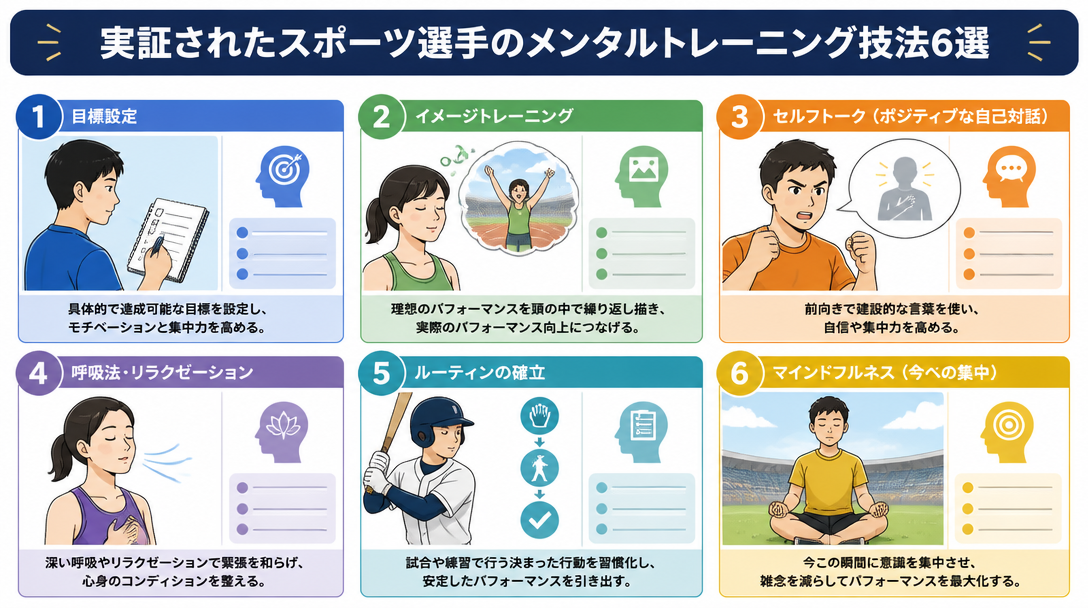
The six techniques below have the strongest scientific support in the sports psychology literature. They are among the methods officially endorsed by the USOPC Mental Performance division and widely implemented in elite athlete development programs worldwide.
Technique | Primary Purpose | Learning Difficulty | Recommended Acquisition Period |
|---|---|---|---|
Imagery (Mental Rehearsal) | Skill consolidation & competition preparation | Moderate | 4–6 weeks |
Self-Talk | Focus & confidence maintenance | Low | 2–3 weeks |
Diaphragmatic Breathing (Relaxation) | Rapid reduction of over-arousal | Low | 1–2 weeks |
Pre-Performance Routine | Triggering an optimal focus state | Moderate | 3–4 weeks |
Goal Setting | Motivation management | Low | Ongoing |
Mindfulness | Present-moment focus & emotion regulation | High | 8+ weeks |
Imagery (Mental Rehearsal)
Imagery—also called mental rehearsal or visualization—involves vividly recreating competitive scenarios in the mind in order to activate neural pathways similar to those engaged during actual physical execution. Functional MRI research has confirmed that imagining a movement produces brain activity patterns closely resembling those generated when the movement is physically performed, providing a clear neurological basis for the technique's effectiveness.
According to FC Barcelona's sports science research hub (Barça Innovation Hub), effective imagery is multisensory: it goes well beyond simply "seeing" a skill unfold. The most powerful rehearsal integrates the kinesthetic feel of the movement, the sounds of the competition environment, and the emotional states associated with peak performance. For a gymnast, this means not just imagining a clean landing, but feeling the impact through the legs, hearing the crowd, and experiencing the flush of confidence that follows a well-executed routine.
A structured imagery session follows these steps:
- Find a quiet space, sit comfortably, close your eyes, and use diaphragmatic breathing to reach a relaxed, focused state.
- Vividly construct the competition environment—the venue, lighting, the feel of the apparatus or playing surface, ambient sounds.
- Rehearse the target performance in real time, using both an internal (first-person) perspective—feeling the movement from inside the body—and an external (third-person) perspective—watching yourself perform as if on video.
- If an error appears in the imagery, pause, correct it, and re-run that section successfully before moving on.
- End by fully dwelling in the positive emotional experience of a successful performance: the sense of achievement, relief, and satisfaction.
Sessions of 5–10 minutes, built into the start and end of physical practice, are an effective way to establish the habit. Running through an entire competition in imagery the evening before a meet serves as powerful psychological preparation for the demands ahead.
Self-Talk: Turning Inner Dialogue Into Performance
Self-talk refers to the internal verbal stream—both deliberate and automatic—that runs through an athlete's mind during training and competition. Negative self-talk amplifies anxiety and fragments concentration. Positive and instructional self-talk, by contrast, has been shown across numerous studies to enhance focus, sustain confidence, and improve technical execution.
Two categories of self-talk serve distinct functions in sport:
- Motivational self-talk (e.g., "I've got this," "Trust your training," "Enjoy this moment"): Effective for sustaining effort, managing emotions, and maintaining confidence. Most useful before a routine begins or in the moments leading up to a key skill.
- Instructional self-talk (e.g., "Shoulders square," "Drive through the hips," "Punch the board and extend"): Anchors attention to specific technical cues, improving skill precision. Particularly valuable during skill acquisition and for reinforcing correct movement patterns in practice.
One critical principle: frame self-talk in positive, action-oriented language. The brain processes negatively framed instructions poorly—"don't fall" triggers the very image of falling. Replace "don't step on landing" with "stick both feet together." The instruction tells the body exactly what to do, rather than what to avoid, making it far more effective as a performance cue.
Diaphragmatic Breathing: Immediate Control Over Over-Arousal
Diaphragmatic (belly) breathing is one of the most immediately practical tools in any athlete's mental performance toolkit. By activating the parasympathetic nervous system, slow, controlled breathing lowers heart rate and reduces muscle tension—providing a direct physiological pathway to calm that can be used seconds before competition begins.
Research in applied sports psychology has documented cases where athletes struggling with chronic over-arousal achieved major competitive breakthroughs after learning to use diaphragmatic breathing as a self-regulation skill. The technique's strength lies in its accessibility: it can be practiced anywhere, requires no equipment, and takes only two to three minutes to produce measurable physiological effects.
The basic protocol:
- Inhale slowly through the nose for 4 seconds, allowing the abdomen to expand outward (the chest should remain relatively still).
- Hold for 2 seconds. (A "box breathing" variant uses equal 4-second intervals for inhale, hold, exhale, and hold—a method also used by military special operations units for stress regulation.)
- Exhale slowly through the mouth for 6–8 seconds. The extended exhale is the key to activating the parasympathetic response; it should always be longer than the inhale.
- Repeat for 3–5 cycles.
This sequence can be completed during any waiting period before competition—in the marshaling area, in the moments before stepping up to an apparatus, or between events. Practiced daily, it becomes an automatic self-regulation tool that activates reliably under pressure. Performed before bed, it also supports sleep quality and physical recovery.
Pre-Performance Routines: Building a Reliable Focus Switch
A pre-performance routine is a consistent sequence of thoughts and actions performed before each competitive effort—designed to reliably trigger an optimal psychological state through the principles of conditioning. Rugby place-kickers, tennis servers, and free-throw shooters are among the most visible examples of athletes who use structured routines to manage focus. Over time, the routine itself becomes a conditioned cue: completing the sequence reliably activates the mental state associated with best performance.
An effective pre-performance routine contains three elements:
- Physical anchor: A deliberate physical action—two controlled breaths, a specific stretch, tapping the hands together—that provides a sensory "reset" and signals the start of the focus sequence. The physical sensation grounds attention in the present moment.
- Cue word: A brief, personally meaningful word or phrase—"sharp," "flow," "own it"—that has been repeatedly paired with concentrated, high-quality performance in practice. Over time, the word alone can reliably access the associated mental state.
- Attentional focusing: A deliberate act of directing attention toward the task—fixing the gaze, running the first movement of the skill in imagery, or narrowing awareness to a single technical cue—while intentionally filtering out crowd noise, scoreboards, and outcome thoughts.
Crucially, the routine must be practiced in training every single time, not just reserved for competition. Consistent repetition in practice is what builds the conditioning that makes the routine reliable under pressure.
Goal Setting: Building Motivation and Mental Strength
The Three-Level Goal Structure: Outcome, Performance, and Process
According to sports psychologist Dr. Kaori Araki, a key principle of effective goal setting is focusing on what is within the athlete's direct control. Competitive goals can be organized across three levels, each serving a different psychological function:
- Outcome goals (e.g., "Win the national championship," "Make the national team"): These describe the ultimate competitive result and provide long-term motivational direction. However, they depend partly on factors outside the athlete's control—judges' decisions, other competitors' performances—so they should not be the sole focus of daily effort.
- Performance goals (e.g., "Build a routine with a Difficulty Score of 6.0 or above," "Achieve a landing success rate above 80%"): These benchmark the athlete's own level against objective, measurable standards rather than against other competitors. Progress is trackable and provides regular feedback.
- Process goals (e.g., "Complete 5 minutes of imagery at the end of every practice," "Maintain a three-times-per-week core training schedule"): These govern daily behavior and are almost entirely within the athlete's control, making them the most reliable source of immediate achievement and intrinsic motivation.
Elite athletes consistently emphasize process goals for a reason that extends beyond motivation: athletes who focus on executing the next process step during competition—rather than thinking about winning or losing—naturally reduce anxiety and improve execution. In a gymnastics meet, directing attention to "nail the landing position on this skill" rather than "I need to beat my rival's score" produces both better performance and better emotional management.
SMART Goals: A Framework for Effective Goal Construction
The SMART framework is widely applied in sports psychology to ensure that goals are structured for maximum motivational impact. Sports psychology practitioners often recommend beginning with short-term goals achievable within about three weeks—early successes build the confidence and momentum needed to sustain effort toward longer-term objectives.
Letter | Meaning | Example (Artistic Gymnastics) |
|---|---|---|
S – Specific | Clearly defined | "Add one C-value release element to the high bar routine" rather than "improve difficulty" |
M – Measurable | Tracked with numbers | Record landing success rate after every session and plot it on a graph |
A – Achievable | A realistic stretch beyond current level | Set the goal one step above present capability, not three steps |
R – Relevant | Linked to the bigger picture | Derived by working backward from the long-term goal (e.g., personal best score at national championships) |
T – Time-bound | Has a clear deadline | "By the regional qualifier in three months" rather than "someday" |
Pressure Training: A Scientific Approach to Simulating Competition
The Research Case for Pressure Training
A 2025 study published via PubMed Central examined fifteen Division I collegiate field hockey players who completed five sessions of psychological skills training combined with structured pressure training (PT). The results showed a statistically significant improvement in Mental Toughness Index (MTI) scores (t(12) = −3.34, p = .006) with a large effect size (Cohen's d = 0.93). The study also found that athletes who entered with higher baseline mental toughness scores showed superior performance in the pressure training environment (F(1,16) = 4.67, p = .0499), underscoring the value of building mental toughness proactively rather than waiting for competition to test it.
A 2025 scoping review published in Taylor & Francis adds an important nuance: the effectiveness of pressure training depends heavily on how faithfully the training environment replicates the subjective sense of stakes that athletes experience in real competition. In other words, the athlete must genuinely feel the pressure for the training to produce psychological adaptation. Superficial simulations that fail to create real anxiety responses are unlikely to transfer to competition performance.
Practical Methods for Designing Pressure Training
Four evidence-informed approaches for building competition-level pressure into daily training:
- Introduce an evaluative audience: Have coaches or teammates formally "score" a performance, or simply announce that the session will be filmed for review. The awareness of being observed and assessed is sufficient to generate meaningful competitive stress, even in a training hall.
- Attach consequences to outcomes: Establish conditions such as "successful routine = end of conditioning sets; unsuccessful routine = three additional sets." When results carry real costs or rewards, competitive anxiety rises appropriately and the training stimulus becomes more transferable to competition.
- Conduct regular intrasquad competitions or mock meets: Running a formal trial approximately once per month—complete with official marshaling, warm-up sequences, full routines, and scoring announcements—dramatically increases the psychological fidelity of the preparation. The closer the simulation is to the actual competition format, the greater the psychological adaptation.
- Add cognitive loading tasks: Require athletes to perform secondary cognitive tasks during execution—counting backward, responding to random verbal cues from a coach—to stress attentional control under divided-attention conditions. This builds the capacity to maintain technical focus despite environmental interference, a skill directly applicable to managing distraction in competition.
A Practical Mental Training Guide for Gymnasts
Step-by-Step: Building Your Pre-Routine Focus Sequence
In artistic gymnastics, the brief window before each routine begins—typically 30 to 60 seconds—is the most consequential moment for psychological management. The following five-step pre-routine sequence is recommended as a starting framework, to be personalized and refined through consistent practice:
- Apparatus contact (3–5 seconds): Touch the bar, beam, vault table, or handle grips. Use the physical sensation to connect with the implement and anchor awareness in the present moment.
- Breath regulation (10–15 seconds): Complete 2–3 diaphragmatic breath cycles to stabilize heart rate and lower excess muscle tension before the salute.
- Rapid imagery run (5–10 seconds): Flash through the opening sequence of the routine up to the first major element. This primes the motor system and confirms the movement plan.
- Cue word (3 seconds): Internally say your personal focus word—"sharp," "flow," "committed"—to activate the conditioned focus state built through consistent training.
- Start trigger: Execute a fixed initiation action—clap the hands, take one final breath and set the shoulders, step into the starting position—that reliably signals to the nervous system that performance mode has begun.
This sequence must be practiced in every training session without exception. Consistency in practice is what transforms the routine from a set of arbitrary actions into a reliable psychological trigger. Combining this mental preparation with physical peaking and tapering strategies before a major competition maximizes the probability of delivering best-ever performances when it counts most.
Mental Performance Journals: Recording and Improving Self-Regulation
Continuous self-assessment through a structured mental performance journal is a cornerstone practice recommended by leading sports psychology institutions worldwide. Logging the following data points after each training session or competition builds the self-knowledge necessary for systematic improvement:
- Pre-performance anxiety level (0–10 scale)
- Perceived performance quality (0–10 scale)
- What went well and what did not (specific, behavioral descriptions)
- Which mental skills were used and how effectively they worked
- Key learning point and specific adjustment to apply next session
Over weeks and months, this data reveals individual patterns. An athlete may discover that a pre-competition anxiety rating of 7–8 consistently correlates with their best routines, while ratings above 9 or below 5 predict underperformance. That information—personal IZOF data—gives the athlete a concrete target for their arousal self-regulation efforts. Pairing the mental log with a record of sleep quality and recovery status reveals how physical readiness interacts with psychological state, providing an even richer picture of performance readiness. For the relationship between nutritional status and mental performance, the article on nutrition and weight management for gymnasts offers complementary guidance.
Making Mental Training a Habit: Integrating It Into Daily Practice
Integrating Physical and Psychological Training
Mental training reaches its full potential when it is woven into physical practice rather than treated as a separate, add-on activity. The Barça Innovation Hub reports that the most effective performance programs are those that embed cognitive demands directly into physical training rather than addressing them in isolation.
Practical integration checkpoints for daily training:
- Before each attempt at a difficult new skill, spend 2–3 minutes on imagery of successful execution.
- After every run-through or competitive routine in practice, pause for a 10-second focus reset using breathing and a cue word before beginning the next attempt.
- Whenever a mistake occurs, consciously replace negative self-talk with an instructional cue that redirects attention to the correct movement pattern.
- Once per week, write the following week's process goals by hand and review them every morning.
- In the one to two weeks before a competition, progressively introduce pressure training protocols to accelerate psychological readiness.
Working With a Sport Psychologist or Mental Performance Coach
In the early stages of developing psychological skills, working with a qualified specialist accelerates the learning process considerably. Certified sport psychologists and mental performance consultants can conduct individual assessments, identify sport-specific psychological demands, and design personalized programs that would take far longer to develop through self-directed learning alone.
The USOPC Mental Performance division provides national-team athletes with access to sport psychology services as a standard component of their high-performance support. Many national Olympic committees around the world offer similar programs. Digital tools for self-guided mental performance training are also expanding in availability, providing structured programs for athletes who do not yet have access to in-person consulting. Regardless of the delivery mode, the underlying evidence base—the six techniques described in this article—remains consistent across the research literature.
Summary
The key takeaways from the sports psychology evidence on mental training for athletes:
- Mental skills are trainable competencies, not fixed personality traits—they respond to deliberate, systematic practice in the same way physical skills do.
- At elite levels, psychological factors account for up to 30% of performance variance (Frontiers in Psychology, 2025), making mental training a non-negotiable component of total athletic preparation.
- The six core techniques—imagery, self-talk, diaphragmatic breathing, pre-performance routines, goal setting, and mindfulness—all have robust scientific support and are applicable across sports and skill levels.
- Structured pressure training produces statistically significant improvements in mental toughness (Cohen's d = 0.93, PMC 2025) and should be incorporated into training cycles well before major competitions.
- For gymnasts specifically, a 30–60 second pre-routine focus sequence is one of the highest-impact applications of mental training, given the sport's brief but psychologically demanding performance windows.
- Mental performance journals that track arousal levels and performance quality over time allow athletes to identify their personal IZOF and systematically improve their self-regulation—the foundation of long-term competitive development.