Time Management for College Athletes: Balance Sport & Study
Practical time management strategies for college athletes to balance sport and academics—from weekly scheduling and the Pomodoro Technique to sleep optimization and UNIVAS support.
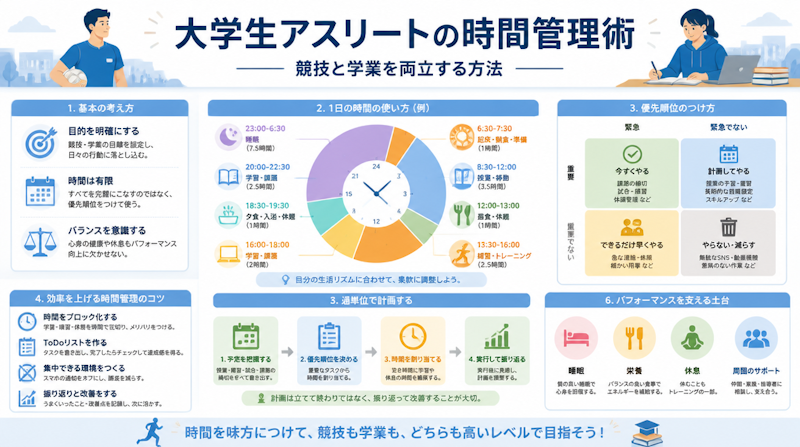
Time management is one of the greatest challenges college athletes face when trying to balance competitive sport with academic success. Between practices, competitions, travel, lectures, assignments, and exams, there is simply no room for an unstructured approach to the day. This article draws on current research and institutional frameworks to offer a comprehensive, actionable guide to time management for the student-athlete.
The Reality of Time Scarcity for College Athletes
How Much Time Do Student-Athletes Actually Spend on Sport?
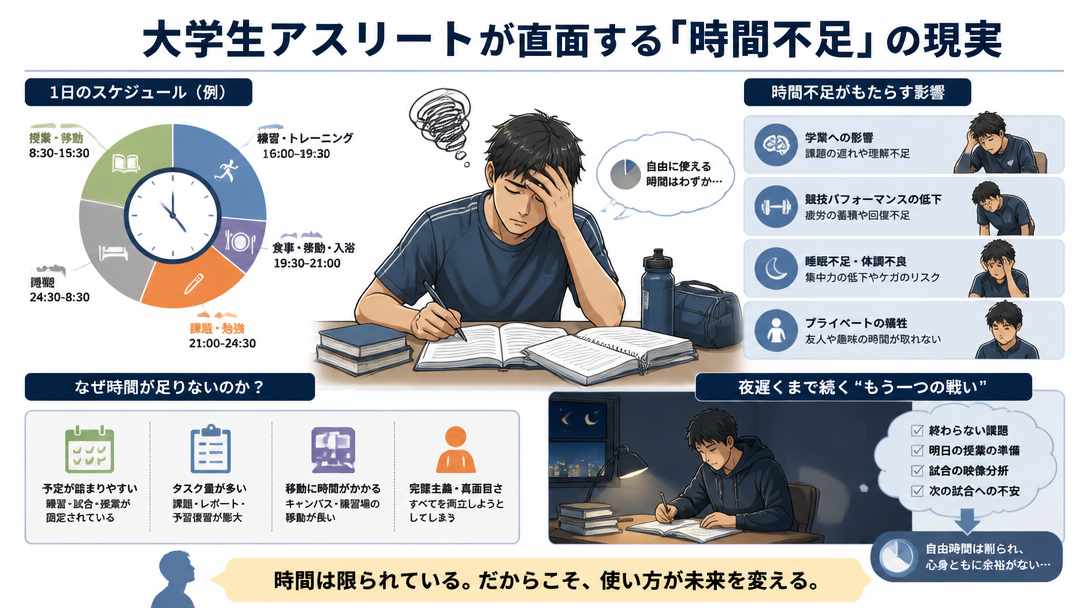
The scale of the commitment required of college athletes is often underestimated. According to a NCAA study on student-athlete time demands, athletes in many Division I sports report spending 30 or more hours per week on athletics-related activities during their season—equivalent to a part-time job on top of a full course load. When practice sessions alone average two to three hours per day, five or more days a week, that accounts for ten to fifteen hours of structured athletic activity every week before factoring in travel, film review, strength and conditioning, or team meetings.
During competition season, away trips and multi-day tournaments add further disruption to any semblance of a regular weekly routine. Attending classes, completing readings, writing papers, and preparing for exams alongside this schedule is not simply a matter of working harder—it requires working smarter. Time management, in this context, is not a soft skill. It is a strategic capability that directly determines both academic and athletic outcomes.
Why Balancing Sport and Study Is Genuinely Difficult
Reports from governing bodies such as the NCAA and academic researchers consistently identify structural barriers that make dual success difficult—not simply a lack of willpower. The core obstacles fall into three categories:
- Inflexible athletic schedules: Practice times, game dates, and travel itineraries are largely non-negotiable. Athletes cannot rearrange their sport calendar to suit academic deadlines.
- Physical fatigue and cognitive decline: Intense training depletes energy reserves and impairs the concentration required for effective studying. Attempting to absorb complex material after a two-hour practice session is physiologically harder than doing so when rested.
- Difficulty switching mental modes: Transitioning from the high-arousal, physically engaged state of athletic competition or training into the focused, analytical mindset required for academic work takes time and deliberate effort.
Understanding these structural realities is the first step. The following sections address each challenge with concrete strategies.
The Foundation: Designing a Weekly Schedule That Actually Works
Time Blocking: Making Every Hour Visible and Intentional
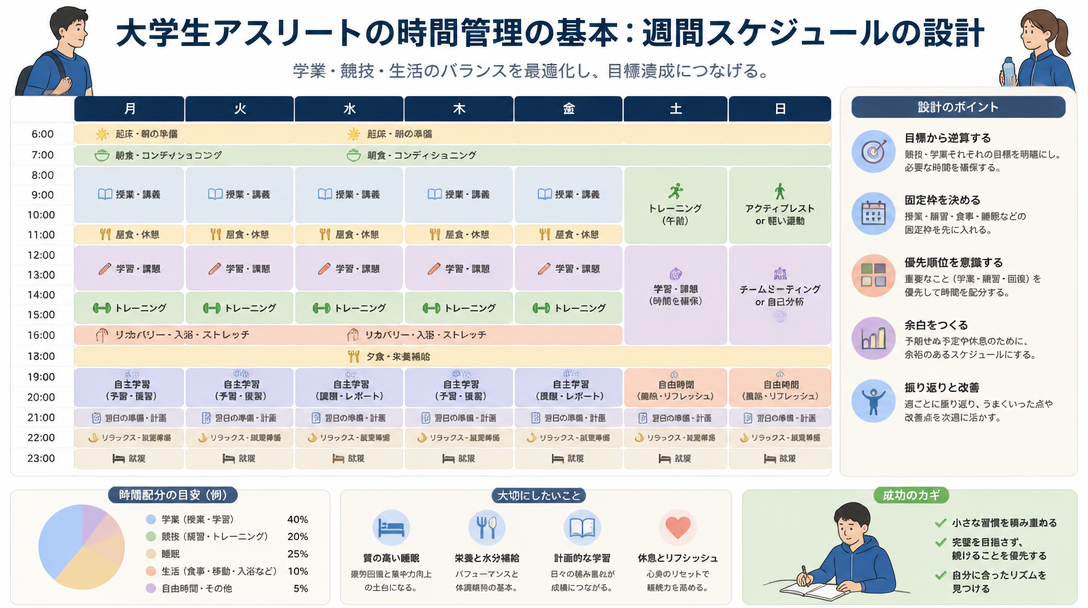
The single most effective scheduling strategy for college athletes is time blocking—assigning specific tasks to specific time slots in advance, rather than deciding what to work on in the moment. Tools like Google Calendar, a physical planner, or any digital scheduling app can support this approach. The process unfolds in three steps:
- Lock in fixed commitments first: Enter every practice session, class time, team meeting, and target sleep window into the calendar before anything else. These blocks are non-negotiable and define the framework around which everything else must fit.
- Schedule dedicated study blocks: Within the remaining time, identify and protect two to three hours each day specifically for academic work. Treat these blocks with the same seriousness as a practice session—they are appointments, not intentions.
- Build in buffer time: Reserve two to three hours each week as unassigned buffer time. This absorbs unexpected assignments, extended travel, or extra recovery time without causing the entire schedule to collapse.
The critical shift in mindset is moving from "studying when there's nothing else going on" to scheduling study time in advance, just like practice. Without a reserved slot, academic work will perpetually be crowded out by social commitments, team activities, or simple exhaustion.
Setting Priorities: The Eisenhower Matrix for Athletes
When everything feels urgent, nothing gets done well. The Eisenhower Matrix is a prioritization framework that sorts tasks along two axes—urgency and importance—creating four quadrants that guide decision-making:
Urgent | Not Urgent | |
|---|---|---|
Important | Do immediately (exam review the night before, pre-competition preparation) | Schedule and plan (fitness development, language study, professional certifications) |
Not Important | Delegate or handle briefly (unnecessary group chats, minor administrative tasks) | Eliminate (aimless social media scrolling, passive entertainment with no recovery value) |
College athletes frequently fall into the trap of spending disproportionate time in the bottom-left quadrant—responding to things that feel urgent but carry little actual importance. Research consistently shows that the average person spends over two hours per day on social media. Consciously reclaiming even one hour of that time creates meaningful space for academic work without requiring any change to the athletic schedule.
Equally important is protecting the top-right quadrant—important but not urgent tasks like consistent fitness development, language acquisition, or building skills relevant to a post-sport career. These activities rarely feel pressing in the moment but compound significantly over a four-year college career.
The Weekly Review: Keeping the System Alive
A schedule built once and never revisited quickly becomes irrelevant. Building a weekly review habit—fifteen to thirty minutes on Sunday evening—ensures the system adapts to changing circumstances. A useful weekly review covers three areas:
- What was accomplished last week, and what was missed or left incomplete?
- What does next week's athletic schedule look like—any away games, early morning practices, or competitions that will affect study time?
- What academic deadlines (exams, papers, presentations) fall in the next two to three weeks, and are the corresponding study blocks already on the calendar?
The athletic calendar is not static. Practice intensity during the competition season differs substantially from the off-season, and schedule demands shift from week to week. A weekly review anchors the time management system to current reality rather than an idealized plan created at the start of the semester.
Study Smarter: Learning Techniques That Work for Fatigued Athletes
The Pomodoro Technique: Sustained Focus in Short Bursts
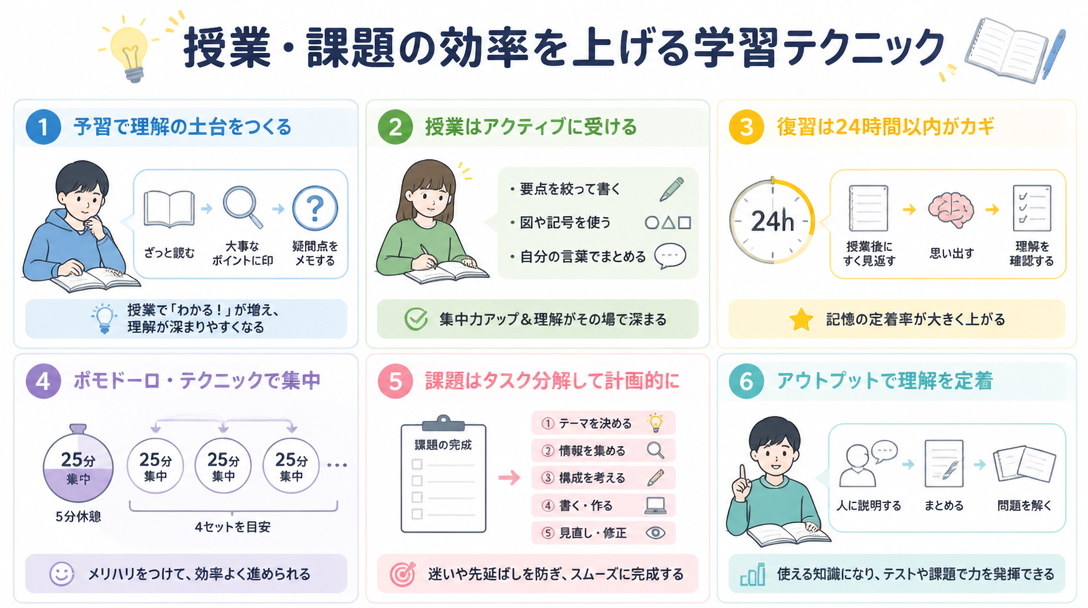
Developed by Francesco Cirillo in the late 1980s, the Pomodoro Technique structures work into 25-minute focused intervals followed by 5-minute breaks. For athletes studying after physically demanding training, this format is particularly well-suited because it does not require sustained high-level concentration for long stretches—a cognitive state that is genuinely difficult to maintain when physically depleted.
The standard process:
- Choose a single, specific task (e.g., "write the introduction and first two paragraphs of my history essay").
- Set a timer for 25 minutes and work exclusively on that task until the timer sounds.
- Take a genuine 5-minute break—stand up, stretch, close your eyes, or do light movement.
- After four complete Pomodoro cycles, take a longer break of 15 to 30 minutes.
The 25-minute work interval aligns with research on attention span and cognitive endurance. On days of particularly heavy training, shortening intervals to 20 minutes is entirely reasonable. The key is maintaining the structure: a defined task, a timer, and a real break. Working in a vague, open-ended way for "as long as possible" is far less productive for a fatigued athlete than structured, time-bounded sprints.
Micro-Learning: Turning Dead Time Into Study Time
A distinctive feature of the college athlete's schedule is the abundance of short, often overlooked pockets of time: the commute to campus, the wait before practice begins, the ride to an away competition, the fifteen minutes between finishing a meal and heading to a team meeting. Individually, these fragments seem too short to be useful. Accumulated across a week, they can represent several hours of additional study time.
Micro-learning is the practice of using these brief windows for targeted, low-friction academic activity:
- Commuting by bus or train: Listen to recorded lectures, review audio flashcards, or use a language learning app.
- Waiting before practice: Use a spaced-repetition flashcard app (such as Anki) to review vocabulary, formulas, or key concepts.
- Mealtimes: Watch lecture recordings at 1.5x or 2x speed—many learning management systems support variable playback.
- The ten minutes before sleep: Preview the next day's lecture material at a high level so the content is familiar when it is taught in class.
The key to making micro-learning work is deciding in advance what will be studied in each pocket of time. If the decision is made in the moment—"what should I work on right now?"—the window is usually spent deciding rather than learning. The evening before, identify which small task will fill each anticipated gap in the next day's schedule.
Digital Tools That Multiply Study Efficiency
The right tools reduce friction between intention and action. The following are widely used and well-suited to the college athlete's workflow:
Tool | Primary Use | Key Benefit for Athletes |
|---|---|---|
Google Calendar | Weekly schedule and time blocking | Easy sharing with teammates; color-coded blocks for sport vs. study; mobile reminders |
Notion / Obsidian | Note-taking and assignment tracking | Searchable, tagged notes that are easy to review during micro-learning sessions |
Anki | Memorization via spaced repetition | Algorithms surface cards at optimal review intervals, maximizing retention per minute spent |
Forest / Be Focused | Pomodoro timer with phone-use restriction | Discourages phone checking during study intervals; tracks cumulative focused time |
Tool selection matters less than consistent use. Choosing one or two tools and mastering them is more effective than cycling through multiple apps looking for the perfect system.
Why Sleep Is the Most Underrated Variable in Athlete Time Management
The Dual Impact of Sleep on Learning and Athletic Performance
Sleep occupies a peculiar position in the college athlete's life: it is the one activity that simultaneously improves both academic performance and athletic output, yet it is routinely sacrificed when schedules become congested. The research case for protecting sleep is compelling from both directions.
From a cognitive standpoint, sleep—particularly the REM phase that comprises roughly 25% of total sleep time—is when the brain consolidates newly acquired information into long-term memory. Studying without subsequent adequate sleep produces markedly lower retention than the same study session followed by a full night of sleep. In practical terms, an athlete who stays up until 2 a.m. cramming before an exam and sleeps five hours will likely retain less than one who studied for fewer hours but slept eight.
From an athletic performance standpoint, the evidence is equally clear. A landmark study conducted at Stanford University followed men's basketball players who extended their sleep to approximately ten hours per night for several weeks. The results included faster sprint times, improved shooting accuracy from both the free-throw line and three-point range, and better reaction times—all without any change to training protocols. The sleep itself was the performance intervention. (See: Mah et al., 2011, Sleep journal, PubMed Central.)
Sleep deprivation, by contrast, is among the most thoroughly documented impairments to both cognitive function and physical performance. Decision-making, reaction time, emotional regulation, immune function, and muscle recovery all deteriorate measurably with insufficient sleep. For an athlete trying to perform well in both domains, chronic sleep restriction is not a manageable trade-off—it is a compounding deficit.
How Much Sleep Do College Athletes Actually Need?
The general adult recommendation of seven to nine hours per night is a floor, not a ceiling, for athletes in heavy training. Most sports science practitioners and organizations recommend eight to ten hours per night for athletes with significant training loads. The following sleep hygiene practices support both sleep quantity and quality:
- Consistent sleep and wake times: Going to bed and waking at the same time each day—including weekends—stabilizes the circadian rhythm and improves sleep quality. Irregular schedules create a form of chronic "social jet lag" that degrades both mood and cognitive function.
- Limiting screen exposure before bed: The blue-wavelength light emitted by phones, tablets, and laptops suppresses melatonin production and delays sleep onset. Reducing screen use in the hour or two before bed makes it easier to fall asleep at a consistent time.
- Managing caffeine timing: Caffeine has a half-life of approximately five to seven hours in most individuals, meaning that a coffee consumed at 3 p.m. still has roughly half its stimulant effect at 8 or 9 p.m. Athletes relying on caffeine for afternoon training or study sessions should be aware of its impact on sleep latency.
- Cool, dark sleeping environment: Core body temperature naturally drops during sleep onset. A room temperature of approximately 65–68°F (18–20°C) supports this process and is associated with deeper, more restorative sleep.
Strategic Napping: How to Use Power Naps Effectively
For athletes with a mid-day gap between morning classes and afternoon practice, a short nap can dramatically improve afternoon performance—both in training and in any subsequent study session. The most effective format is the power nap of 10 to 20 minutes, which captures the restorative benefits of light sleep stages without entering deep slow-wave sleep.
Naps shorter than ten minutes provide limited benefit; naps longer than 30 minutes risk inducing sleep inertia—the grogginess associated with waking from deep sleep—which can temporarily impair the very alertness the nap was intended to restore. A useful technique is to consume a small amount of caffeine immediately before a 20-minute nap: the caffeine takes approximately 20–30 minutes to absorb and begin acting, so it becomes active precisely as the nap ends, compounding the alertness benefit.
For a deeper exploration of sleep and recovery science for athletes, see Sleep and Recovery Strategy: The Science Every Athlete Should Know.
Leveraging Institutional Support: UNIVAS and University Systems
UNIVAS: Japan's Framework for Student-Athlete Academic Support
In Japan, the University Sport Association (UNIVAS), established in March 2019, serves as the national governing body for university sport and has made the dual pursuit of athletic and academic excellence a central institutional mission. With over 220 member universities and 35 affiliated sport associations, UNIVAS has implemented several mechanisms to support student-athletes academically:
- Coordinating competition scheduling to reduce conflicts with examinations and key academic periods
- Providing online career development and job-search support programs
- Operating recognition programs that honor athletes who achieve distinction in both academic and athletic domains
- Issuing academic performance guidelines to member institutions to establish minimum standards for athletic participation
Some member universities have moved toward explicit GPA requirements for athletic eligibility—a model with well-established precedent in the United States, where the NCAA requires a minimum core GPA of 2.3 for Division I eligibility and 2.2 for Division II. The underlying logic is sound: an institutional standard creates a shared expectation that academic performance is not optional for student-athletes, and it gives athletes a concrete benchmark to plan toward.
Beyond specific GPA thresholds, the broader principle is that student-athletes should treat available institutional support as a resource to be actively used, not a background benefit to be passively aware of.
Building a Support Network: Professors, Tutors, and Teammates
Institutional systems are only effective when individuals engage with them proactively. Several interpersonal and organizational strategies can meaningfully reduce academic burden without reducing academic quality:
- Review the course syllabus at the start of each semester and map every exam, paper deadline, and major assignment onto the athletic calendar. Identifying conflicts three months in advance is dramatically more manageable than discovering them one week before a competition.
- Communicate with professors early about competition travel. Most universities have formal academic excuse or accommodation policies for student-athletes. A brief, professional email sent two weeks before an absence—not the night before—is far more likely to result in flexibility and goodwill. Professors appreciate the advance notice.
- Create note-sharing arrangements with teammates in the same courses. When one athlete must miss a lecture due to travel, another can provide notes in exchange for reciprocal coverage. This is not academic dishonesty—it is collaborative learning that mirrors real-world professional practice.
- Use office hours and tutoring services consistently, not only in crisis. Teaching assistants and faculty office hours are underutilized resources at most universities. Regular engagement—asking questions, seeking clarification, discussing upcoming assignments—builds relationships that provide both academic benefit and a safety net during the most demanding periods of the competitive season.
The mental skills required to navigate these relationships—communicating clearly under pressure, advocating for personal needs without aggression, managing competing priorities—are closely related to the mental skills required for athletic performance. For more on this connection, see Sports Mental Training: How to Overcome Pressure and Perform at Your Best.
Surviving the Overlap: Exam Season and Competition Season Together
Front-Loading: The Most Effective Strategy for Busy Athletes
The most reliable strategy for navigating the inevitable overlap of peak competition and academic deadlines is front-loading—systematically completing more academic work in the weeks before the most congested period arrives. Rather than attempting to cram everything into the two days around an exam while also competing, athletes who front-load their learning can enter the final exam week needing only light review of material they already know well.
In practice, front-loading means:
- Identifying the three or four most demanding weeks of the semester—when major competitions and examinations coincide—at the start of the term.
- Working two to three weeks ahead of the syllabus in those subjects during lighter athletic periods (pre-season, bye weeks, or early in the semester).
- Targeting 70–80% completion of exam material before the final review week, so that the last few days before an exam are spent reinforcing knowledge rather than acquiring it for the first time.
This approach requires discipline when the pressure is not yet visible—it is easier to coast during a light week than to study ahead for an exam that is still a month away. But the athletes who develop this habit in their first year consistently report less stress and better academic outcomes during competition season. Research published in sports psychology literature supports the finding that the habits and approaches developed early in a college athlete's career shape their long-term ability to manage dual demands effectively.
Talking to Your Coach: Flexible Focus and Collaborative Problem-Solving
The relationship between an athlete and their coach is central to managing the tension between athletic and academic demands. Many coaches are more willing to accommodate academic needs than athletes assume—particularly when the conversation is handled proactively and professionally.
When approaching a coach about academic accommodations during exam periods, the following structure is effective:
- Be specific about what is being asked: not "I need to miss practice" but "I have a final exam on Thursday that covers material I'm behind on. Could I attend a shortened session Tuesday and take Wednesday off to prepare?"
- Quantify the academic stakes: a final examination worth 40% of a course grade carries different weight than a weekly quiz, and coaches generally understand this distinction.
- Offer alternatives: asking to participate in a reduced capacity (attending film sessions but skipping conditioning, for example) demonstrates commitment to the team while acknowledging academic necessity.
Research published in the Journal of Ecohumanism (2024), drawing on a study of 360 college athletes, found that the ability to shift attention fluidly between athletic and academic modes—termed "flexible focus"—was one of the strongest predictors of success in both domains. Developing flexible focus depends partly on environmental permission: athletes who feel that their coaches and institutions support dual success are more able to practice this skill than those who experience academic engagement as a betrayal of athletic commitment.
Building a coaching relationship characterized by mutual respect and honest communication is therefore not simply a social nicety—it is a structural component of effective dual-career management.
The Bigger Picture: Time Management as Career Investment
The Skills That Outlast the Sport
Time management is sometimes framed as a sacrifice athletes make for the sake of academic compliance—a burden layered on top of an already demanding athletic life. A more accurate framing is that it is one of the most valuable professional skills a person can develop, and the college athletic environment is an unusually rich training ground for it.
Surveys of employer preferences consistently rank self-management, prioritization, and the ability to perform under pressure among the most sought-after graduate competencies. College athletes who have genuinely managed the dual demands of competitive sport and full-time study have demonstrated these capabilities in a context that few of their peers have experienced. The key is that the academic record supports this narrative—a transcript that reflects consistent, disciplined effort is the evidence that the time management skills were real, not merely claimed.
Data from employment surveys suggest that student-athletes often have higher career ambitions than their non-athlete peers—and also face specific disadvantages in recruitment processes due to reduced availability during internship and networking seasons. A strong academic record serves as a partial counterweight to these structural disadvantages. For more on navigating the transition from sport to professional life, see Second Career Planning for Athletes: Skills and Career Transition Strategies After Retirement.
The Dual Career Framework: Committing to Both Domains Simultaneously
The concept of the dual career—pursuing athletic excellence and academic or professional development in parallel, rather than sequentially—has gained significant traction in sports policy. Rather than treating education as something to return to after sport ends, the dual career model treats both pursuits as legitimate and simultaneous priorities from the beginning of the athletic career.
This reframing has practical implications for how college athletes approach their daily schedules. An athlete who sees academic work as a temporary inconvenience to be minimized until sport is finished will manage time very differently from one who understands their GPA, their professional network, and their academic competencies as assets being built in parallel with their athletic skills.
The structural challenge is real: athletes who are in season during typical internship and early-career recruitment windows have reduced access to those opportunities. This makes it more important, not less, that the academic record, course selection, and any available off-season professional experiences are used strategically. A student-athlete who graduates with a strong GPA, evidence of academic engagement, and a clearly articulated connection between athletic experience and professional capability is well-positioned relative to peers—both athletic and non-athletic—in a competitive job market.
Career planning resources from sports governing bodies increasingly emphasize that this integration should begin not at graduation but from the first year of college athletic eligibility. The habits, relationships, and academic records built across four years compound in ways that cannot be replicated by a single intensive effort at the end.
Summary
Balancing competitive sport and academic study as a college athlete is genuinely difficult—but it is achievable with the right systems, habits, and support structures. The key takeaways from this guide are:
- Time blocking creates the structural foundation: Scheduling study time with the same commitment as practice prevents academic work from being perpetually displaced by other demands.
- The Pomodoro Technique and micro-learning maximize efficiency under fatigue: Short, structured study intervals and the strategic use of pockets of dead time can generate several additional hours of effective study per week without extending the day.
- Sleep is non-negotiable: Eight to ten hours of quality sleep per night is the single intervention that simultaneously improves athletic performance and academic retention. Protecting sleep is time management, not laziness.
- Institutional resources exist to be used actively: Academic accommodation policies, tutoring services, professor office hours, and national governing body programs are most valuable to athletes who engage with them proactively and consistently.
- Front-loading and coach communication make competition season survivable: Beginning exam preparation well in advance and having honest conversations with coaches about academic needs transforms a reactive, stressful crunch into a manageable, planned process.
- Time management skills are a career asset, not just an athletic necessity: The capacity to manage competing demands under pressure—demonstrated across four years of college athletic and academic life—is among the most transferable and valued professional competencies available to any graduate.